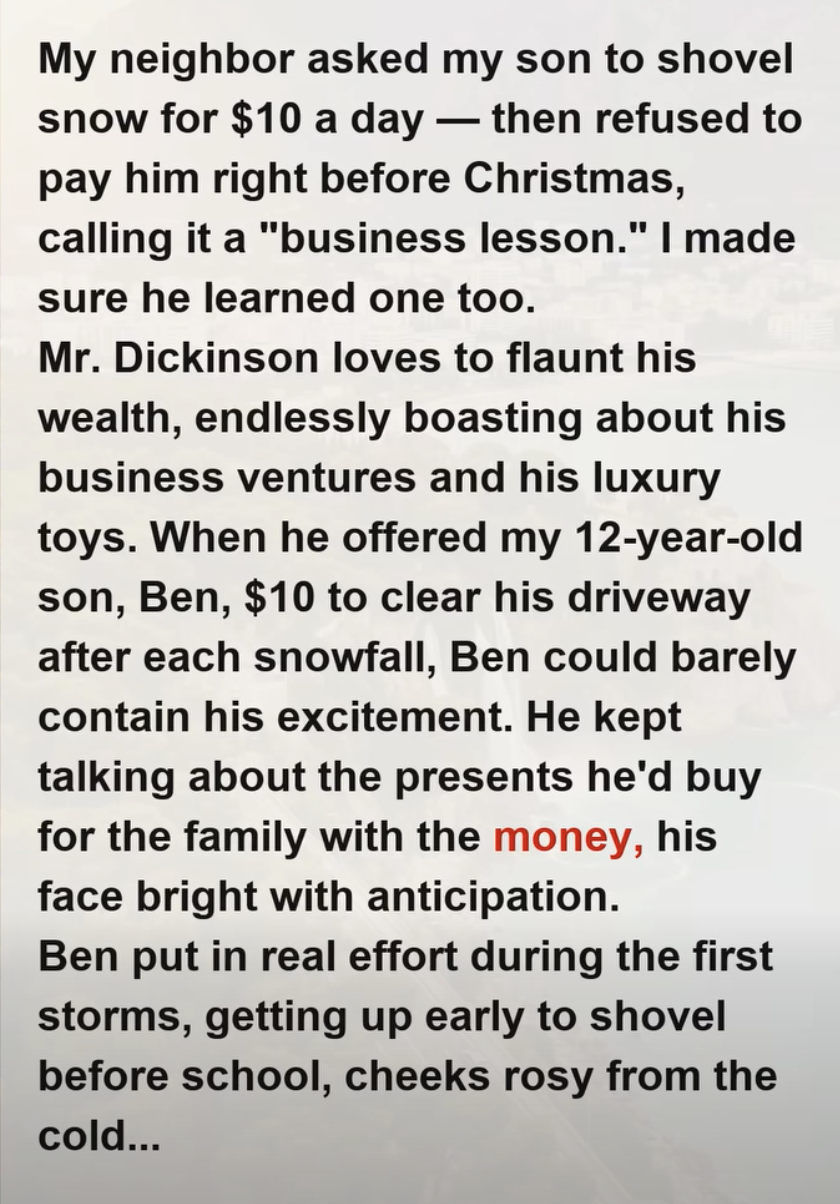
My neighbor, Mr. Dickinson, loved reminding everyone how successful he was.
He drove different luxury cars every year. He hosted loud backyard parties. He spoke about “smart investments” and “discipline” like he was giving a TED Talk from his driveway.
So when he offered my 12-year-old son, Ben, ten dollars to shovel his driveway after each snowfall, Ben thought it was the opportunity of a lifetime.
“Mom, that’s easy money!” he said, eyes shining. “I can buy everyone Christmas presents this year.”
We aren’t poor, but we live carefully. Ben had been saving for months. This job meant independence to him — pride.
The first snowfall came in early December.
Ben woke up before sunrise. He layered up, grabbed the shovel, and worked until his gloves were soaked and his cheeks were bright red from the cold. When he came back inside, he was shaking — but smiling.
“I did the whole driveway and the sidewalk,” he said.
Mr. Dickinson gave him a thumbs-up from the porch.
The storms kept coming. Ben never complained. Even on school mornings, he got up early. Even when his friends stayed warm inside.
By Christmas week, he had cleared that driveway seven times.
He was expecting $70.
Two days before Christmas, he went next door to collect his pay.
He came back home quiet.
Too quiet.
“What happened?” I asked.
Ben swallowed hard. “He said he’s not paying me.”
I felt something tighten in my chest.
“Why?”
“He said it’s a ‘business lesson.’ That sometimes people don’t get paid. He said I should’ve gotten it in writing.”
A business lesson.
From a grown man to a twelve-year-old boy.
Ben tried to act tough, but I saw the tears forming. It wasn’t about the money. It was about the betrayal.
That night, I didn’t storm over. I didn’t yell.
Instead, I made a plan.
The next snowfall came three days later — heavy and relentless. By morning, Mr. Dickinson’s driveway was buried.
Ben didn’t go.
Around 9 a.m., Mr. Dickinson knocked on our door.
“Your son didn’t come,” he said impatiently.
I smiled politely. “Oh. I thought you were teaching him a business lesson.”
He frowned. “What does that mean?”
“Well,” I said calmly, “since there was no written contract, there’s no obligation to provide services either.”
He stared at me.
I continued, “In business, reliability goes both ways. Payment is part of the agreement.”
He muttered something about attitude and walked away.
But I wasn’t finished.
That afternoon, I posted in our neighborhood group:
“Looking for someone reliable to shovel your driveway this winter? My hardworking 12-year-old son is available. Payment upfront required. References available.”
Within hours, five neighbors responded.
Apparently, Mr. Dickinson wasn’t as beloved as he thought.
Ben spent the rest of the winter shoveling driveways for people who paid him fairly — some even tipped him extra.
By New Year’s, he had made over $200.
On the first warm day after Christmas, Mr. Dickinson’s driveway was still layered with old, packed snow and ice. No one volunteered to help him.
A week later, he came to our door again.
He handed Ben $70 in cash.
“I may have overdone the lesson,” he said stiffly.
Ben looked at me before taking it.
“Thank you,” he said politely — because that’s the lesson I wanted him to learn.
Not revenge.
Integrity.
Later that night, Ben wrapped presents for his little sister and for me.
“I guess I learned something too,” he said.
“What’s that?”
“Work hard. But work for people who respect you.”
Mr. Dickinson tried to teach my son about business.
But what he really taught him was this:
Character matters more than contracts.
And sometimes, the real lesson isn’t about money.
It’s about knowing your worth.