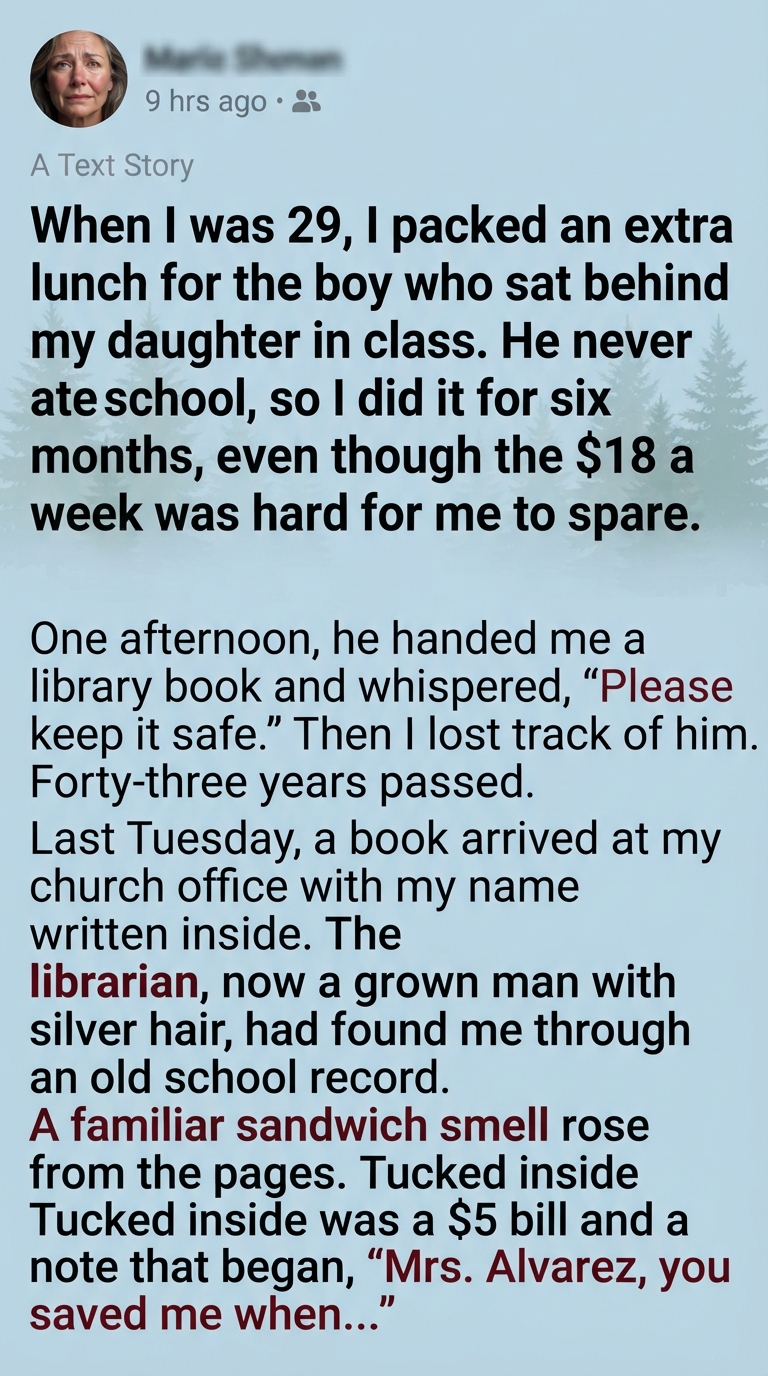
When I was twenty-nine, I packed an extra lunch every morning.
Not for my daughter.
For the boy who sat behind her in class.
His name was Daniel.
He was quiet.
Too quiet.
While the other children opened lunchboxes filled with sandwiches, fruit, cookies, and juice, Daniel would simply sit at his desk and pretend he wasn’t hungry.
At first, I didn’t notice.
Then one afternoon, my daughter came home and said,
“Mom, Daniel didn’t eat again.”
I looked at her.
“Why not?”
“He said he wasn’t hungry.”
Something about the way she said it made me pause.
The next morning, I packed an extra sandwich.
I added an apple and a small cookie.
When I dropped my daughter off, I handed her the lunch.
“Give this to Daniel.”
She looked surprised.
“He won’t take it.”
“Tell him I made too much.”
She did.
The next afternoon, my daughter came home smiling.
“He ate everything.”
So I did it again.
And again.
And again.
Six months passed.
Every Sunday evening, I’d sit at the kitchen table and calculate our grocery money.
We weren’t wealthy.
Far from it.
I was raising my daughter on my own, and an extra $18 a week wasn’t nothing.
Sometimes that $18 meant buying cheaper meat.
Sometimes it meant putting off a new pair of shoes.
But every Monday morning, I packed two lunches.
Because I knew Daniel was eating.
One afternoon, as I was waiting outside the school, Daniel approached me.
He was holding a library book.
“Mrs. Alvarez?”
“Yes?”
He looked around nervously.
Then he handed me the book.
“Please keep it safe.”
I laughed softly.
“Why?”
He shrugged.
“Just promise.”
I promised.
He smiled.
Then he ran back toward the school.
I took the book home.
I put it on a shelf beside my daughter’s books.
But life moved quickly.
My daughter graduated.
We moved to another neighborhood.
Then another city.
Years became decades.
I eventually lost track of Daniel.
I never forgot him.
But I assumed he’d forgotten me.
Forty-three years passed.
Then last Tuesday, I walked into my church office and found a package sitting on my desk.
There was no return address.
Just my name.
Mrs. Elena Alvarez.
I opened it.
Inside was an old library book.
The cover was faded.
The corners were worn.
But I recognized it immediately.
My hands began shaking.
I opened the first page.
My name was written inside.
For Mrs. Alvarez.
I sat down.
Then I noticed something strange.
A familiar smell rose from the pages.
Bread.
Mustard.
A faint trace of the kind of brown paper bag I’d used every morning for years.
I turned the page.
A five-dollar bill fell onto my desk.
Then I found a note.
My eyes filled with tears before I even finished the first sentence.
It began:
“Mrs. Alvarez, you saved me when…”
I stopped.
I couldn’t continue.
I wiped my eyes and started again.
“Mrs. Alvarez, you saved me when I was eight years old and convinced nobody in the world cared whether I ate.”
I covered my mouth.
The letter continued.
Daniel explained that his mother had been struggling with addiction.
His father had left.
Some days there was food at home.
Some days there wasn’t.
He hadn’t been refusing school lunches because he wasn’t hungry.
He was ashamed.
He was afraid other children would notice that he didn’t have money.
Then came the sentence that broke me.
“When you told your daughter to say you had made too much lunch, I knew you were giving me something much bigger than a sandwich.”
I kept reading.
Daniel had become a librarian.
He said books had saved him too.
The book he’d given me all those years ago had been his favorite.
He’d asked me to keep it safe because he was afraid he’d never see me again.
And apparently, he had been right.
He eventually moved away with his aunt.
But he never forgot me.
For years, he tried to find me.
Then, after becoming a librarian himself, he found an old school record containing my name.
He searched through public records.
He found my church.
And he finally sent the book.
Then I reached the last paragraph.
“You once spent $18 a week feeding a little boy you barely knew.”
“I wanted you to know what that kindness became.”
“The $5 isn’t payment. It isn’t repayment.”
“It’s the same amount you once gave me without ever asking for anything back.”
I stared at the five-dollar bill.
Then I noticed something else.
A photograph was tucked behind the letter.
It showed Daniel standing outside a library.
Beside him were three children.
On the back, he’d written:
“I became the man you believed I could become.”
I was crying so hard I could barely see.
Then my phone rang.
It was an unknown number.
I answered.
“Hello?”
A man’s voice said,
“Mrs. Alvarez?”
“Yes.”
“This is Daniel.”
I couldn’t speak.
He laughed softly.
“I finally found you.”
I cried.
“So did I.”
There was a long silence.
Then he said,
“Do you remember what you told me when I gave you that book?”
I thought for a moment.
“No.”
“You said, ‘I’ll keep it safe.’”
I smiled through my tears.
“I did.”
He laughed.
“You kept more than the book safe.”
We talked for almost two hours.
He told me about his life.
I told him about my daughter.
He told me he had spent forty years trying to repay a kindness that I had never considered a sacrifice.
Then I told him something I had never told anyone.
“There were weeks when that extra $18 was difficult.”
He went quiet.
“You never said.”
“I didn’t need to.”
I heard him take a breath.
“That’s why it mattered.”
Before we ended the call, he asked if he could visit me.
I said yes.
Three weeks later, a silver-haired man walked into my church office carrying flowers.
For a moment, I didn’t recognize him.
Then he smiled.
And I saw the little boy who had once sat behind my daughter.
I opened my arms.
He hugged me.
And whispered,
“Thank you.”
I whispered back,
“You don’t have to thank me.”
He pulled away.
“I know.”
He smiled.
“But I wanted to.”
Then he handed me another book.
This one was brand new.
He had written something inside.
“To Mrs. Alvarez—
You packed me lunch when I thought nobody cared.
You taught me that kindness doesn’t have to be big to change someone’s life.
I became a librarian because books gave me a future.
But I became a kind man because you showed me what kindness looked like.
Please keep this one safe too.”
I held the book against my chest.
And suddenly, I understood.
We spend so much of our lives wondering whether the little things we do matter.
A sandwich.
A kind word.
Five dollars.
An extra seat at the table.
We rarely get to see where those small acts eventually lead.
But sometimes, decades later, someone comes back to show us.
That afternoon, Daniel left the church office.
I watched him walk down the hallway.
Then I looked at the two books sitting on my desk.
One was old.
One was new.
And beside them was that five-dollar bill.
I never spent it.
I framed it.
Not because it was worth five dollars.
Because it reminded me that kindness is never really gone.
Sometimes it simply takes forty-three years to come back.
And when it does, it may arrive carrying a book.
A memory.
And the proof that something you almost considered insignificant…
meant everything to someone else.