My neighbor, Mr. Dickinson, loved to talk about money.
Not just having it — displaying it.
He parked his new cars at angles so everyone could see the shine. He hosted loud backyard parties and made sure to mention how “busy” his investment portfolio was. He wore expensive watches even while taking out the trash.
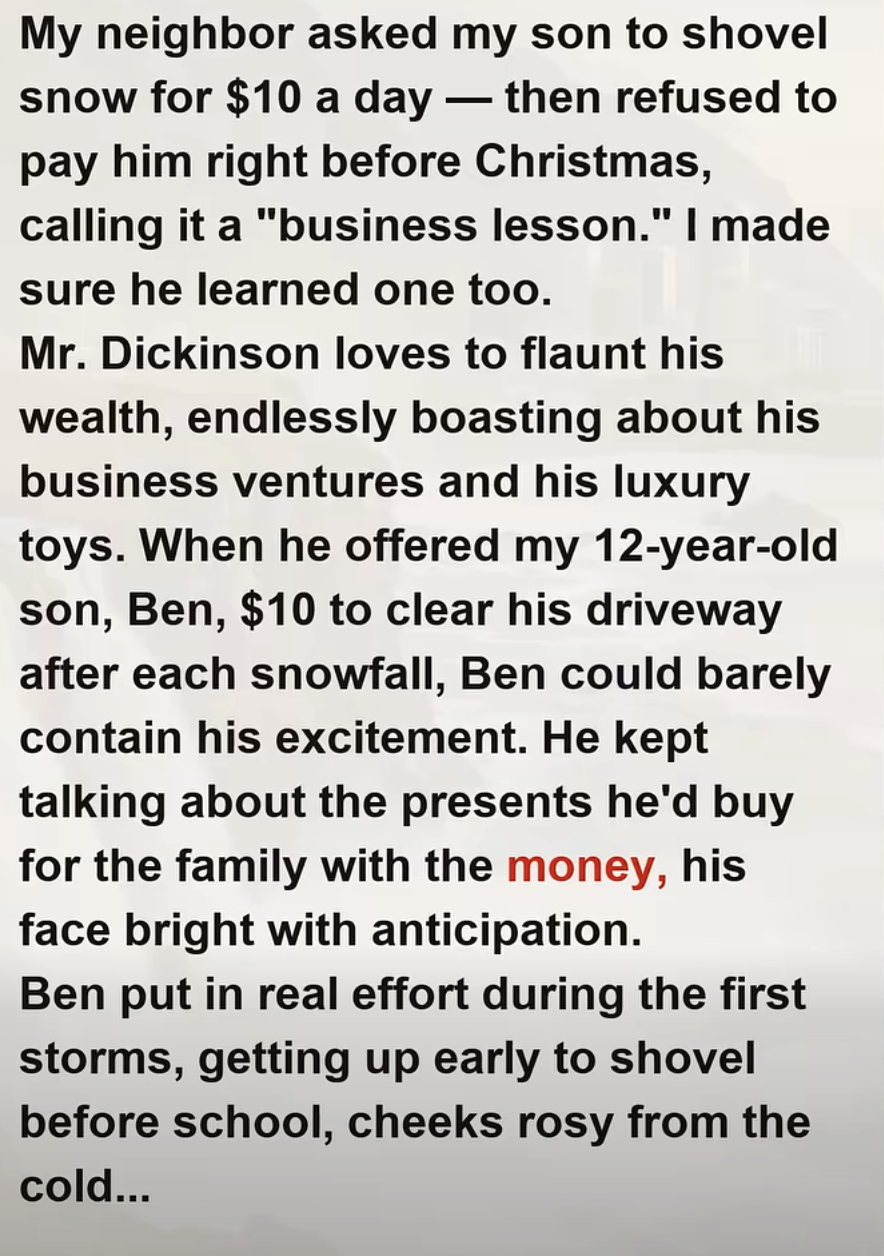
So when he offered my 12-year-old son, Ben, $10 per snowfall to shovel his driveway, it felt… generous.
Ben could barely contain himself.
“Dad, that’s easy money!” he said, already picturing Christmas presents he’d buy for his little sister and maybe even something for his mom.
It wasn’t about the amount. It was about the pride.
Ben woke up before sunrise after every storm. He bundled up, cheeks red from the cold, and cleared that long driveway before school. Sometimes I watched from the window, hot coffee in hand, feeling a quiet kind of pride you can’t buy.
Mr. Dickinson would stand at the door, nod approvingly, and say things like, “Hard work builds character, kid.”
Weeks passed. Snow kept falling. Ben kept shoveling.
By mid-December, he’d earned $120.
To him, it felt like a fortune.
He had it all planned out — gifts wrapped early, a surprise for his sister, maybe even a small tree he wanted to decorate himself.
Then, three days before Christmas, he knocked on Mr. Dickinson’s door to collect what he was owed.
Mr. Dickinson stepped outside, hands in his coat pockets, looking amused.
“About that,” he said casually. “I’ve decided not to pay you.”
Ben blinked. “What?”
The man smiled like he was giving a TED Talk.
“Consider it a business lesson. In the real world, you don’t always get paid. You learn. That’s more valuable than money.”
I saw my son’s face when he walked back home.
He wasn’t crying.
That would’ve been easier.
He was quiet.
That hurt more.
He sat at the kitchen table and stared at his gloves for a long time.
“Did I do something wrong?” he finally asked.
And in that moment, I knew this wasn’t about $120 anymore.
It was about dignity.
The Lesson He Didn’t Expect
I told Ben to finish his homework and not worry about it.
Then I grabbed my coat.
I didn’t yell. I didn’t knock aggressively.
I rang the bell like any neighbor would.
Mr. Dickinson answered with that same confident grin.
“Yes?”
“I heard about the ‘business lesson,’” I said calmly.
He chuckled. “Teachable moment. Builds resilience.”
I nodded slowly.
“You’re right,” I said. “Business lessons are important.”
His smile widened.
“So here’s one.”
I pulled out my phone and opened our neighborhood community app — the one where everyone shares recommendations, warnings, and local updates.
Earlier that week, Mr. Dickinson had posted asking for referrals for a new snow removal company because he “didn’t want to rely on unreliable services.”
I scrolled to the post and hit “comment.”
Out loud, as he watched.
“Just a heads up to anyone considering doing business with Mr. Dickinson — my 12-year-old son shoveled his driveway after every snowfall this month. He completed the agreed work. Payment was refused three days before Christmas because, quote, ‘In the real world you don’t always get paid.’”
I pressed send.
His smile disappeared.
“That’s unnecessary,” he snapped.
I tilted my head.
“Transparency is part of business, right?”
Within minutes, my phone buzzed.
Neighbors replying.
“Is this true?”
“That’s unacceptable.”
“He did the same thing to my nephew last year!”
“Hard work deserves pay.”
Mr. Dickinson’s face shifted from irritation to something closer to panic.
“You can’t just—”
“Oh,” I interrupted gently. “And I’ve also shared this with the HOA board. Since you’re running for community treasurer next month, I figured they’d want to understand your approach to financial agreements.”
He went pale.
Checkmate
The next morning, there was a knock at our door.
Mr. Dickinson stood there holding an envelope.
He looked… different.
Less shiny.
“I owe Ben an apology,” he muttered.
Ben stood beside me.
Mr. Dickinson handed him the envelope.
Inside was $120 — plus another $80.
“For… inconvenience,” he added stiffly.
Ben looked up at me.
I nodded.
He took the envelope.
“Thank you,” Ben said politely — because that’s who he is.
As Mr. Dickinson turned to leave, he stopped.
“I suppose,” he said quietly, “that was a business lesson for me.”
I smiled.
“Yes,” I said. “In the real world, your reputation is worth more than $200.”
The Real Lesson
That Christmas morning, Ben wrapped gifts with his own money.
He bought his sister the art set she’d been begging for.
He bought his mom a candle she liked.
And he slipped $20 into the church donation box on Christmas Eve.
“Why?” I asked him later.
He shrugged.
“Because when you say you’ll do something… you should.”
That’s the lesson that mattered.
Not the snow.
Not the money.
And definitely not Mr. Dickinson’s version of “business.”
Because sometimes the real world doesn’t teach you when you don’t get paid.
It teaches you when someone stands up for you.
And Mr. Dickinson?
He hires a professional snow service now.
He pays upfront.