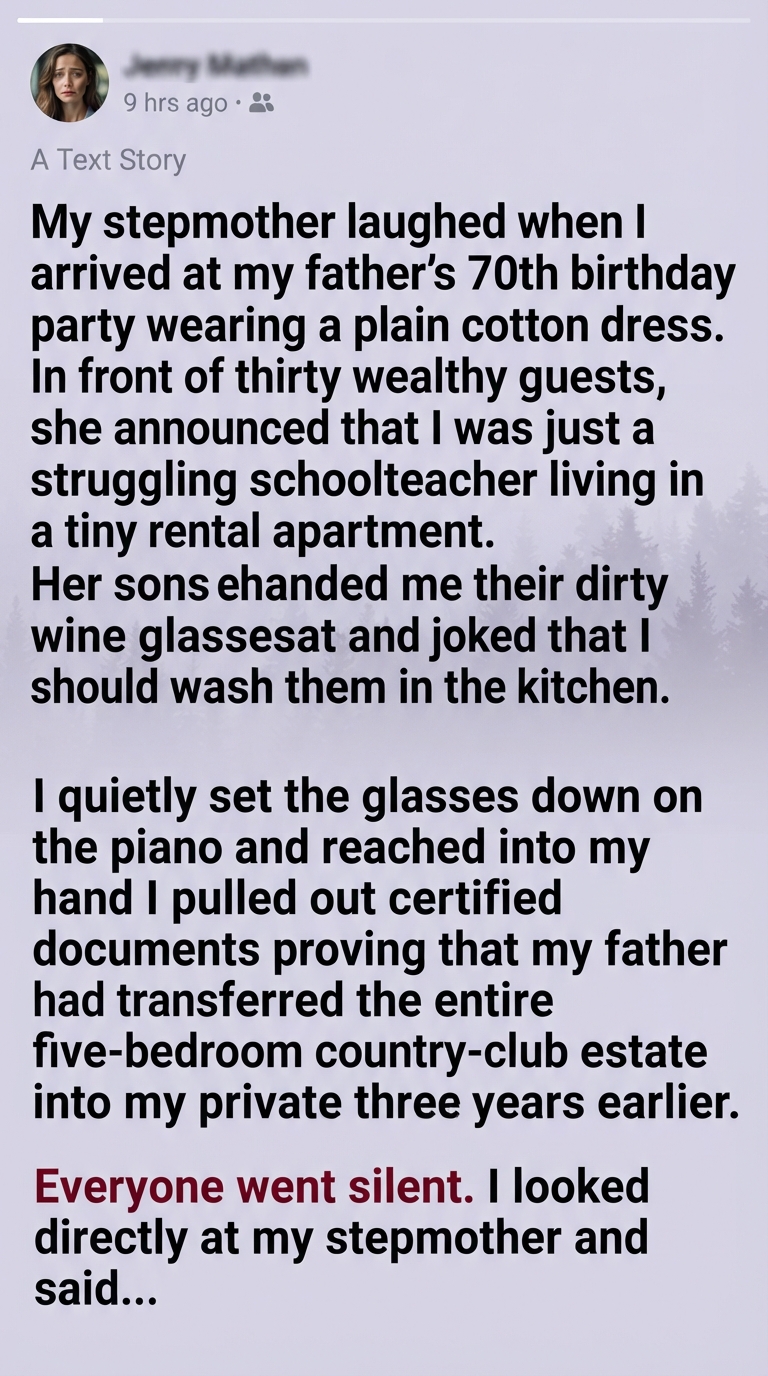
My stepmother laughed when I arrived at my father’s seventieth birthday party wearing a plain cotton dress.
She looked me up and down.
Then she smiled.
Not the kind of smile you give someone you love.
The kind you give someone you think you’ve already defeated.
“Oh, everyone,” she announced loudly, “this is my husband’s daughter.”
Thirty wealthy guests turned toward me.
“She teaches at a little school across town,” my stepmother continued.
“She lives in a tiny rental apartment.”
A few people smiled awkwardly.
I said nothing.
My father stood across the room.
He looked uncomfortable.
But he didn’t interrupt her.
That hurt more than her words.
I’d known my stepmother, Vivian, for almost twenty years.
From the beginning, she had made it clear that I didn’t belong in their world.
My father had built a successful real-estate business.
Vivian loved expensive parties, designer clothes, and country-club dinners.
I chose something completely different.
I became a teacher.
I lived in a modest apartment.
I drove an old car.
And I was happy.
But Vivian treated my choices as evidence that I had failed.
That evening, her two sons made things even worse.
One of them finished his wine and handed me the empty glass.
“Since you’re used to doing humble work, could you take this to the kitchen?”
His brother laughed.
“Give her mine too.”
Then he handed me his dirty glass.
A few guests laughed.
I took both glasses.
I didn’t argue.
I didn’t insult them.
I simply walked across the room.
But instead of going to the kitchen, I placed the glasses carefully on the piano.
Then I returned to my seat.
Vivian frowned.
“What are you doing?”
I smiled.
“I’m waiting.”
“For what?”
I reached into my handbag.
And pulled out a thick folder.
The room slowly became quiet.
I placed the folder on the table.
Then I opened it.
Inside were certified legal documents.
Property records.
Trust documents.
Transfer agreements.
And a notarized deed.
One of Vivian’s sons glanced at the papers.
“What is that?”
I looked at my father.
He knew exactly what it was.
His face changed.
Vivian picked up the first page.
She read it.
Then read it again.
Her expression slowly disappeared.
“What is this?”
I answered calmly.
“The estate.”
She looked at me.
“What estate?”
“The five-bedroom country-club property.”
Silence.
My father finally spoke.
“Vivian…”
She turned toward him.
“You knew about this?”
He nodded.
Three years earlier, my father had transferred ownership of the estate into a private trust.
I was the sole beneficiary.
The trust had been established to protect the property from future disputes, creditors, and unnecessary estate complications.
But my father had never told Vivian.
He hadn’t told her sons either.
He had told me to keep the documents private.
Not because he wanted to embarrass anyone.
Because he wanted to see what happened when nobody knew what I owned.
Vivian stared at me.
“But why?”
I looked at her.
“Because Dad wanted me to have something that could never be taken away because someone decided I wasn’t wealthy enough to deserve it.”
One of her sons laughed nervously.
“This has to be some kind of mistake.”
I slid the certified deed across the table.
“Read the name.”
He did.
Then his face went pale.
My father cleared his throat.
“The transfer is legitimate.”
Vivian stared at him.
“You gave her the estate?”
He nodded.
“I did.”
She looked furious.
“But that’s our home!”
My father shook his head.
“It was mine.”
The room became completely silent.
Then Vivian looked back at me.
“So you’re telling me you’re secretly wealthy?”
I shook my head.
“No.”
She looked confused.
“I never said that.”
“Then what are you saying?”
I closed the folder.
“I’m saying that you were wrong about me.”
I looked around the room.
“Yes, I’m a teacher.”
“Yes, I live in a small apartment.”
“Yes, I wear inexpensive clothes.”
“And none of those things make me less successful than you.”
Nobody spoke.
Then I turned toward my father.
“Happy birthday.”
He stood up.
His eyes were wet.
“Thank you for coming.”
I smiled.
“I wouldn’t miss it.”
Vivian suddenly stepped toward me.
“You’ve been planning this.”
“No.”
“Then why bring the documents tonight?”
I looked at the two wine glasses sitting on the piano.
“Because you made tonight about humiliating me.”
I paused.
“And I decided it was time everyone knew the truth.”
She stared at me.
Then something unexpected happened.
My father walked over and picked up one of the wine glasses.
He carried it back to his wife.
“Vivian,” he said quietly, “you owe her an apology.”
She looked at him.
Then at me.
For the first time that evening, she had nothing to say.
One of her sons finally muttered,
“I’m sorry.”
His brother followed.
“Me too.”
I nodded.
But I didn’t stay.
I picked up my handbag.
Before leaving, I walked over to my father and hugged him.
“Thank you.”
He whispered,
“You earned it long before I transferred the property.”
I smiled.
Outside, I sat in my old car and took a deep breath.
I didn’t feel victorious.
I didn’t feel richer.
I simply felt relieved.
Because for years, I’d allowed people to make me feel ashamed of living a simple life.
That night taught me something I’d forgotten.
A person’s value isn’t measured by the clothes they wear, the car they drive, or the size of their apartment.
And sometimes the quietest person in the room is the one who has the least to prove.
I never moved into the country-club estate.
Instead, I kept teaching.
I eventually turned part of the property into a scholarship and community learning center.
My father helped me establish it.
Children from families who couldn’t afford private education were able to attend programs there.
When someone asked why I didn’t sell the estate and keep the money, I smiled.
“Because Dad didn’t give me a house.”
I looked at the children studying in the library.
“He gave me an opportunity to give something back.”
And that was the moment I realized my stepmother had accidentally given me the greatest gift of all.
She reminded me that I never needed to become like them to prove that I had succeeded.
I only needed to remain myself.
The schoolteacher in the plain cotton dress had never been poor in the ways they thought.
She had simply never believed that wealth was something she needed to wear.