I sat beside Kit for another few minutes, letting him use the tablet without interrupting.
He eventually selected a phrase I hadn’t heard him use before.
<escape>“She takes my things.”</escape>
I kept my face calm.
“What things, Kit?”
He began tapping through several folders. It took him a while. His fingers occasionally slipped, and he became frustrated when he couldn’t find the words he wanted.
I didn’t rush him.
Finally, the tablet spoke.
<escape>“My headphones.”</escape>
Then:
<escape>“My blanket.”</escape>
Then:
<escape>“My books.”</escape>
I swallowed.
“She takes them away?”
He nodded.
He pressed another button.
<escape>“When I make noise.”</escape>
I glanced toward Dana. She was no longer watching us. She had picked up her phone and was pretending to scroll.
I didn’t confront her again that night.
I knew I needed to be careful. Kit was already frightened, and I wasn’t going to turn the kitchen into another argument he had to endure.
I took him upstairs, helped him change into clean pajamas, and tucked him into bed. His communication tablet stayed beside him, charging on the nightstand.
Before I left his room, he reached for my hand.
He pressed a button.
<escape>“Stay.”</escape>
So I stayed.
I sat beside his bed until he fell asleep.
Then I went downstairs.
My father, Mark, had been working late. I called him, and he answered from his car.
“Orla? I thought you weren’t coming until Wednesday.”
“I’m home. I need you to come home immediately.”
“What’s wrong?”
I struggled to keep my voice steady.
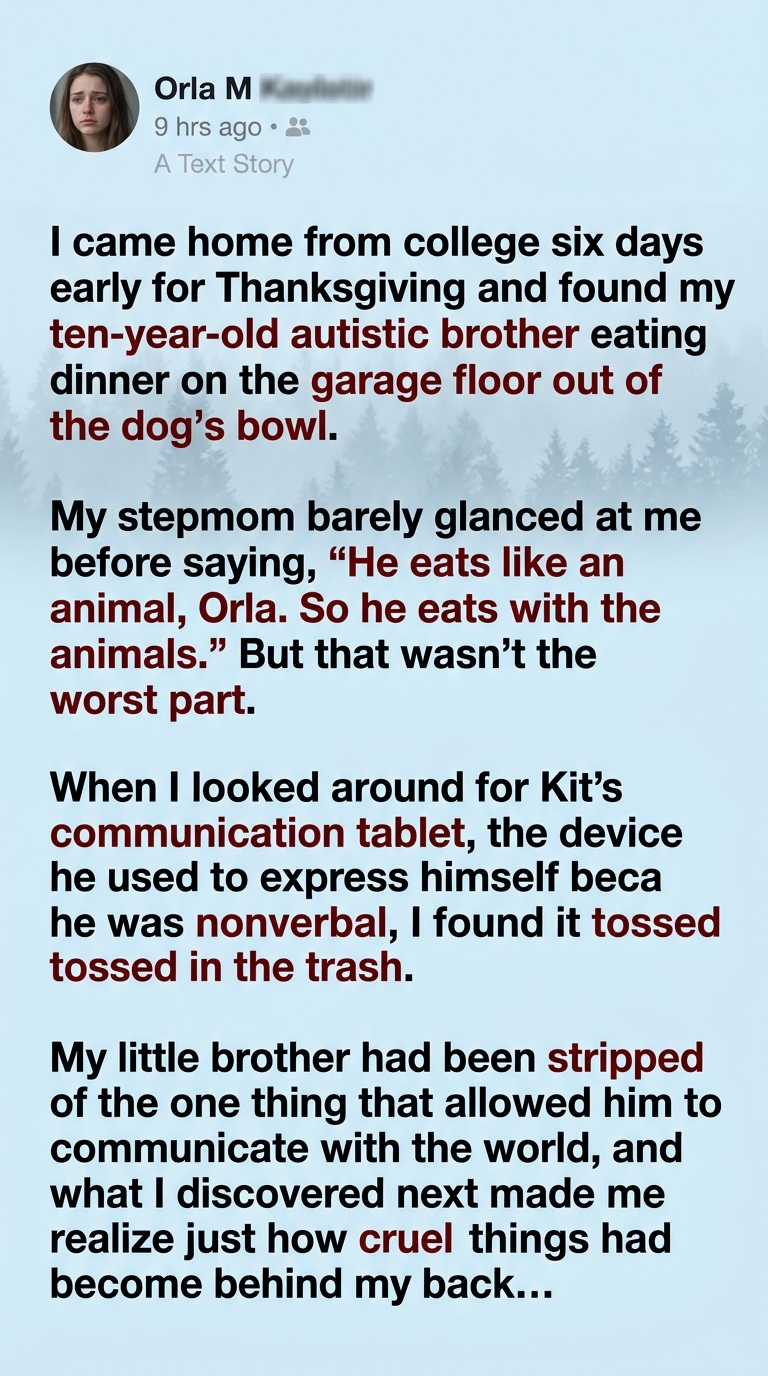
“Kit is eating dinner out of the dog’s bowl in the garage. Dana threw his communication tablet in the trash. And he just told me she takes away his things when he makes noise.”
There was a long silence.
Then Dad said, “What?”
I repeated everything.
He told me he was turning around.
When he arrived, I was waiting in the kitchen with the recovered tablet, the dog bowl, and several photographs I had taken of the scene before cleaning everything up.
Dana immediately started defending herself.
“Oh, for goodness’ sake. Orla is exaggerating everything. Kit was having a tantrum, and I was trying to manage it.”
Dad looked at the bowl.
“Why was he eating in the garage?”
“He threw his food.”
“Then why was his dinner in the dog’s bowl?”
“He was refusing to eat properly!”
Dad looked at me, then at Dana.
“Where’s his tablet?”
“In the trash. I told you, that thing is a distraction.”
Dad picked it up.
He had always understood that Kit needed the tablet. He had attended school meetings, learned how to navigate the communication software, and helped Kit customize the buttons as his vocabulary expanded.
But he had never known Dana had been taking it away.
“How long has this been happening?” he asked.
Dana crossed her arms.
“Don’t make me sound like some monster. I take it away when he misbehaves. That’s what parents do.”
“Kit can’t communicate without it.”
“He can communicate plenty. He makes noises all day.”
Dad’s expression changed.
“Those noises aren’t the same as having a communication device.”
Dana became louder.
“You’re both acting like I abuse him! I’m the one who stays home with him! I’m the one who has to deal with everything! You have no idea how exhausting it is!”
Dad didn’t dismiss her frustration. He knew caregiving could be difficult, and he had always tried to make sure Dana had help and support.
But exhaustion didn’t justify what she had done.
“Then you ask for help,” he said. “You don’t put him in the garage and throw away the device he uses to tell us what he needs.”
Dana started crying.
She said she was overwhelmed, that Kit’s behavior had become impossible, and that she felt nobody appreciated what she did.
Dad listened.
Then he said something I had never heard him say so clearly before.
“Kit’s needs are not a burden we get to punish him for.”
Dana stormed upstairs.
Dad sat at the kitchen table, staring at the tablet.
“I should have noticed,” he said quietly.
I sat beside him.
“You didn’t know.”
“I should have checked more.”
He rubbed his face.
“I thought things were okay. You called, and I told you he was doing fine. I believed it.”
That night, we didn’t try to solve everything at once.
We focused on Kit.
The next morning, Dad called Kit’s school and arranged to speak with his special education teacher and speech-language therapist. He also contacted his pediatrician to discuss what we had discovered and ask for guidance on assessing Kit’s emotional well-being and support needs.
His school had noticed changes.
Kit had become more withdrawn during the previous few weeks. He had stopped using certain communication phrases. He had occasionally arrived without his headphones, and his teacher had noticed that he seemed unusually anxious about making mistakes.
They had assumed he was experiencing a difficult adjustment period.
Now, the pieces were beginning to connect.
With Dad’s permission, the school helped arrange a meeting with the appropriate support professionals. They discussed Kit’s communication access, his routines, sensory needs, and the importance of ensuring that his device was available to him.
The school also helped us document the concerns and identify additional support.
Meanwhile, Dad made a decision about Dana.
She would no longer be responsible for caring for Kit alone while the situation was being assessed. He arranged additional help, and Kit’s care routines were reviewed with professionals who understood his needs.
Dana wasn’t allowed to take his communication device, headphones, or comfort items away as punishment.
Dad also made it clear that Kit would not be made to eat in the garage or anywhere else as a form of humiliation or discipline.
When Dana learned that the school had been informed, she accused us of ruining her reputation.
“You’ve made me sound like some abusive stepmother!” she shouted.
Dad answered quietly.
“We didn’t invent what happened. We documented it, and we’re getting help to make sure it doesn’t happen again.”
She insisted that she had never intended to hurt Kit.
I believed she may not have thought of herself as cruel. But intent didn’t erase the harm.
Kit had been frightened enough to use his communication tablet to tell me not to tell her.
That was something we could not ignore.
Over the next several weeks, Kit gradually began to feel more comfortable.
His tablet was always available. His headphones were kept in a designated place. We worked with his school and therapists to make sure he had consistent ways to communicate across settings.
Dad also spent more time learning how Kit expressed distress, rather than relying on other adults to interpret his behavior.
And I stayed home through Thanksgiving.
On Thanksgiving morning, Kit came downstairs wearing his dinosaur pajamas. He carried his tablet, climbed into his chair, and looked at the food on the table.
Dad placed a plate in front of him.
Kit pressed a button.
<escape>“Thank you.”</escape>
Dad smiled.
“You’re welcome, buddy.”
Kit ate at his own pace. Nobody rushed him. Nobody criticized his movements. Nobody told him that he was making too much noise.
When he finished, he pressed another button.
<escape>“I want pie.”</escape>
Dad laughed.
“Absolutely. Pie it is.”
I watched my little brother sitting at the table, surrounded by people who were finally listening to him.
And I realized how easily the adults around him had mistaken his inability to speak for an inability to understand.
Kit had understood what was happening.
He had understood that his belongings were being taken away. He had understood that he was being treated differently. He had understood that he was frightened.
He simply hadn’t been given the tools he needed to tell us.
That afternoon, Dana sent me a message.
She said she was hurt that I had “turned the family against her.” She said she had been overwhelmed and that I should have spoken to her privately instead of involving the school.
I read it, but I didn’t respond.
This wasn’t about winning an argument or making her feel bad.
It was about ensuring that Kit could never again be deprived of his ability to communicate as a punishment.
Dad eventually made it clear that the household arrangements would have to change if Dana couldn’t respect Kit’s needs. He sought advice and support rather than allowing the situation to be swept under the rug.
The family didn’t magically become perfect. There were difficult conversations, disagreements, and consequences. Trust had to be rebuilt, and some decisions remained unresolved for months.
But Kit was safe, supported, and heard.
And that mattered more than any Thanksgiving tradition.
I had come home six days early expecting to surprise my family.
Instead, I discovered that my little brother needed someone to notice what he couldn’t say aloud.
I’ll never forget the sight of him on that garage floor, eating out of a dog’s bowl.
But I’ll also never forget the moment his tablet spoke the words he had been trying to tell us.
<escape>“Don’t tell Dana.”</escape>
Because that was the moment I understood that protecting someone doesn’t always begin with a loud confrontation.
Sometimes it begins with listening carefully enough to hear the voice that everyone else has overlooked.