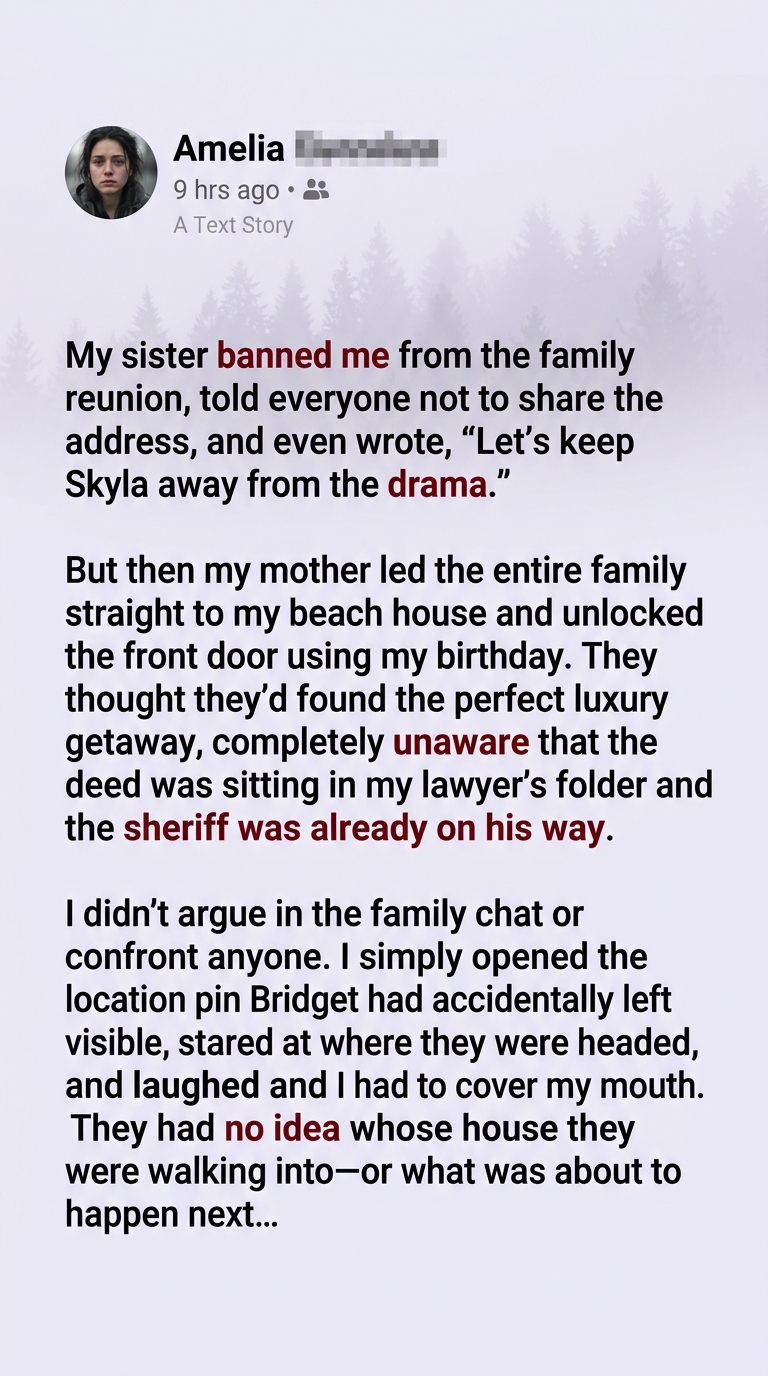
The next morning, I called the property manager who lived nearby and asked him to keep an eye on the house.
I also informed the local sheriff’s office that a group of relatives might attempt to enter a property they did not have permission to occupy. I wasn’t asking them to arrest anyone preemptively. I wanted the situation documented and wanted to know how to handle it if the family arrived, entered, and refused to leave.
The deputy I spoke with was straightforward.
“If they enter without permission and won’t leave when the owner requests it, call us. Don’t put yourself in the middle of a confrontation.”
I followed that advice.
By Friday afternoon, I was sitting at my kitchen table in my city apartment, drinking coffee and watching the notifications from the family chat.
Bridget had apparently become the unofficial travel coordinator.
“Mom, bring the snacks.”
“Uncle David, don’t forget the cooler.”
“Lauren, you’ll have the upstairs room.”
“Everybody should arrive by four.”
Then my mother posted a message that made my eyebrows rise.
“Bridget, are you sure the keypad will work? I don’t want us standing outside.”
Bridget replied, “Of course. I have the code.”
I nearly choked on my coffee.
She had apparently assumed the code hadn’t changed.
At 3:42 p.m., the security system on my beach house sent me a notification.
Someone was at the front door.
I opened the camera feed.
My mother stood on the porch holding a large tote bag. Bridget was behind her, carrying two suitcases. Several relatives were unloading coolers, folding chairs, and grocery bags from their cars.
I watched my mother punch in the code.
The keypad flashed red.
She tried again.
Red.
Bridget stepped forward, entered the code herself, and frowned when the door remained locked.
Then she began knocking.
I watched them look at each other.
My mother pulled out her phone and called someone. I already knew who she was calling.
Me.
I let it ring.
Then the family chat erupted.
“Skyla, are you at the house?”
“Why isn’t the code working?”
“Did you change it?”
“Mom is standing outside with all the food!”
Bridget finally sent a direct message.
<PRIVATE_PERSON>: “What did you do to the code?”
I replied for the first time that week.
Skyla: “I changed it.”
Three dots appeared almost immediately.
Bridget: “Why?”
Skyla: “Because it’s my house.”
The group chat went silent for several seconds.
Then my mother called.
I answered.
“Skyla,” she said, in that strained voice she always used when she was about to tell me I had disappointed her, “what are you talking about?”
“I’m talking about the beach house.”
“Bridget said she arranged for us to use it this weekend.”
“Bridget didn’t arrange anything with me.”
My mother lowered her voice.
“Don’t make this difficult. Everyone has already driven here.”
“Then everyone should drive somewhere they actually have permission to stay.”
“Skyla! It’s a family reunion!”
“And I wasn’t invited.”
There was silence.
Then she said, “We thought you wouldn’t mind.”
I couldn’t help laughing.
“You thought I wouldn’t mind being excluded from a reunion at my own house?”
My mother didn’t answer.
I ended the call.
A few minutes later, I received a video call from Bridget.
She was standing on my porch, visibly furious.
“Are you seriously doing this?”
“Yes.”
“Everyone is here! We planned this for weeks!”
“Not with me.”
“You’re acting like we were going to steal the house!”
“You were trying to enter a property you don’t own, using an access code you weren’t authorized to use anymore.”
“We’re family!”
“Family doesn’t mean you get to use my property without asking.”
Bridget rolled her eyes.
“Mom said you were going to be difficult.”
That sentence was the one that finally made everything click.
My mother had not merely assumed the house was available. She had apparently decided my sister could organize a reunion there and had told everyone I would be difficult if I objected.
They had excluded me from the gathering, but they had still expected to use my home.
I ended the video call.
Then I received a notification from my security system.
The front door had been opened.
My mother had apparently found another way to enter. I checked the camera footage and saw Bridget standing beside her, while my mother used a small key she had kept from the day she helped me move furniture.
I hadn’t realized she still had it.
The door opened.
Several people began walking inside.
I immediately called the sheriff’s office and explained that individuals had entered my property without my permission after I had expressly denied access.
I also called Melissa.
“Don’t go there yourself,” she said. “Stay on the phone with the authorities if needed, and keep the footage.”
I stayed at my apartment.
The camera showed my mother walking into the living room, looking around, and smiling as though she had just arrived at a vacation rental.
Bridget followed, setting her bags on the floor.
My aunt walked toward the windows.
“Look at this view!” she exclaimed.
Someone else opened the refrigerator.
My cousin began carrying bags toward the bedrooms.
They were acting as if the house belonged to them.
Then, less than ten minutes later, the sheriff’s vehicle pulled into the driveway.
The deputy knocked on the front door.
My mother opened it.
I couldn’t hear everything, but the camera showed the deputy speaking calmly and asking the occupants to step outside.
Bridget appeared behind my mother, gesturing wildly.
The deputy remained composed.
He explained that the property owner had denied permission for them to enter and had requested assistance. He asked them to leave the property while the situation was addressed.
My mother pointed toward the house.
“It’s a family property!”
The deputy asked her to provide documentation establishing that she had permission to occupy it.
She couldn’t.
Bridget tried to explain that the reunion had been planned and that everyone had traveled a long distance.
The deputy listened, then repeated that planning a gathering did not give them permission to enter someone else’s property.
My mother finally stepped onto the porch.
Bridget followed, furious.
The deputy remained there while they gathered their belongings. He didn’t arrest anyone. He simply made sure the occupants left and documented the incident.
Within an hour, the house was empty.
I later learned that my mother had tried to argue that the old key meant she had permission. But the deputy explained that possession of a key didn’t establish an ongoing right to enter or stay, particularly after the owner had expressly withdrawn permission.
Melissa arranged for a locksmith to rekey the doors that evening. Every remaining access credential was removed or changed.
I also made sure the security system was properly updated.
By dinner time, the family chat had become a battlefield.
Bridget wrote:
“Skyla ruined the reunion. We had already brought everything, and she called the sheriff on her own family.”
My aunt responded:
“Honestly, this could have been handled privately.”
My cousin Lauren wrote:
“Privately? She wasn’t even invited to the reunion.”
That was the first message I had seen all day that made me smile.
Bridget replied with a long paragraph about how I had always been selfish, how I never supported family, and how my behavior proved that I was exactly the person she had warned everyone about.
I finally sent one message.
“The beach house is my privately owned property. I was not consulted about the reunion, was explicitly excluded from it, and was not asked for permission to let anyone use the house. When I learned that people intended to enter without my authorization, I changed the access code. When they entered anyway, I asked the sheriff for assistance. I will not apologize for protecting my property.”
Then I left the group chat.
The next few days were uncomfortable.
My mother called repeatedly. I didn’t answer every call. When I did speak with her, I kept the conversation short.
She insisted she had never intended to hurt me.
I told her intention didn’t change what she had done.
“You could have just let us stay,” she said during one conversation.
“You could have asked.”
“Bridget was trying to do something nice for everyone.”
“Then she should have organized something she had permission to use.”
My mother sighed.
“You’re making this into a bigger thing than it needs to be.”
I responded calmly.
“You entered my house after I told you that you didn’t have permission. That’s the part you’re refusing to understand.”
She had no answer.
Bridget, meanwhile, didn’t apologize. She told relatives that I had humiliated her and that she would never forgive me for calling the sheriff.
I didn’t chase her for forgiveness.
Two weeks later, Lauren called me.
“I just wanted to tell you something,” she said. “I didn’t know Bridget had excluded you until I saw the messages. I thought you were coming. And when your mom said the house was available, I assumed she’d asked you.”
“Did you really?”
“Yes. I should have asked. I didn’t want to get involved, but I honestly thought everything was arranged.”
I appreciated her honesty.
She told me that several relatives had been uncomfortable with the way Bridget had handled things. They had been told that I was difficult and that I didn’t want to participate in the reunion.
The truth had been much simpler: Bridget wanted the house, and she didn’t want me there.
Months later, my mother finally asked if she could visit the beach house.
This time, she asked properly.
I told her she could come for lunch on Saturday, provided she respected the boundaries I had established.
She arrived alone.
We sat on the deck overlooking the water. She brought flowers and, after a long silence, admitted that she had made a mistake.
“I thought you would eventually agree,” she said. “I thought if we were already there, you wouldn’t make everyone leave.”
I looked at her.
“So you thought putting me in a position where I had to either surrender my house or disappoint everyone was acceptable?”
She looked down.
“I didn’t think about it that way.”
“That was the problem.”
She apologized. It wasn’t perfect, and it didn’t erase what had happened, but it was the first honest acknowledgment I’d received.
I accepted the apology without pretending everything had suddenly changed.
Bridget and I remained distant. I didn’t need to turn the incident into a permanent family war, but I also wasn’t going to pretend that trust had been restored.
The beach house became what I had originally intended it to be: a quiet place where I could relax, read, swim, and enjoy the weekends without worrying about someone else’s expectations.
And the next time my family planned a reunion, they chose a hotel.
Nobody asked me for the address of my beach house.
Nobody tried to use my birthday as a door code.
And nobody walked through my front door without being invited.
For the first time in years, I didn’t feel guilty for saying no.
I felt relieved.
Because I finally understood that being part of a family doesn’t mean surrendering your boundaries, your privacy, or your property.
And sometimes, the most peaceful family gathering is the one you don’t have to host.