The third section contained records Vincent never expected me to have.
For months, he’d been quietly moving money from our joint accounts into accounts I didn’t recognize. At first, the amounts were small. Then the transfers grew larger. When I questioned him, he’d blamed investment opportunities, business expenses, and his mother’s medical bills.
I’d believed him.
But after discovering messages between him and Sabrina, I hired a financial adviser and began documenting everything. The records showed that some of the money had been used to pay expenses at his family’s estate, including renovations to a room Sabrina had described as Audrey’s nursery.
I hadn’t been imagining things.
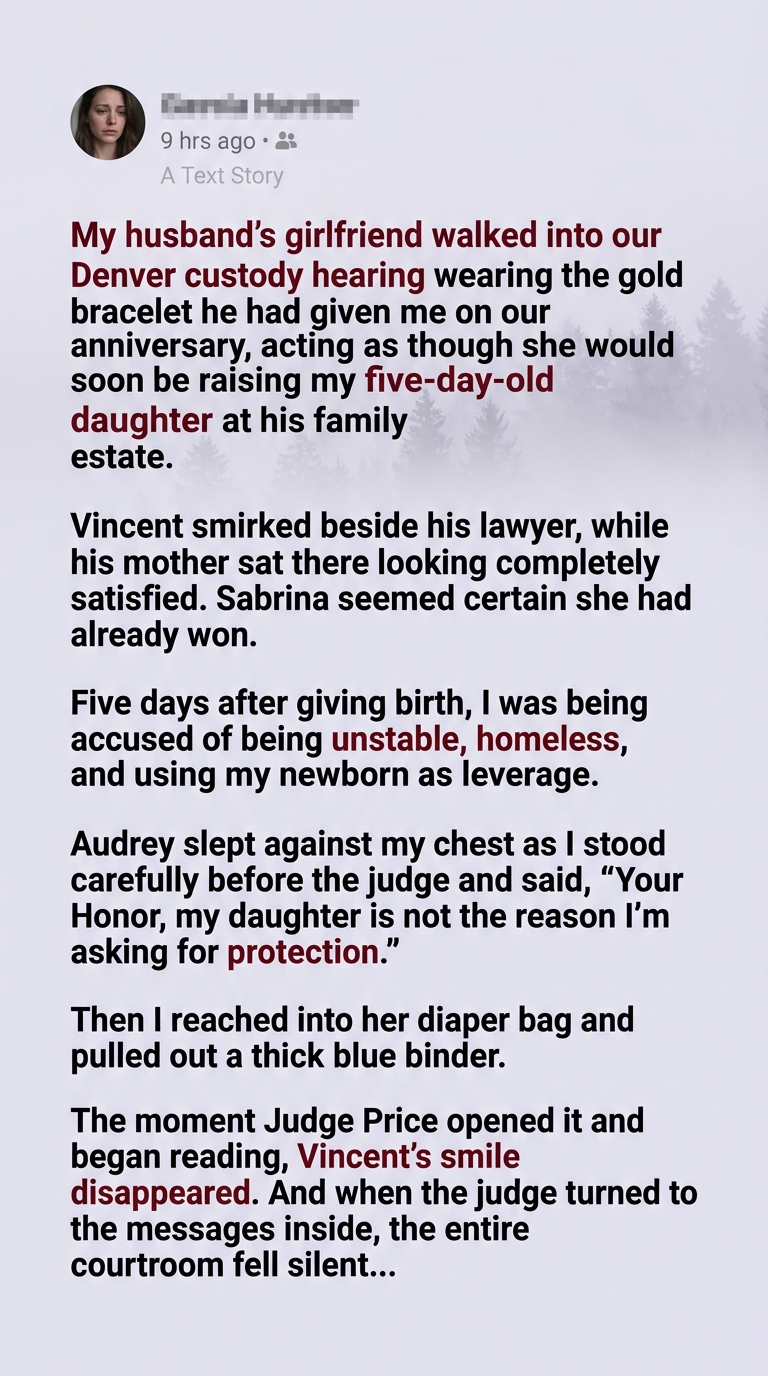
They weren’t simply having an affair. They were making plans involving my child while attempting to weaken my position before the custody hearing.
The fourth section contained a letter from Vincent’s mother.
She had sent it to him weeks before Audrey’s birth, and I’d found it accidentally while organizing documents he’d left in our home.
It read:
“Vanessa won’t be able to manage a newborn alone. Once she realizes how much support we can offer, she’ll either agree to our arrangement or give up. Sabrina is much better suited to the life we’re building.”
I had no idea what she meant by “our arrangement” until I found the messages.
They were planning to request temporary custody, claiming I was unstable and unable to provide a suitable environment. They intended to use my recovery after childbirth and the fact that I had temporarily stayed with my sister during the final weeks of pregnancy as evidence against me.
They had mistaken exhaustion for weakness.
And they had assumed I wouldn’t prepare.
When the hearing resumed, Judge Price had reviewed the initial exhibits. My attorney explained that we were requesting temporary protective measures, a proper review of the financial records, and that custody decisions be based on Audrey’s safety and best interests rather than unsubstantiated accusations.
Vincent’s attorney attempted to dismiss the messages as private conversations that didn’t reflect actual intentions.
But the judge wasn’t interested in speculation.
She wanted documentation.
She wanted dates.
She wanted to know why Sabrina, who wasn’t Audrey’s parent, was discussing taking responsibility for a newborn before the mother had even recovered from childbirth.
And she wanted to know why Vincent had been transferring marital funds into accounts associated with his family without properly accounting for them.
Vincent finally stood.
“Your Honor, I was trying to provide my daughter with the best possible environment.”
Judge Price looked at him.
“Then your actions should reflect that intention.”
She didn’t grant me permanent custody that day. She didn’t need to. She issued temporary orders establishing Audrey’s primary care with me while the allegations and financial issues were reviewed. Vincent’s visitation was structured, and any further disputes would be handled through the proper process.
She also directed both parties to preserve relevant financial records and communications.
Sabrina was no longer smiling.
As we left the courtroom, Vincent caught up with me near the elevators.
“What did you do?” he whispered angrily.
I looked at him.
“I documented what you did.”
“You could have talked to me!”
I almost laughed.
I’d spent months trying to talk to him. I’d asked about the money, the strange messages, and why Sabrina suddenly seemed involved in every decision about our daughter.
He’d called me paranoid.
Now he was angry because the court had seen the evidence.
His mother approached, her face red.
“You’re destroying this family!”
I adjusted Audrey in my arms.
“No. I’m protecting my daughter.”
Then I walked away.
The following weeks were difficult. The financial investigation took time. Vincent disputed several transfers, and our attorneys negotiated the temporary arrangements while the records were reviewed. I moved into a secure apartment with my sister’s help and focused on Audrey’s recovery, feeding schedules, and the little moments I’d nearly lost in the chaos.
Sabrina eventually stopped wearing my bracelet.
I heard she had returned it to Vincent after an argument. I never asked why.
The financial review eventually confirmed that Vincent had diverted substantial marital funds without my knowledge. Those funds were accounted for during the divorce negotiations, and the court considered the documented conduct when evaluating the disputed issues, though no single message automatically determined custody.
Vincent’s family estate was no longer being presented as a magical solution to every problem.
And Audrey was never treated as a bargaining chip.
Months later, Vincent asked for a private conversation.
He apologized for the affair. He apologized for the money. He even apologized for the messages.
But I knew the difference between regret and accountability.
I accepted that the apology was his to give.
I didn’t owe him reconciliation.
The divorce eventually concluded through a negotiated settlement reviewed by our attorneys. Custody arrangements were established with Audrey’s best interests as the priority, and the financial matters were resolved through the legal process.
I rebuilt my life slowly.
There were nights when I cried from exhaustion, mornings when I felt overwhelmed, and days when the smallest things seemed impossible.
But Audrey was safe.
And I was no longer living in a home where someone else’s family believed they could decide my worth.
Sometimes I think about that courtroom, Sabrina’s gold bracelet, and Vincent’s smile disappearing when Judge Price opened the binder.
They had expected a woman who had just given birth to be too exhausted to fight.
Instead, they met a woman who had spent every available moment preparing to protect her daughter.
I didn’t win because I humiliated them.
I won because I stopped allowing their accusations to define me.
And the day Audrey fell asleep in my arms in our own little apartment, with no courtroom, no lawyers, and no one telling me I wasn’t enough, I finally understood something.
I hadn’t lost my family.
I’d escaped the people who never truly considered me part of theirs.