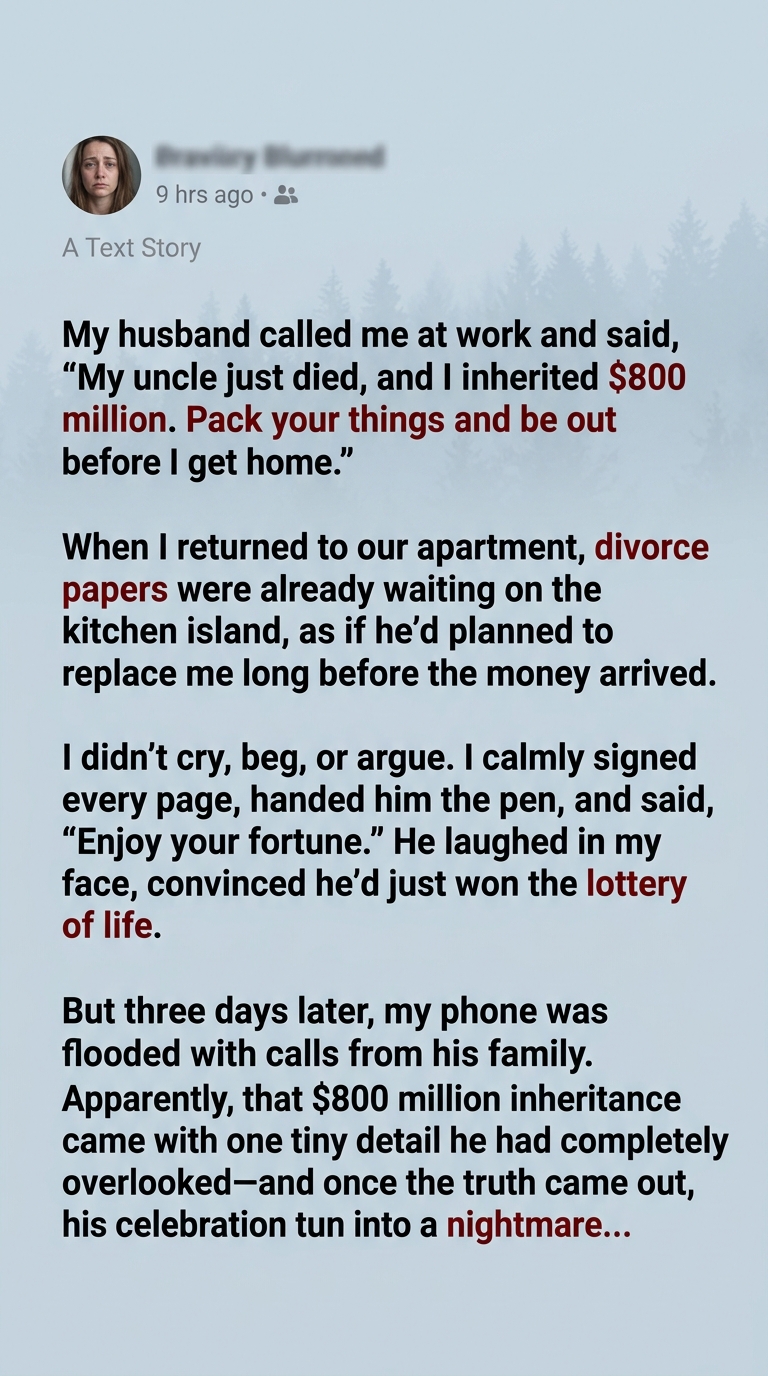
My husband called me at work, and I could hear the excitement in his voice before he even finished his first sentence.
“My uncle just died,” he said. “And guess what? I inherited $800 million.”
I barely had time to process the number before he continued.
“Pack your things and be out before I get home. I don’t want to spend my money dealing with you.”
For a moment, I thought he was joking. We’d been married for seven years. We’d survived job changes, financial struggles, family arguments, and countless sleepless nights together. I never imagined he’d throw our marriage away in the same breath he announced he’d become wealthy.
But he wasn’t joking.
When I arrived at our apartment that evening, two suitcases sat beside the bedroom door. Divorce papers were spread across the kitchen island, neatly arranged beside a pen. His attorney had apparently prepared everything in advance.
I read every page carefully.
Then I signed.
When my husband arrived, he found me finishing the last document.
“You actually signed?” he laughed. “I thought you’d make this difficult.”
I slid the papers toward him.
“Enjoy your fortune.”
He smirked, grabbed the documents, and told me I was finally making one sensible decision in my life.
I left without another word.
Three days later, my phone began ringing nonstop. His mother called. His sister called. Even his cousin, whom I hadn’t spoken to in years, left frantic messages.
Apparently, my husband had discovered something about that $800 million inheritance that his uncle had made impossible to ignore.
And the problem wasn’t the money.
It was the condition attached to it.
His uncle, a famously private businessman, had spent decades building a fortune but had never trusted his nephew’s judgment. In fact, the inheritance wasn’t a straightforward transfer of cash.
It was tied to a trust.
And the trust had very specific rules.
My husband had spent the first three days celebrating, buying cars, talking about mansions, and telling relatives that his old life was officially over. He’d even begun negotiating the purchase of a luxury property before the estate’s attorneys finished explaining the terms.
But when he finally read the documents properly, he discovered that the $800 million wasn’t simply his to spend.
The trust required him to remain legally married for at least five years after the inheritance became effective, unless he had already been divorced before his uncle’s death. The provision was designed to prevent impulsive marriages and divorces motivated by the inheritance.
His uncle had also included a separate clause requiring the beneficiary to disclose any pending divorce proceedings initiated after notification of the inheritance.
My husband had called me and ordered me out before the estate’s attorneys officially notified him of the final terms.
He had filed for divorce believing he could discard me and keep everything.
Instead, his actions triggered a review.
The trust’s attorneys weren’t accusing him of a crime, but they were examining whether he had deliberately attempted to circumvent the conditions of the inheritance. His divorce paperwork, his messages to me, and the timing of his decisions had suddenly become relevant.
And that was when his family started calling.
His mother was the first.
“You need to talk to him,” she begged. “He’s furious. The attorneys are saying the divorce could affect the inheritance.”
I told her I wasn’t his attorney, his financial adviser, or his wife anymore.
Then she said something that made me realize just how little she understood what had happened.
“Please don’t ruin his future over a misunderstanding.”
A misunderstanding?
Her son had ordered me out of my home, handed me divorce papers, and laughed while I signed them. There hadn’t been a misunderstanding. There had been a decision.
And I’d made mine, too.
I hired my own attorney, made sure my rights under the divorce process were protected, and refused to participate in any attempt to manipulate the trust’s rules.
Meanwhile, the estate’s lawyers continued reviewing the situation.
My husband had assumed the divorce was a simple way to remove me from his life. He hadn’t considered that the trust’s conditions might require him to demonstrate that his decisions weren’t driven by the inheritance itself.
His uncle’s estate wasn’t obligated to reward him simply because he’d been named beneficiary.
Three weeks later, my husband finally called me himself.
His voice sounded nothing like the man who’d announced his fortune.
“Can we talk?” he asked.
“About what?”
“About us. About the divorce. Maybe we should slow things down.”
I almost laughed.
“Slow things down? You told me to pack my things before you got home.”
“I was overwhelmed.”
“You were excited.”
He went silent.
Then he told me that the attorneys believed there might be a way to resolve the trust issue, but it would require him to reconsider his divorce and demonstrate that the marriage hadn’t been abandoned solely because of the inheritance.
He wanted me to help.
He wanted me to withdraw my cooperation with the divorce process, agree to certain statements, and give him time to sort everything out.
I refused.
I wasn’t going to lie for him, change my testimony, or pretend that his cruelty hadn’t happened.
My attorney advised me to let the legal process proceed independently of the trust dispute. The divorce was about our marriage, our rights, and our future—not about rescuing his inheritance.
And that’s exactly what I did.
Eventually, the estate’s attorneys reached their decision. The trust wasn’t going to be manipulated through a rushed divorce or a fabricated reconciliation. My husband would have to comply with the trust’s conditions, and his eligibility would be determined according to its actual terms.
His fortune wasn’t suddenly gone, but neither was it the effortless $800 million he had imagined.
He couldn’t simply spend it all.
And he couldn’t use me as a convenient solution.
The divorce continued.
I moved into a small apartment, rebuilt my life, and stopped answering calls from relatives who suddenly seemed to think my marriage was a financial negotiation.
Months later, I heard that my husband had finally accepted the restrictions imposed by the trust and was working with professional advisers to manage the money he could legally access.
I never learned whether he eventually became the billionaire he’d dreamed of being.
I didn’t care.
The last time I saw him was in a courthouse hallway. He looked at me, shook his head, and said, “You could have helped me.”
I looked at the man who had once promised to build a life with me, then told me to leave the moment he believed money made him untouchable.
“No,” I replied quietly. “I could have helped you build a marriage. You chose to throw that away.”
And I walked past him.
Because the greatest thing I had signed that evening wasn’t the divorce paperwork.
It was the permission to stop spending my life begging someone to treat me with respect.