I Kicked My 18-Year-Old Daughter Out for Choosing College. Thirteen Years Later, Her Wedding Invitation Broke Me.
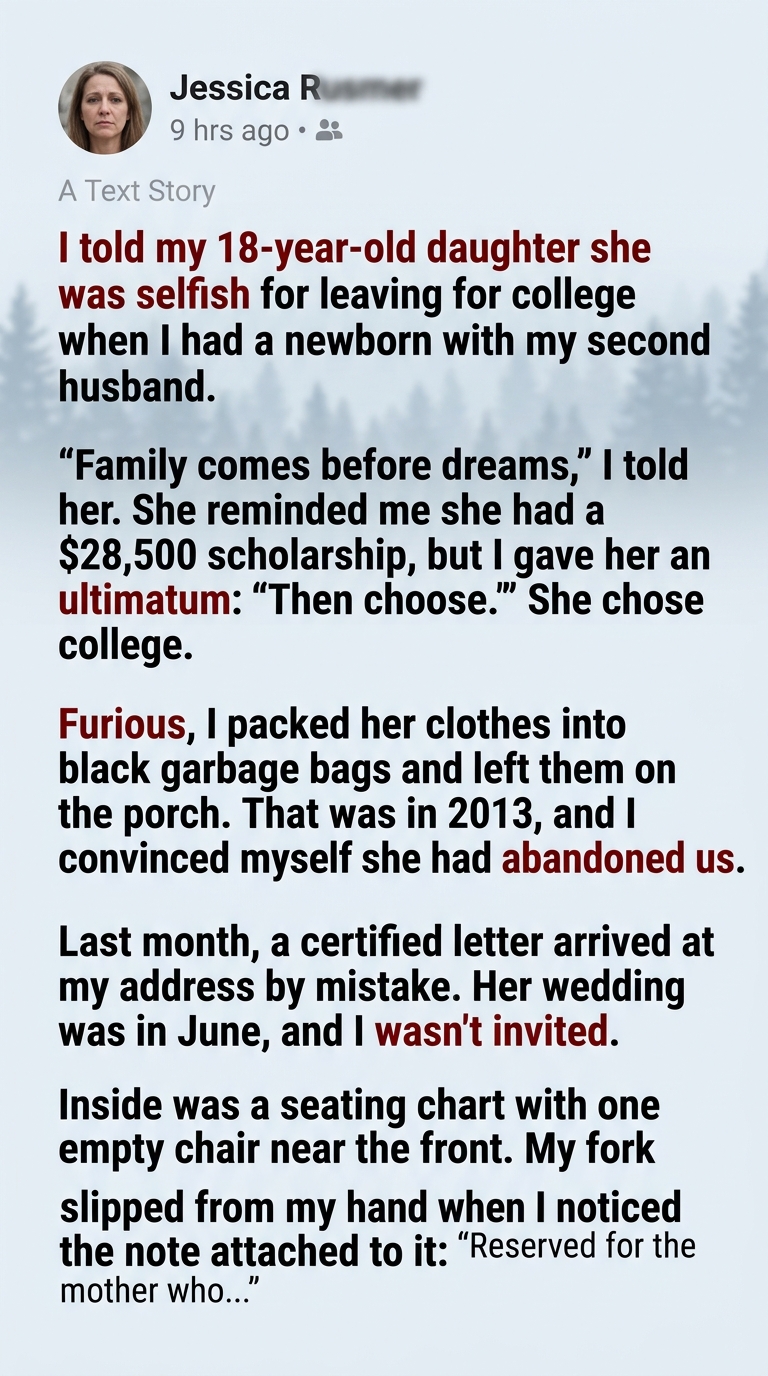
I told my eighteen-year-old daughter she was selfish for leaving home when I had a newborn to care for.
“Family comes before dreams,” I told her.
She stood in our kitchen holding a college acceptance letter, her eyes red from crying.
“Mom, I have a $28,500 scholarship. I’ve worked for this since I was fourteen. I can finally go.”
I looked down at the baby in my arms.
Her half-brother, Ethan, was only three months old. My second husband, Mark, had recently returned to work, and I was exhausted. I felt as though the entire household depended on me.
“Your brother needs you,” I said.
“He’s a baby. I’m his sister, not his mother.”
That answer made me furious.
I told myself she was being ungrateful. I had raised her alone for years before marrying Mark. I had sacrificed so much for her, and now that I finally had a new family, she wanted to walk away.
“Then choose,” I told her. “Your college or this family.”
She stared at me.
“You’re really making me choose?”
I nodded.
She looked at the scholarship letter again.
Then she whispered, “I’m choosing college.”
I felt something inside me snap.
That afternoon, I packed her clothes into black garbage bags and left them on the porch.
She stood there for several minutes, crying.
“Mom, please don’t do this.”
I folded my arms.
“You made your decision.”
She loaded the bags into an old car belonging to one of her friends and drove away.
Her name was Emily.
And that was the last time I saw my daughter for thirteen years.
At least, that was what I told myself.
For years, I convinced myself she had abandoned us. Whenever relatives asked about her, I said she had chosen a career over her family.
I never mentioned the garbage bags.
I never mentioned the ultimatum.
I certainly never admitted that she had begged me not to throw her out.
Mark occasionally suggested that I contact her.
“She’s your daughter,” he would say. “Maybe she’s waiting for you to reach out.”
I always found an excuse.
“She’s the one who left.”
And life continued.
Ethan grew up. Mark and I bought a larger house. I attended school events, birthday parties, and family vacations.
But sometimes, when I saw a young woman graduating or celebrating a new job, I wondered what Emily was doing.
I never asked.
I told myself she was probably fine.
Then, last month, a certified envelope arrived at my house.
The address was correct, but the name on the envelope was Emily’s.
I almost returned it unopened.
But curiosity got the better of me.
Inside was a wedding seating chart.
At the top was a printed heading:
EMILY AND JAMES — WEDDING RECEPTION
The wedding was scheduled for June.
I wasn’t invited.
There was no invitation, no personal message, and no explanation.
Just the seating chart.
I almost threw it away.
Then I noticed one empty chair near the front.
It was marked with a small handwritten note.
I picked it up.
My fork slipped from my hand and hit the kitchen floor.
The note said:
“Reserved for the mother who taught me that choosing my future doesn’t mean I stopped loving my family. I hope she finds the courage to sit here someday.”
I read it again.
And again.
Then I began crying.
For thirteen years, I had told myself Emily didn’t care about us.
But that chair told a different story.
She had remembered me.
She had thought about me when planning her wedding.
And despite everything I had done, she had left a place for me.
I sat at the kitchen table until Mark came home.
He found me holding the seating chart.
“What happened?”
I handed it to him.
He read the note silently.
Then he sat beside me.
“That’s from Emily?”
I nodded.
“Her wedding is in June.”
“Are you invited?”
I shook my head.
Mark studied the seating chart.
“Maybe she wants you to understand what that chair means before you decide whether to contact her.”
I looked at him.
“What do you mean?”
“She didn’t send you a formal invitation. But she didn’t leave you out completely, either.”
I stared at the note.
For the first time in years, I wondered whether Emily had been waiting for an apology rather than an explanation.
I called my sister, Linda.
She was the only person who had stayed in contact with Emily after she left.
When I told her about the seating chart, she became quiet.
“Did you know about the wedding?” I asked.
“Yes.”
“And you didn’t tell me?”
“Emily asked me not to.”
“Why?”
Linda sighed.
“Because she didn’t want you to show up and make the day about the past.”
I felt offended.
“I wouldn’t do that.”
Linda didn’t argue.
Instead, she asked, “Have you ever apologized to her?”
I opened my mouth.
Then closed it.
“She left me.”
“No,” Linda said quietly. “You made her leave.”
I felt my face grow hot.
“That’s not fair.”
“Isn’t it?”
I hung up.
But her words stayed with me.
That night, I went upstairs and opened the old storage closet.
I still had some of Emily’s school photographs, a few drawings, and a small box of things she had left behind.
At the bottom was a folded college brochure.
I recognized the university.
It was the school she had been accepted into in 2013.
The scholarship amount was printed on the first page: $28,500.
I sat on the floor.
I remembered how proudly she had shown it to me.
I remembered her talking about studying architecture. She had always loved drawing houses and designing rooms. When she was little, she used to build entire cities out of cardboard boxes.
She had worked so hard for that scholarship.
And I had treated it like a betrayal.
I opened another box.
Inside was a birthday card she had made for me when she was sixteen.
It showed a little house with two people standing outside.
The message read:
“Mom, when I grow up, I hope I can give you a house where you never have to worry about anything. Love you forever.”
I pressed the card against my chest.
I had spent thirteen years believing she had abandoned me.
But I was the one who had put her belongings in garbage bags.
I was the one who had told her that her future was less important than my convenience.
The next morning, I called Linda again.
“Can you give Emily a message?”
“Of course.”
“Tell her I received the seating chart.”
Linda paused.
“And?”
I swallowed.
“Tell her I’m sorry.”
“Are you going to explain?”
“No. Just tell her I’m sorry.”
Two days later, Emily called.
I almost didn’t recognize her voice.
“Hello, Mom.”
My eyes filled immediately.
“Emily.”
There was a long silence.
Then she asked, “Did you get the chart?”
“Yes.”
“Okay.”
I gripped the phone.
“Thank you for leaving that chair.”
She exhaled.
“I wasn’t sure whether I should.”
“Why did you?”
Another silence.
“Because I wanted you to know that I haven’t forgotten everything good about us.”
I began crying.
“Emily, I am so sorry.”
She didn’t answer.
I continued.
“I was wrong. I made you choose between your education and your family. I made you feel like you were selfish for wanting a future. And then I put your clothes outside like you were someone I didn’t love.”
Her voice trembled.
“You didn’t just make me feel that way, Mom. You made me homeless.”
The words struck harder than I expected.
“I know.”
“No, I don’t think you do. I slept in my friend’s car for two nights. I was eighteen. I had a scholarship, but I didn’t have a place to live or enough money for everything else.”
I covered my mouth.
“I didn’t know.”
“You never asked.”
She explained that her friend Rachel’s parents had eventually let her stay in their spare room. Emily worked part-time while attending university and used her scholarship to cover much of her tuition.
She had struggled.
There were nights she studied after closing shifts at a restaurant. There were semesters when she nearly dropped out because she couldn’t afford rent and textbooks.
But she graduated.
She became an architect.
And she met James at her first full-time job.
I listened without interrupting.
Then she told me something I hadn’t expected.
“Do you know why I sent you the seating chart?”
“Why?”
“Because when I started planning the wedding, I realized I still wanted you there. But I couldn’t send you an invitation and pretend thirteen years hadn’t happened.”
I wiped my cheeks.
“I understand.”
“I needed you to know that the empty chair wasn’t a promise. It was a possibility.”
I nodded, even though she couldn’t see me.
“That’s fair.”
She took a breath.
“I don’t know if I’m ready to have you at the wedding.”
My heart sank, but I didn’t argue.
“Then I won’t come unless you invite me.”
She was quiet.
“Thank you.”
Before we ended the call, I asked one question.
“Can I write you a letter?”
She considered it.
“Yes. But please don’t write to explain why you did what you did. I already know you were overwhelmed. I need you to understand what it cost me.”
“I will.”
I spent the next three days writing.
I didn’t mention how difficult it had been raising a newborn. I didn’t blame Mark. I didn’t talk about how Emily should have understood my stress.
I wrote about what I had done.
I wrote that she had been eighteen, not an adult who should have been expected to sacrifice her future to help raise a baby.
I wrote that her scholarship was an achievement, not an act of selfishness.
I wrote that I had confused her independence with rejection because I was afraid of being left behind.
And I wrote that none of those feelings justified what I had done.
I mailed the letter.
A week later, Emily called again.
“Mom, I read it.”
I held my breath.
“Thank you for not making excuses.”
I began to cry.
“Are you still thinking about the wedding?”
“Yes,” she said. “I want you to come.”
I couldn’t speak.
“But I need you to understand something,” she continued. “I don’t want you to come expecting everything to be fixed. I want you to come because you want to support me. Not because you want to be forgiven in front of everyone.”
“I understand.”
“And please don’t bring up the past during the ceremony or reception.”
“I won’t.”
She paused.
“There’s another thing.”
“What is it?”
“I’d like you to meet James before the wedding.”
I smiled through my tears.
“I would love that.”
We met at a small café two weeks later.
Emily arrived first.
When I saw her, I noticed how much she resembled the little girl in the photographs. She had the same eyes, the same smile, and the same habit of pushing her hair behind her ear when she was nervous.
James stood and introduced himself.
He was polite, warm, and clearly loved my daughter.
He told me about their work, their apartment, and their plans for the future.
I listened.
I didn’t ask why Emily hadn’t called sooner.
I didn’t ask why she hadn’t forgiven me.
I simply tried to get to know the woman she had become.
When we were leaving, Emily hugged me.
It was brief.
But it was real.
The wedding took place in June.
I arrived early and sat quietly in the front section.
There was a chair beside me with a small card attached.
“Reserved for Mom.”
I touched the card.
When Emily walked down the aisle, she looked beautiful.
I cried through the entire ceremony.
Afterward, during the reception, she came over and sat beside me.
“Are you okay?” she asked.
I nodded.
“I’m proud of you.”
She smiled.
“Thank you.”
Then she looked at me.
“I know I didn’t become the daughter you expected.”
I shook my head.
“Emily, you became the woman you worked so hard to become. I should have been proud of you from the beginning.”
She reached for my hand.
We didn’t magically become close again that day.
There were still thirteen years of birthdays, graduations, holidays, and ordinary conversations we couldn’t get back.
There were still painful memories that needed time.
But that evening, we danced together.
Not as if nothing had happened.
As two people who were finally willing to begin again.
And when I returned home, I took the old college brochure from the storage box and placed it in a frame.
I put it beside the wedding photograph.
For years, I had told myself that Emily abandoned her family when she chose college.
Now I understood the truth.
She had chosen her future because I had given her no room to choose both.
And the empty chair at her wedding had taught me something I should have understood thirteen years earlier:
A child does not stop loving her mother just because she finally learns to stand on her own.