My Husband Filed for Divorce Six Days After We Won $2.4 Million. Then the Lottery Office Called.
After thirty-four years of marriage, I thought I knew every side of my husband.
I knew how Arthur took his coffee, how he snored when he was tired, and how he always checked the front door twice before going to bed.
I knew his favorite football team, his mother’s birthday, and the exact expression he made whenever he was about to tell a lie.
Or at least, I thought I did.
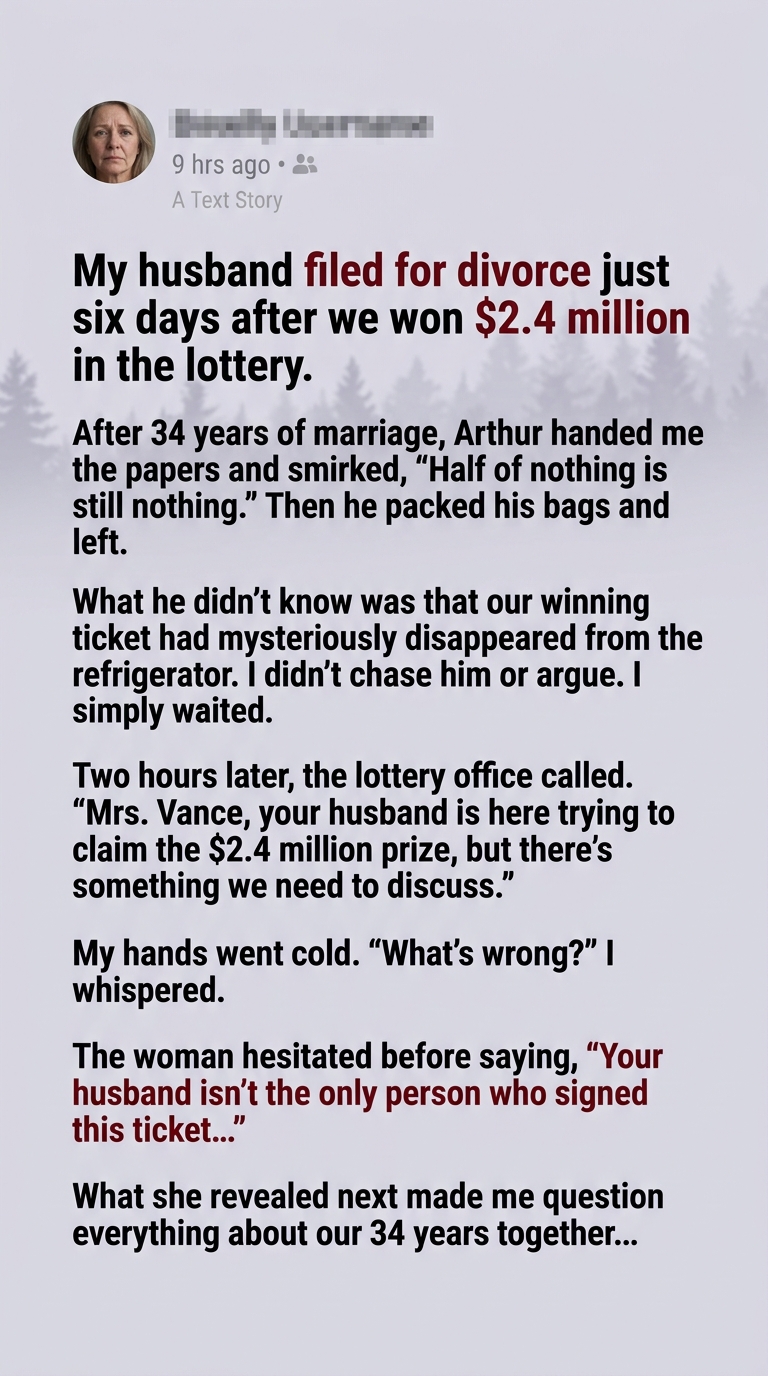
Six days after we won $2.4 million in the lottery, Arthur handed me divorce papers.
He stood in our kitchen wearing the same expensive watch I’d bought him for our thirtieth anniversary.
“Sign them,” he said.
I stared at the papers.
“Arthur, what is this?”
“Divorce papers. I think it’s time we stopped pretending.”
I felt as if the floor had shifted beneath me.
“We just won the lottery.”
He smiled.
“Exactly.”
Then he delivered the sentence I would never forget.
“Half of nothing is still nothing.”
He laughed, packed two suitcases, and walked out.
I didn’t follow him.
I didn’t throw anything.
I didn’t even ask where he was going.
I simply watched him drive away.
Because there was something Arthur didn’t know.
The winning ticket was missing.
And I knew exactly when it had disappeared.
Six days earlier, Arthur and I had been sitting at our kitchen table when the lottery numbers were announced. We had bought the ticket together at a little convenience store near our house.
When the final number appeared, Arthur checked the ticket three times.
Then he started shouting.
We had won $2.4 million.
We hugged, cried, and spent the next hour talking about everything we’d finally be able to do.
A new roof.
A comfortable retirement.
A trip to Italy.
Maybe helping our grandchildren with college.
Arthur placed the ticket inside a small envelope and taped it to the refrigerator behind a family photograph.
“We’ll keep it here until we speak to the lottery office,” he said.
I agreed.
But two days later, I noticed the envelope was gone.
I asked Arthur about it.
He shrugged.
“I moved it somewhere safe.”
I believed him.
After all, we’d been married for thirty-four years. I had no reason to think my husband would steal from me.
But now, after he had filed for divorce and walked out with a smug smile, I understood that the missing ticket might have been part of something much bigger.
I sat at the kitchen table for several minutes.
Then my phone rang.
The caller ID showed the state lottery office.
I answered.
“Hello?”
“Mrs. Vance?”
“Yes.”
“My name is Elaine. I’m calling from the prize verification department. Your husband, Arthur Vance, is here attempting to claim the $2.4 million prize.”
My hands went cold.
“He’s there?”
“Yes. But there’s something we need to discuss.”
I swallowed.
“What’s wrong?”
Elaine hesitated.
“Your husband isn’t the only person who signed this ticket.”
I stared at the wall.
“What?”
She continued carefully.
“We have a ticket submitted for verification bearing two signatures. Your husband’s signature is one. The second appears to be yours. Before we proceed, we need to confirm the circumstances surrounding the purchase and ownership.”
My heart began pounding.
“Why does that matter?”
“Because the claim is being submitted as a jointly owned ticket. We need to establish the identity and authorization of all named claimants.”
I closed my eyes.
Then Elaine said something that made me grip the edge of the table.
“Your husband has also presented a document stating that you transferred your interest in the prize to him.”
I couldn’t breathe.
“I never signed anything like that.”
“That’s why we’re calling you.”
I looked toward the empty space on the refrigerator.
“Please don’t approve anything until I speak to my attorney.”
“Of course. The claim is on hold pending verification.”
I thanked her and hung up.
Then I called my lawyer.
Her name was Patricia Collins, and she had handled our estate planning for nearly fifteen years.
When I explained what had happened, she became very quiet.
“Do you have a copy of the ticket?”
“No. Arthur took it.”
“Do you have any photographs?”
I opened my phone.
I remembered taking a picture of the ticket on the night we won. I had sent it to our daughter, Melissa, with the message: WE WON! I STILL CAN’T BELIEVE IT!
I forwarded the photograph to Patricia.
She studied it.
“There’s something important here,” she said. “The ticket appears to have been signed by both of you before the claim. We need to determine the applicable lottery rules and whether Arthur has submitted any document that could affect your interest.”
“Can he take all the money?”
“Not simply because he filed for divorce. But we need to act quickly and preserve every piece of evidence.”
I told her about the divorce papers.
She asked me to send photographs of those, too.
Then she said, “Do not sign anything Arthur gives you. And don’t contact him about the ticket until we’ve reviewed the documents.”
I agreed.
That afternoon, Patricia contacted the lottery office and requested that the claim remain on hold while the ownership dispute was investigated.
She also asked for copies of the documents Arthur had submitted.
Two days later, we received them.
The first was a claim form.
The second was a document titled “Assignment of Lottery Proceeds.”
It appeared to carry my signature.
But it wasn’t mine.
I knew immediately.
The signature looked similar, but the final letter in my surname was wrong. Whoever had written it had copied the shape without understanding how I actually signed my name.
Patricia arranged for a document examiner to review it.
Then she found something else.
Arthur had submitted a letter claiming I had agreed to let him claim the prize because I didn’t want my name associated with the winnings during the divorce.
I had never written that letter.
I had never agreed to anything.
The examiner’s preliminary assessment found significant inconsistencies between the disputed signature and my verified signatures.
Patricia looked at me across her desk.
“Nora, this may be more than a divorce dispute.”
I nodded.
“I know.”
Then she asked, “Did Arthur have access to your personal documents?”
“Of course. We lived together for thirty-four years.”
“Did he know your signature?”
I almost laughed.
“He watched me sign birthday cards, mortgage documents, tax forms, and Christmas checks for decades.”
Patricia made a note.
“Then we need to preserve the original evidence and let the appropriate authorities investigate.”
I thought about all the years I’d trusted him.
All the documents I’d signed without hesitation.
All the times he’d told me not to worry about money because he handled the paperwork.
And suddenly, I began wondering how much of our marriage I had actually understood.
A week later, Arthur called.
His voice sounded irritated.
“Why did you tell the lottery office to stop my claim?”
I sat down.
“I didn’t tell them anything. I told them I never signed away my share.”
“You know we were going to split the money.”
“Then why did you submit a document saying I gave you my interest?”
He went silent.
Then he laughed.
“You’re making this complicated.”
“Did you forge my signature?”
“Don’t use words like that.”
“Did you sign my name?”
He lowered his voice.
“Nora, listen. We were getting divorced anyway. I thought it would be easier if I claimed the money first. We could work everything out later.”
“Later?”
“Yes.”
“After you took the entire prize?”
He sighed.
“You’re being dramatic.”
I ended the call.
I forwarded the recording of the conversation to Patricia.
She told me not to contact him again except through legal counsel.
The following weeks were difficult.
The lottery office continued its review. The ticket itself was verified as the winning ticket, but the claim remained on hold while the ownership and disputed assignment were examined.
The authorities also began investigating the suspicious document.
Arthur’s lawyer argued that the prize should be treated as his because he had physically submitted the claim.
Patricia disagreed.
She explained that physical possession of a ticket did not automatically settle ownership, particularly when there was evidence of joint purchase and signatures from both parties.
The original purchase receipt, the photograph I had sent to Melissa, and the messages exchanged on the night of the win all became important evidence.
Then something unexpected happened.
Melissa called me.
“Mom, I need to tell you something.”
“What is it?”
“Dad called me last week.”
I felt my stomach tighten.
“What did he want?”
“He asked me to say that you had agreed he could claim the lottery money.”
I closed my eyes.
“Did you?”
“Of course not. I told him I wasn’t going to lie.”
She paused.
“Mom, there’s something else. He asked whether I still had the photograph you sent me when you won.”
I sat up.
“Why?”
“He said he needed it for his claim. I told him I wasn’t giving him anything without speaking to you.”
I thanked her.
Then I called Patricia.
She was interested in the timing.
“If he was asking for the photograph after submitting the claim, that could be relevant. Save your daughter’s messages and ask her to preserve anything he sent.”
We did.
Two weeks later, the document examiner completed the report.
The examiner concluded that the signature on the assignment document was not written by me and showed evidence consistent with imitation.
The report did not identify the person who had written it.
That was for the investigation to establish.
But it was enough for the lottery office to reject the assignment as proof that I had surrendered my interest.
Arthur’s claim was no longer moving forward as a sole claim.
The lottery office required the ownership issue to be resolved before releasing the prize.
Meanwhile, our divorce proceedings continued.
Patricia explained that the lottery winnings would need to be addressed under the marital-property laws that applied to us. The fact that the ticket had been jointly signed was important evidence, but the final division would depend on the applicable law, the date of purchase, and the court’s findings.
I wasn’t guaranteed the entire prize.
I wasn’t expecting it.
I simply wanted the truth established.
Then, one Thursday morning, Elaine from the lottery office called again.
“Mrs. Vance, we’ve completed the initial ownership review.”
I gripped the phone.
“What did you find?”
“The evidence supports that the winning ticket was purchased jointly and signed by both you and your husband. We have also rejected the assignment document as evidence of your consent because the signature could not be authenticated.”
I closed my eyes.
“So Arthur can’t claim everything?”
“Not on the basis of that document. The prize remains subject to the required legal and tax procedures, but your interest will not be disregarded.”
I began to cry.
Not because I had won the lottery.
Because someone had finally listened when I said my husband was trying to take something that belonged to both of us.
The divorce took several more months.
Arthur continued to insist that he had acted because he wanted to protect the money. But the evidence did not support his claim that I had voluntarily transferred my share.
The disputed document became part of the formal investigation, and the authorities reviewed whether it constituted fraud or forgery under the applicable law.
The financial settlement was eventually handled through the divorce proceedings.
The lottery proceeds were divided according to the final agreement and legal determination, after taxes and required deductions.
Arthur didn’t get to keep the entire $2.4 million.
And I didn’t walk away with all of it either.
But I received my legally established share.
Enough to secure my retirement, pay off the remaining mortgage, and help our grandchildren with their education.
Arthur eventually contacted me after the divorce was finalized.
He sounded older.
“We spent thirty-four years together,” he said.
“Yes, we did.”
“I never thought things would end like this.”
I looked out the window.
“Neither did I.”
He paused.
“Do you really think I would have stolen from you?”
I remembered the missing ticket, the fake assignment, and the way he had laughed when he handed me the divorce papers.
“I don’t have to think about it anymore, Arthur. The documents speak for themselves.”
He didn’t answer.
I ended the call.
A few months later, I took the trip to Italy we’d talked about at our kitchen table the night we won.
I went with Melissa.
We visited Florence, walked through Rome, and sat beside the water in Venice.
One evening, she raised her glass.
“To new beginnings, Mom.”
I smiled.
“To knowing your worth.”
For thirty-four years, I thought marriage meant trusting someone with everything.
I never imagined that the person who shared my bed, my home, and my family would try to turn a winning lottery ticket into a weapon against me.
But I learned something.
Money doesn’t necessarily change people.
Sometimes it simply reveals what they were willing to hide.
And when Arthur told me that half of nothing was still nothing, he forgot one important detail.
The ticket had never belonged to him alone.
Neither had the life we’d built.