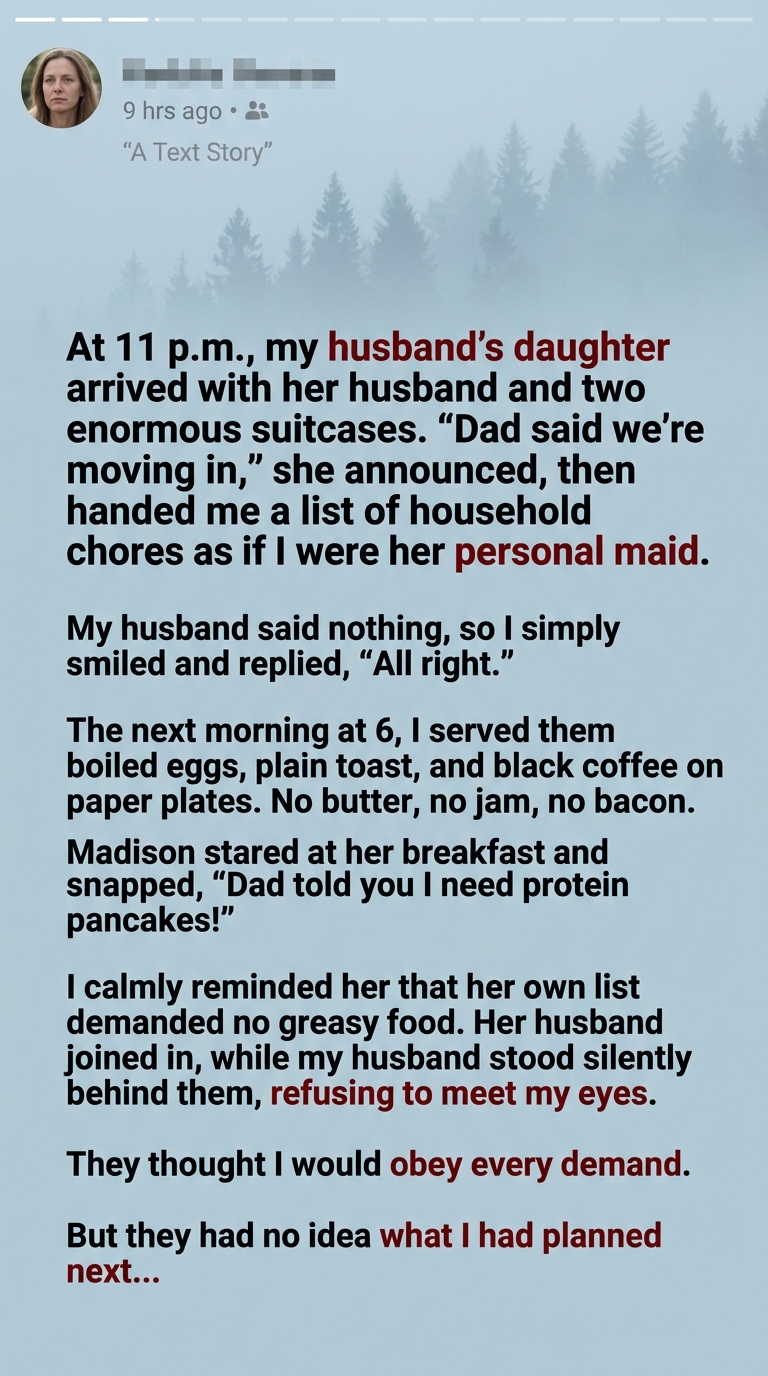
My Husband’s Daughter Moved In at 11 P.M. and Handed Me a List of Chores. The Next Morning, I Had a Surprise for Them.
At exactly 11:07 p.m., someone pounded on our front door.
I was already in my pajamas, halfway through a cup of chamomile tea, when my husband, Richard, got up from the sofa.
“Who is it?” I called.
“Madison,” he answered.
I frowned.
His daughter hadn’t mentioned visiting, let alone arriving this late.
Richard opened the door.
There stood Madison, his thirty-year-old daughter, wearing an expensive coat and holding her phone. Behind her was her husband, Tyler, struggling with two enormous suitcases.
“Dad!” she announced, stepping inside without waiting for an invitation. “We’re finally here.”
I looked at the suitcases.
“Here for what?”
Madison smiled as if I’d asked an amusing question.
“Moving in, obviously. Dad said we could stay.”
I turned toward Richard.
He suddenly became very interested in closing the front door.
“Richard?”
He cleared his throat.
“It’s temporary, sweetheart. Just until they get things sorted out.”
Madison dropped her handbag on the hallway table.
“It’s not a big deal. We need somewhere comfortable for a while.”
Then she pulled a folded piece of paper from her purse and handed it to me.
I opened it.
It was a list of household expectations.
Not requests.
Expectations.
Madison had written them in neat bullet points:
- Breakfast prepared by 7 a.m.
- Protein pancakes on weekdays.
- Fresh coffee available throughout the morning.
- Laundry washed separately.
- Bedroom cleaned twice weekly.
- Bathroom stocked with luxury toiletries.
- Dinner served by 6:30 p.m.
- No greasy food or strong cooking smells.
- No unnecessary noise before 9 a.m.
At the bottom, she’d written:
Please make sure the house is comfortable for us. We’re going through a stressful time.
I stared at the paper.
Then I looked at her.
“Did you write this?”
She nodded.
“It’s just easier if everyone knows what to expect.”
I glanced at Richard.
He didn’t say a word.
I could have argued.
I could have reminded him that this was my home, too, and that nobody had discussed moving two additional adults into it.
Instead, I folded the paper carefully.
“All right,” I said with a smile.
Madison looked satisfied.
“Great. I knew we’d get along.”
She had no idea what I meant by that smile.
The next morning, I woke at 5:30.
I went downstairs, made breakfast, and set the dining table.
Except I didn’t use our usual plates.
I placed four paper plates on the table.
Each had one boiled egg and two slices of plain toast.
I made a pot of black coffee.
No butter.
No jam.
No bacon.
No fruit.
No protein pancakes.
At exactly six, I called everyone downstairs.
Madison appeared first, wearing a silk robe.
She stared at the table.
“What is this?”
“Breakfast,” I replied.
She picked up a piece of toast.
“Where are the protein pancakes?”
I took a sip of coffee.
“Your list specifically requested no greasy food or strong cooking smells. I thought plain toast would be safest.”
“Dad told you I need protein pancakes!”
I nodded toward the boiled egg.
“There’s protein.”
Tyler came downstairs and looked at his plate.
“Are you serious?”
“Completely.”
He pushed the paper plate away.
“This is ridiculous.”
I smiled politely.
“I’m sorry you feel that way.”
Madison turned toward Richard.
“Dad! Are you going to let her do this?”
Richard stood near the kitchen doorway.
He looked at his daughter.
Then at me.
Then down at the floor.
He said nothing.
That silence told me more than any argument could have.
I had been married to Richard for six years.
When we met, I knew he had a daughter from his first marriage.
I had never tried to replace her mother.
I had welcomed Madison into our home, attended her birthday dinners, bought her graduation gifts, and helped her whenever she asked.
When she married Tyler, I helped organize the reception.
When they struggled financially, Richard and I had paid several of their bills.
I never kept score.
But over the years, Madison had developed a habit of treating my kindness as an obligation.
She rarely asked.
She simply announced what she expected.
Richard always defended her.
“She doesn’t mean it that way,” he would say.
“She’s had a difficult time.”
“Just let this one go.”
I had let so many things go that I had almost forgotten what it felt like to stand up for myself.
But the night before, something had finally become clear.
Richard had agreed to let two adults move into our home without asking me.
And his daughter had arrived believing I would become their unpaid housekeeper.
I wasn’t going to shout.
I wasn’t going to fight.
I was going to let everyone understand exactly what they had agreed to.
At 8 a.m., Madison handed me another piece of paper.
“Here,” she said. “I updated the schedule.”
I unfolded it.
There were more demands.
She wanted the guest bedroom changed to a different color, the closet cleared for her clothes, and the bathroom shelves reorganized.
She had also written that Tyler preferred his towels warmed before showers.
I looked at the page.
Then I placed it on the kitchen counter.
“Thank you.”
She blinked.
“That’s it?”
“What else would you like me to say?”
“I just want to know you’ll follow it.”
I smiled.
“Madison, I read your list. I understand your preferences. But I’m not your employee.”
Her expression hardened.
“I’m not treating you like an employee.”
“Then why are you handing me a work schedule?”
Tyler laughed under his breath.
Richard walked into the kitchen.
“Can we please not start arguing? They’re under a lot of stress.”
I turned to him.
“Richard, did you agree to let them move in?”
“Yes.”
“Did you ask me?”
He hesitated.
“I knew you wouldn’t mind helping.”
I stared at him.
“You knew I wouldn’t mind, or you hoped I wouldn’t object?”
He didn’t answer.
Madison folded her arms.
“Dad said this was his house, too.”
I nodded.
“It is.”
“Then we have every right to be here.”
I looked at her calmly.
“Your father and I own this home together. That doesn’t mean either of us gets to make permanent decisions about other people moving in without discussing them.”
She rolled her eyes.
“It’s not permanent.”
“Then we should have no trouble agreeing on an end date.”
For the first time, she looked uncertain.
At 10 a.m., I went upstairs and brought down a folder.
Richard recognized it immediately.
His face changed.
“What is that?”
“Our household agreement.”
Madison laughed.
“You have an agreement?”
“Yes.”
I opened the folder and placed three documents on the table.
The first was a copy of our home’s ownership records.
The second was our mortgage and household expense summary.
The third was a written occupancy agreement I had prepared with a lawyer’s help several months earlier.
Richard and I had previously discussed the possibility of allowing relatives to stay with us for extended periods.
After an earlier disagreement about his brother’s proposed move-in, I had asked our lawyer how we could protect both owners’ rights and establish clear expectations for guests.
We had never needed to use the document.
Until now.
I pointed to the first page.
“Any extended stay needs the written agreement of both owners. It also needs a clear duration, a contribution toward additional household expenses, and an understanding that guests are responsible for their own personal care.”
Madison stared at the paperwork.
“Are you saying we have to pay rent?”
“I’m saying that two additional adults increase household costs. We need to discuss how those costs will be handled.”
Tyler leaned forward.
“We’re family. Why are you making this about money?”
I looked at him.
“Because groceries, electricity, water, and other expenses aren’t free.”
Madison scoffed.
“Dad never said anything about paying.”
I turned to Richard.
“Did you discuss any of this with them?”
He rubbed his forehead.
“No.”
“Then we have a problem.”
Richard asked Madison and Tyler to give us some time to talk privately.
They went upstairs, complaining loudly enough for us to hear.
When the bedroom door closed, I faced my husband.
“Why didn’t you tell me?”
He sighed.
“Madison called me last week. They had a disagreement with their landlord, and they needed somewhere to stay.”
“For how long?”
“She said a few weeks.”
“Then why did she bring two enormous suitcases and a list of household duties?”
He looked uncomfortable.
“She gets carried away.”
“Richard, she told me you said they were moving in.”
“I didn’t think she’d make such a production of it.”
I stared at him.
“You didn’t think she’d make a production of it? You didn’t think to ask your wife before inviting two adults to live here?”
He lowered his eyes.
“I didn’t want to upset her.”
I felt something inside me settle.
“You were willing to upset me instead.”
He looked up.
“That’s not fair.”
“Then tell me what would have been fair.”
He had no answer.
I told him I wasn’t refusing to help his daughter.
But helping someone didn’t mean surrendering every boundary.
If Madison and Tyler needed a few nights while they found another place, we could discuss that.
If they wanted a longer stay, we needed a written arrangement.
And nobody was going to hand me a list of chores in my own home.
Richard nodded slowly.
For once, he didn’t tell me to let it go.
At noon, we all sat around the dining table.
I explained the options.
Madison could stay for a short, agreed period while she and Tyler arranged alternative accommodation.
They would contribute to the additional household expenses.
They would handle their own laundry, meals, and personal cleaning.
They would respect the household’s routines.
And any extension would require another discussion.
Madison looked offended.
“So you’re putting conditions on helping your own family?”
I answered gently.
“I’m putting boundaries on living together.”
Tyler shook his head.
“We thought we’d be welcomed.”
“You were welcomed last night,” I said. “But being welcomed doesn’t mean being entitled to control the household.”
Madison turned to her father.
“Dad, say something!”
Richard looked at her for a long moment.
Then he spoke.
“Your stepmother is right about one thing. I should have discussed this with her before inviting you. I made a decision that affects both of us.”
Madison stared at him.
I think she had expected him to defend her automatically.
Instead, he continued.
“You’re welcome to stay for the short period we discussed, but you need to respect the agreement.”
She pushed back her chair.
“This is unbelievable.”
She walked upstairs.
Tyler followed.
For the next few days, the house was tense.
Madison barely spoke to me.
She complained about the breakfast options, the lack of extra closet space, and the fact that I wouldn’t wash her clothes.
I remained polite.
I cooked the meals I normally cooked.
I cleaned the rooms I normally cleaned.
I didn’t reorganize my schedule around her preferences.
And I stopped apologizing for it.
On the fourth evening, Madison came downstairs while I was preparing dinner.
“Can I ask you something?”
“Of course.”
“Why are you being so difficult?”
I put down the spoon.
“I’m not being difficult. I’m living my life in my own home.”
She crossed her arms.
“You know Dad feels guilty about not helping me more.”
“I understand that.”
“Then why not just make things easier for him?”
I looked at her.
“Because making things easier for your father shouldn’t require making my life harder.”
She stared at me.
Then she looked away.
For once, she didn’t have an immediate reply.
A week later, Richard and I received a call from our lawyer.
He had reviewed the situation and confirmed that our proposed written arrangement was a sensible way to document the temporary stay.
He also reminded us that any decision about ending an occupancy arrangement would need to follow applicable local tenancy and property laws.
I was relieved.
I had never intended to throw anyone out in anger or take matters into my own hands.
I simply wanted clarity.
Richard and I signed the agreement.
Madison and Tyler refused to sign it.
They said they weren’t going to pay to stay with family.
I told them that was their choice.
But without an agreement, the temporary arrangement would not be extended.
They had already been given time to make other plans.
Madison called her father selfish.
Tyler accused me of turning him against his daughter.
Richard looked exhausted.
But this time, he didn’t ask me to change my mind.
On the final evening of their agreed stay, Madison came into the kitchen.
“We found an apartment,” she said.
“That’s good news.”
She looked at me as if she expected a different response.
“Dad is helping us with the deposit.”
I nodded.
“I’m glad you’ve found somewhere.”
She hesitated.
Then she asked, “Are you happy we’re leaving?”
I thought about giving her a comforting answer.
Instead, I chose honesty.
“I’m happy that everyone will have their own space again.”
She looked down.
“I didn’t think you’d take it this seriously.”
I dried my hands.
“That’s because you didn’t think about how it would affect me.”
For a moment, she seemed to consider that.
Then she picked up her phone and went upstairs.
The next morning, she and Tyler loaded their suitcases into a rented van.
Richard helped them carry the last few boxes.
Before leaving, Madison stood at the door.
“Bye,” she said.
“Take care,” I replied.
And that was it.
No dramatic argument.
No slammed doors.
Just two adults moving into their own apartment.
After they left, Richard and I sat together in the quiet living room.
He looked at me.
“I owe you an apology.”
I waited.
“I should have asked you before inviting them. I thought I was being a good father, but I wasn’t being a good husband.”
I nodded.
“That was the part that hurt.”
He reached for my hand.
“I understand that now.”
I didn’t tell him everything was instantly forgiven.
Trust doesn’t return because someone says the right words once.
But I appreciated that he had finally acknowledged the problem.
We agreed that any future request involving our home would be discussed together before an answer was given.
And we agreed that family members could be helped without one person becoming responsible for everyone else’s comfort.
A few weeks later, Madison sent me a message.
It read:
I was unfair to you. I thought because Dad invited us, you were supposed to take care of everything. I shouldn’t have handed you that list. I’m sorry.
I read it twice.
Then I replied:
Thank you for apologizing. I hope the new apartment works out for both of you.
It wasn’t a perfect reconciliation.
But it was a beginning.
I never expected Madison to become my closest friend.
I only wanted to be treated with the same respect I offered her.
And I learned something important from that uncomfortable week.
Sometimes people mistake kindness for permission.
They assume that because you have helped them before, you will always say yes.
But a loving home should never require one person to become a servant so everyone else can feel comfortable.
The next time someone asks to move in, I won’t begin by asking how much extra food I’ll need to buy.
I’ll begin by asking whether everyone involved has actually agreed.
Because being family means showing up for one another.
It does not mean one person gets to make all the rules while someone else does all the work.