My Eight-Year-Old Step-Granddaughter Asked If I Had a Timer for How Long She Could Stay. Her Answer Broke My Heart.
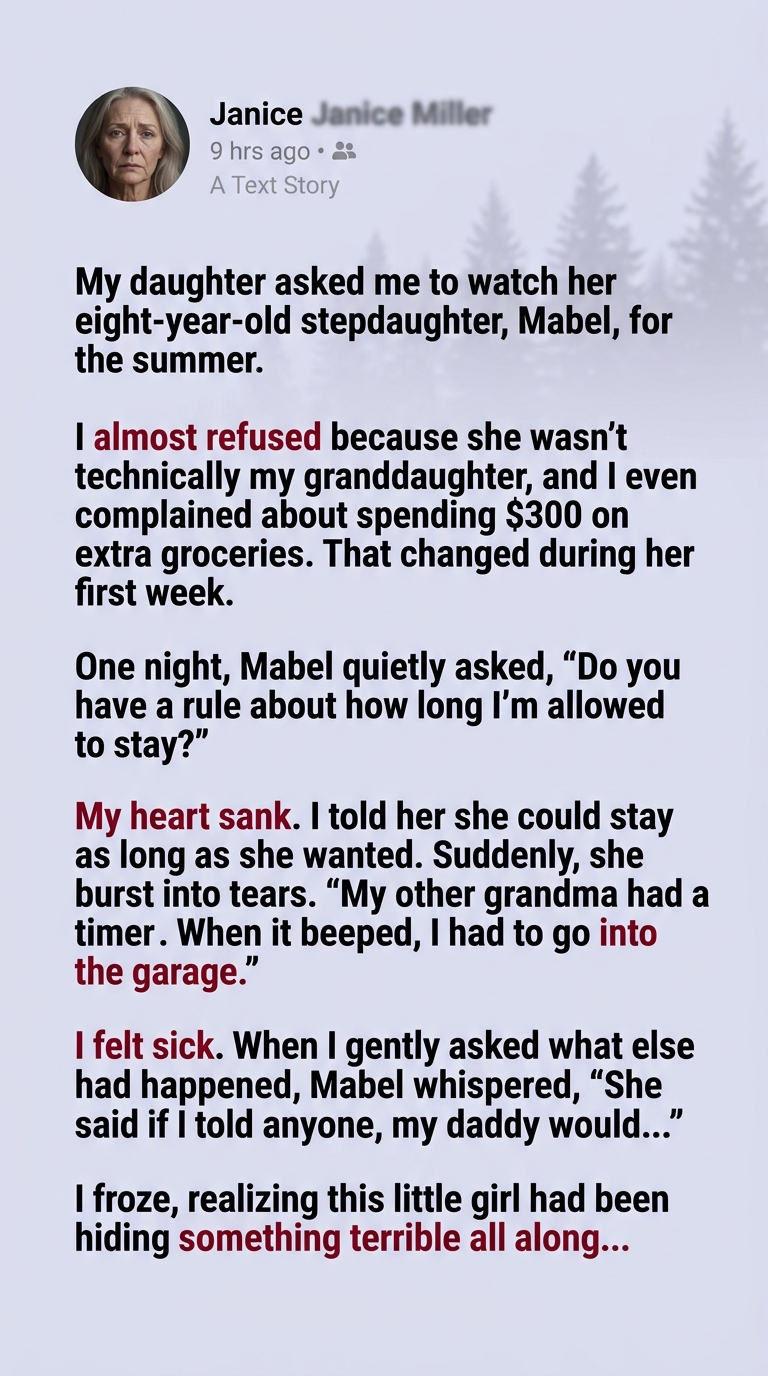
When my daughter asked me to watch her eight-year-old stepdaughter, Mabel, for the summer, my first reaction was to hesitate.
Mabel wasn’t technically my granddaughter.
She was my daughter’s husband’s child from his previous marriage, and although I had met her several times, we had never been especially close.
“Mom, it’s only for the summer,” my daughter, Claire, explained over the phone. “James has a work opportunity out of town, and I can’t take time off. I know it’s a big favor, but I wouldn’t ask if we had another option.”
I sighed.
“Have you thought about how much extra food an eight-year-old eats?”
Claire went quiet.
“I can give you money for groceries.”
“I don’t need money, Claire. I’m just saying it’s a lot of responsibility.”
She apologized, and I immediately felt guilty.
Still, when I looked at the shopping receipt a few days later, I couldn’t help complaining about the additional $300 I’d spent stocking the refrigerator with cereal, fruit, snacks, milk, and everything else Mabel liked.
I told myself I was being generous.
I didn’t realize how much that little girl needed someone to be generous with her heart.
Mabel arrived on a Saturday afternoon carrying a pink suitcase and a stuffed rabbit with one missing button eye.
She stood beside the front door while Claire unloaded her things.
“Grandma Helen,” she said softly.
I smiled.
“Hello, sweetheart.”
She looked at me carefully, almost as if she were checking whether I was happy to see her.
Then she stepped inside.
I thought she was simply shy.
I had no idea she was frightened.
The first few days went smoothly.
Mabel was polite, quiet, and unusually careful.
She never asked for seconds at dinner.
She didn’t touch anything in the refrigerator without permission.
She always asked before turning on the television, using the bathroom upstairs, or taking a cookie from the kitchen.
At first, I thought her parents had raised her with excellent manners.
But there was something uncomfortable about the way she behaved.
Whenever I offered her something, she asked whether it was allowed.
“Can I have another strawberry?”
“Can I sit here?”
“Can I leave my shoes by the door?”
One afternoon, I found her standing beside the washing machine holding a small towel.
“What are you doing, sweetheart?”
She jumped.
“I’m sorry.”
“Sorry for what?”
“I got some water on the bathroom floor. I was going to clean it.”
I looked at the towel.
“You don’t have to clean the bathroom, Mabel.”
She lowered her eyes.
“Okay.”
Then she added, almost inaudibly, “I don’t want to get in trouble.”
I knelt beside her.
“You won’t get in trouble for spilling a little water.”
She nodded, but she didn’t look convinced.
By the end of the first week, I had begun to notice a pattern.
Mabel seemed especially nervous in the evening.
She would watch the clock during dinner and become restless whenever the sun started setting.
One night, I was folding laundry in the living room when she appeared in the doorway.
“Grandma Helen?”
“Yes, sweetheart?”
She twisted the sleeve of her pajamas.
“Do you have a rule about how long I’m allowed to stay?”
I put down the towel.
“What do you mean?”
“Like… how many days?”
My heart tightened.
“You can stay all summer.”
She stared at me.
“Really?”
“Of course.”
“Even if I eat a lot?”
I felt a strange ache in my chest.
“Even if you eat all the cookies in the house.”
She didn’t laugh.
Instead, her lower lip began to tremble.
Then she burst into tears.
I rushed over and sat beside her.
“What’s wrong, sweetheart?”
She tried to speak, but the words came out between sobs.
“My other grandma had a timer.”
I gently brushed the hair away from her face.
“A timer?”
Mabel nodded.
“When it beeped, I had to go into the garage.”
For a moment, I couldn’t move.
“What happened when you went into the garage?”
She hugged her stuffed rabbit.
“She said I had to stay there until Daddy came to get me.”
I felt sick.
“Did you have a chair or somewhere comfortable to sit?”
Mabel shook her head.
“Sometimes I sat on the floor.”
I took a slow breath, trying to keep my voice gentle.
“Sweetheart, did someone tell you that you had to keep this a secret?”
She nodded.
Then she whispered something that made my blood run cold.
“She said if I told anyone, my daddy would…”
Her voice disappeared.
I waited.
“What would Daddy do, Mabel?”
She looked toward the hallway.
“He would stop loving me.”
I didn’t want to frighten her by reacting too strongly.
But inside, I was struggling to understand how an eight-year-old could have been made to believe that love was something she could lose for telling the truth.
I wrapped an arm around her.
“Listen to me. You are not responsible for grown-ups’ behavior. And you never have to keep a secret that makes you feel unsafe.”
She wiped her cheeks.
“But Grandma said I was bad.”
“Who told you that?”
“My other grandma.”
I knew she meant James’s mother, Patricia.
I had met Patricia at family gatherings. She was a proud, outspoken woman who often complained about how difficult children were these days.
I had never liked her much.
But I had never imagined anything like this.
I didn’t ask Mabel to explain everything that night.
I didn’t want her to feel interrogated.
Instead, I told her she could sleep in the spare bedroom, leave her rabbit beside her pillow, and come find me whenever she needed anything.
Before she went to bed, she asked one more question.
“Will you still want me here tomorrow?”
I kissed her forehead.
“Tomorrow, next week, and every day after that.”
She held on to my hand for several seconds before letting go.
That night, I barely slept.
The next morning, I called Claire.
I told her I needed to speak with her and James about something important.
When they arrived that afternoon, I made sure Mabel was comfortable in the living room with her favorite cartoon.
Then I explained what she had told me.
Claire’s face went pale.
James looked as though someone had punched him.
“My mother did what?” he asked.
I repeated Mabel’s words as carefully as I could.
James stood up and began pacing.
“No. That can’t be right. Mom watches Mabel sometimes, but she wouldn’t…”
He stopped.
Claire reached for his hand.
“James, we need to listen to what Mabel said.”
He rubbed his face.
“I thought she was just being difficult about visiting Mom. She started asking whether she had to go there, and I assumed it was because she wanted to stay with us.”
I looked at him.
“Did you know she was being sent into the garage?”
He shook his head.
“No. Never.”
His voice broke.
“She told me Mom was making her sit in a quiet place when she misbehaved. I thought she meant a time-out.”
I didn’t accuse him of deliberately ignoring the warning.
But I could see how easily an adult explanation had replaced a child’s fear.
Claire took a breath.
“We need to make sure Mabel is safe first.”
We agreed that Patricia would not be allowed to supervise Mabel or have unsupervised contact with her while the situation was being assessed.
James also agreed not to confront his mother in front of the child.
We needed to understand what had happened without making Mabel feel responsible for the adults’ reactions.
That evening, Claire contacted Mabel’s pediatrician and asked for guidance.
The pediatrician recommended speaking with a child therapist experienced in trauma and contacting the appropriate child-protection professionals.
James initially looked overwhelmed.
“Are we really going to involve authorities?” he asked.
I answered quietly.
“If Mabel has been frightened and isolated, we can’t simply hope it stops. She needs adults who know how to help.”
He nodded.
The following day, Claire and James arranged a consultation with a child advocacy professional.
Mabel was given the opportunity to speak privately with a trained interviewer in an age-appropriate setting.
No one demanded that she repeat her story to the entire family.
No one asked leading questions.
And no one told her what she was supposed to say.
Over time, she described what had happened during visits to Patricia’s home.
The timer had been placed on a shelf in the kitchen.
When it beeped, Mabel was sent into the garage for extended periods as punishment.
Sometimes she was told to sit on an old storage box.
Other times, she was made to sit on the floor.
She said Patricia had called her ungrateful and told her that her father would eventually get tired of her.
The most frightening part was that Patricia had made Mabel believe she was responsible for keeping her father happy.
“If I told him,” Mabel explained, “Grandma said he would choose her instead of me.”
The professionals documented her account and assessed whether there were other safety concerns.
James was devastated.
He kept repeating that he should have known.
But the therapist gently explained that the responsibility belonged to the adult who had frightened Mabel—not to the child, and not to a father who had been given incomplete information.
That didn’t erase his guilt.
It did give him a place to start.
A few days later, Patricia called.
James answered on speakerphone.
“What is this nonsense I’m hearing?” she demanded. “Why have you suddenly decided I can’t see my own granddaughter?”
James closed his eyes.
“Mom, Mabel told us what happened in the garage.”
There was a pause.
Then Patricia laughed.
“Oh, that? She was being punished. Children need discipline.”
“Did you make her sit in the garage when the timer went off?”
“She was perfectly safe.”
“She was eight years old.”
“And she was being difficult!”
James’s voice became firmer.
“She was a child. You made her believe I would stop loving her if she told me what you were doing.”
Patricia went silent.
Then she said, “I never said that.”
Mabel had described the threat clearly, and the professionals were assessing her account.
But Patricia continued to deny wrongdoing.
“You’re letting that child manipulate you,” she snapped. “If you keep this up, don’t expect me to help you again.”
James looked at Claire.
Then he answered.
“I’m not asking you to help me. I’m protecting my daughter.”
He ended the call.
For the first time since I had known him, I saw him stop trying to make his mother happy at the expense of someone else.
The investigation continued.
Professionals reviewed the available information and spoke with the adults involved.
They also assessed whether the garage had presented additional safety risks and whether Mabel had experienced similar treatment elsewhere.
The findings supported concerns about inappropriate and emotionally harmful punishment.
The family was advised to maintain clear boundaries and follow the child-protection plan.
Patricia was not permitted unsupervised contact with Mabel.
James struggled with the decision, especially when relatives accused him of being cruel to his mother.
But whenever he felt uncertain, he remembered Mabel’s question:
Will you still want me here tomorrow?
That was enough.
Meanwhile, Mabel began to change.
At first, the changes were small.
She started asking for snacks without apologizing.
She left her toys on the living-room floor.
She laughed more often.
One afternoon, I found her sitting at the kitchen table drawing a picture.
It showed a house with a bright yellow sun, a garden, and three people holding hands.
“Who’s that?” I asked.
“That’s me, Daddy, and Claire.”
“And who’s the little person beside the tree?”
She smiled.
“That’s you.”
I looked at the picture.
“Why am I standing so close to the house?”
She shrugged.
“Because you said I can stay.”
I had to turn away for a moment.
As the summer continued, I stopped thinking about the extra groceries.
The $300 I had complained about at the beginning suddenly seemed like the smallest thing in the world.
Mabel loved pancakes, so we made them every Sunday.
She liked strawberries cut into little hearts.
She wanted me to read the same bedtime story over and over.
And sometimes, when she woke from a bad dream, she came quietly into my room and asked if she could sit beside me.
I never made her feel guilty for needing comfort.
One evening, she was helping me put groceries away when she looked into the refrigerator.
“Grandma Helen?”
“Yes?”
“Can I have yogurt tomorrow?”
I smiled.
“You can have yogurt today.”
She hesitated.
“Even if I already had one?”
“Even then.”
She considered that.
Then she asked, “Do you have enough for me?”
I closed the refrigerator and knelt in front of her.
“Mabel, there will always be enough room for you at my table.”
She hugged me.
And I understood that what she needed most wasn’t another adult telling her how lucky she was.
She needed to know she wasn’t a burden.
When the summer ended, Mabel didn’t want to leave.
But she wasn’t being sent away.
Claire and James had arranged their work schedules so she could remain with them, and I would continue seeing her regularly.
On her last night at my house, Mabel climbed into my lap with her stuffed rabbit.
“Grandma Helen?”
“Yes, sweetheart?”
“Do you remember when I asked about your timer?”
“I do.”
She looked down at the rabbit.
“I don’t think about that one as much now.”
I held her close.
“I’m glad.”
Then she smiled.
“Can we make pancakes next Sunday?”
“Absolutely.”
She went quiet for a moment.
Then she asked, “Can I call you Grandma, even though we’re not related?”
My eyes filled with tears.
I kissed the top of her head.
“You don’t have to share my blood to be my granddaughter.”
She smiled and rested her head against my chest.
And in that moment, I finally understood something I should have known from the beginning.
Family isn’t measured by whose name appears on a birth certificate.
It’s measured by who makes a child feel safe, wanted, and loved.
I had nearly refused to care for Mabel because she wasn’t technically my granddaughter.
But that little girl had taught me that the word granddaughter was never about biology.
It was about showing up.
And I would show up for her for as long as she needed me.