My Husband Called Me a Military Fraud in Court. Then a Major General Walked In Carrying a Blood-Red Envelope.
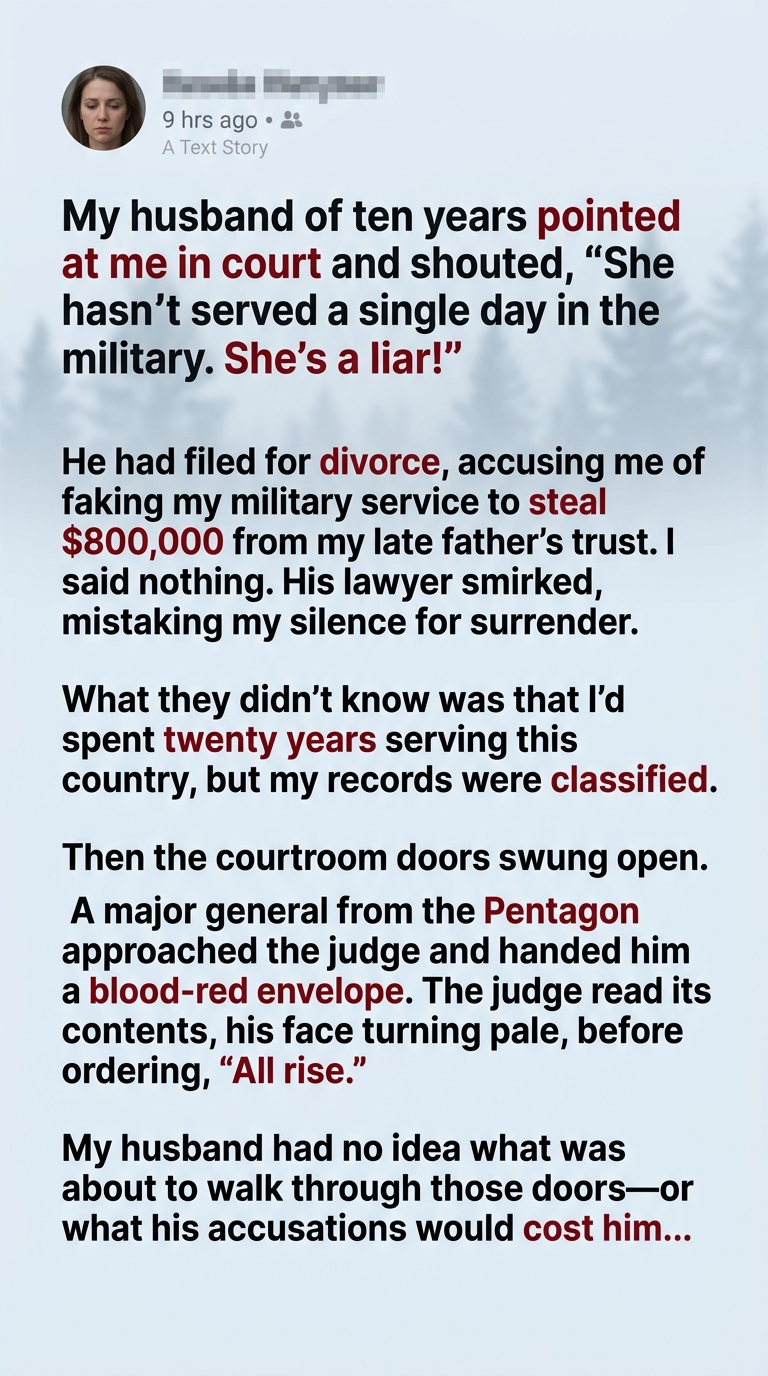
“She hasn’t served a single day in the military. She’s a liar!”
My husband, Richard, pointed at me from across the courtroom.
His voice echoed through the room.
He had spent ten years calling me his wife. Now, in front of a judge, two attorneys, and a gallery full of strangers, he was accusing me of inventing an entire military career to steal $800,000 from my late father’s trust.
His lawyer smiled.
Richard looked pleased with himself.
I said nothing.
Not because I was afraid.
Not because I had no evidence.
But because the truth was protected by obligations I had honored for twenty years, and I wasn’t going to break them just because my husband wanted to humiliate me.
Richard mistook my silence for surrender.
He had no idea what was coming.
I met Richard when I was thirty-two.
At the time, I had already spent several years in military service. My work involved assignments that required confidentiality, strict security procedures, and long periods away from home.
I rarely discussed my work.
I never brought home documents.
I didn’t share operational details, names, locations, or anything that could compromise the people I served with.
Richard knew I was in the military.
He knew I sometimes disappeared for months.
He knew I had received commendations.
But he never asked many questions.
At first, I thought that was respect.
After we married, he began complaining about my absences.
“You’re married now,” he would say. “You can’t keep putting your job before your family.”
I explained that my commitments were not something I could simply abandon.
He eventually stopped asking.
Then my father died.
He had been a successful businessman who left a substantial estate, including an $800,000 trust established in my name.
The trust was administered independently, with its own conditions and financial reporting requirements.
Richard became interested immediately.
“Eight hundred thousand dollars,” he said one evening. “That’s enough to change our lives.”
“It isn’t a joint account,” I reminded him.
He frowned.
“We’re married.”
“It’s still my father’s trust.”
He didn’t argue that night.
But I noticed something change.
He began asking about the trust’s terms.
He wanted to know when distributions would be made.
He asked whether I could use the money to buy a larger house.
I told him I would discuss financial decisions with the trustee and my attorney.
He didn’t like that answer.
The marriage deteriorated over the following year.
Richard accused me of being secretive.
He said I was emotionally unavailable.
He complained that I never talked about my work.
I reminded him that confidentiality was part of my service.
He called it an excuse.
Eventually, he filed for divorce.
At first, I thought he wanted to end the marriage quietly.
Then his lawyer submitted a claim alleging that I had fabricated my military service to obtain financial benefits and conceal the true source of the trust money.
The claim was absurd.
My military career had nothing to do with my father’s estate.
But Richard had attached statements from people who claimed they had never seen me in uniform.
He also submitted photographs from our social life, pointing out that I rarely wore military clothing.
His attorney argued that my claimed service should be treated as evidence of dishonesty and that my father’s trust deserved closer examination.
The accusations were designed to make me look like a fraud before anyone examined the actual records.
I instructed my lawyer to challenge the claims through proper channels.
But there was a complication.
Much of my service history was classified.
My attorney could not simply request every file and present it in open court.
The military had to determine what could be disclosed, what required restricted handling, and how to verify my service without compromising protected information.
That process took time.
Richard knew that.
And he used the delay to his advantage.
The first hearing was held on a Thursday morning.
Richard arrived wearing a dark suit and carrying a thick folder.
His lawyer, Mr. Collins, stood beside him.
My attorney, Helen, had warned me that Richard would try to provoke me.
“Don’t argue with him,” she said. “Let the evidence speak.”
I nodded.
When the hearing began, Collins stood.
“Your Honor, my client maintains that the respondent has repeatedly misrepresented her professional history. She claims twenty years of military service, yet she has produced no publicly verifiable record sufficient to support that claim.”
Helen objected.
“The respondent has requested verification through the appropriate military authority. The absence of publicly accessible information is not evidence that the service did not occur.”
Collins smiled.
“Then perhaps she can tell us where she served.”
Helen stood again.
“My client cannot disclose protected operational information in open court.”
Richard laughed.
Then he pointed at me.
“She hasn’t served a single day in the military. She’s a liar!”
The judge looked at him.
“Mr. Richard, address the court through your attorney.”
But Richard wasn’t finished.
“She made up this whole story. She wants the trust money, and now she’s hiding behind classified records!”
I remained seated.
Collins looked toward me with a smug expression.
He thought my silence meant I had been caught.
Then the courtroom doors opened.
Everyone turned.
A senior officer entered, accompanied by two uniformed personnel.
The insignia on his uniform identified him as a major general.
He carried a sealed blood-red envelope.
The room became completely still.
He approached the clerk and presented his credentials.
Then he asked to speak with the judge.
The judge examined the credentials, nodded, and accepted the envelope.
He opened it carefully.
His expression changed as he read.
He looked up.
Then he addressed the room.
“All rise.”
Richard’s smile disappeared.
The major general introduced himself as General Thomas Whitaker.
He explained that he was appearing as the designated representative of the military authority responsible for verifying my service record.
He did not reveal classified details.
Instead, he presented a formal certification confirming that I had completed twenty years of honorable military service.
The document also confirmed that I had held positions requiring restricted access and that portions of my service history could not be disclosed in ordinary civil proceedings.
The judge reviewed the certification.
Then he asked General Whitaker whether the military could provide further verification through a restricted process.
“Yes, Your Honor,” the general replied. “The appropriate records are available for judicial review under the required security procedures. We can confirm her service dates, status, and eligibility for the commendations listed in the submitted certification without disclosing protected operational information.”
Richard looked at Collins.
Collins stopped smiling.
The judge turned toward my husband’s attorney.
“Mr. Collins, do you still maintain that this woman has never served?”
Collins stood slowly.
“Your Honor, we would like an opportunity to examine the document.”
“You will have that opportunity through the appropriate procedure.”
The judge then looked at Richard.
“Mr. Richard, you made a serious allegation in this courtroom. Do you have any evidence that this certification is false?”
Richard opened his mouth.
Nothing came out.
For the first time that morning, he looked uncertain.
But the general wasn’t finished.
He asked the judge for permission to submit a second document.
The judge accepted it.
It was a letter from the military records authority explaining that my service had been verified through official personnel records and that the restricted portions were being handled separately.
It also confirmed that I had received a number of formal commendations.
One of them was particularly significant.
The general looked toward me.
“Your Honor, the respondent’s service included a period of extraordinary duty during which she was recognized for protecting members of her unit and completing an assignment under dangerous conditions.”
He paused.
“I am not authorized to discuss the operational details in this courtroom. However, I can confirm that the commendation was formally approved and remains part of her official record.”
Richard stared at me.
I didn’t look away.
For years, I had kept those experiences private.
Not because they were shameful.
Because the people who served beside me deserved their privacy, and because some things were never meant to become dinner-table stories.
The judge thanked the general.
Then he asked for a brief recess so the parties could review the new material.
As everyone stood, Richard approached me.
“You arranged this,” he whispered.
I looked at him.
“No. I served.”
He shook his head.
“You could have told me.”
“I did tell you I was in the military.”
“You never told me any of this.”
“I wasn’t allowed to.”
He looked furious.
Then he said something that made me realize the military accusations were only part of his plan.
“Fine. You can prove you were in the military. That doesn’t mean you deserve the trust money.”
I studied his face.
There it was.
The real issue.
The $800,000.
During the recess, Helen showed me a document Richard’s lawyer had submitted.
It was a request for financial disclosure relating to the trust.
At first glance, it appeared ordinary.
But one attachment caught my attention.
It was a copy of a letter supposedly written by my father’s former attorney.
The letter claimed that my father had intended the trust to become marital property if I ever divorced.
I had never seen it before.
Neither had the trustee.
Helen looked at me.
“Do you recognize this?”
“No.”
She examined the signature.
“Your father’s attorney died three years ago.”
I read the letter again.
The wording was strange.
My father had always been precise with legal documents. This letter was vague, emotional, and inconsistent with the actual trust agreement.
“Could it be forged?” I asked.
“We don’t know yet. But we should investigate.”
She turned to the judge’s clerk and requested that the document be preserved as evidence.
Then she called the trust administrator.
The administrator confirmed that the original trust instrument contained no provision converting the inheritance into marital property.
It also confirmed that no amendment had ever been executed.
Richard’s claim was becoming weaker.
But Helen had another concern.
She pointed to a series of bank transfers included in the financial disclosure.
“Do you recognize these?”
I studied the statements.
Several transfers had been made from our joint household account into an account I didn’t recognize.
The amounts were small at first.
Then they became larger.
I looked at the dates.
Some had occurred while I was away on assignment.
“Who owns this account?”
Helen checked the account details.
“It’s associated with a consulting company.”
I recognized the name.
It belonged to Richard’s business partner.
I felt my stomach tighten.
“Why would our money be going there?”
Helen didn’t answer immediately.
“We need to trace it.”
The hearing resumed.
Richard’s lawyer requested more time to review the military certification.
The judge granted a limited extension.
But the judge also ordered that the disputed trust letter be preserved and independently authenticated.
He warned Richard that making allegations without reliable evidence could have consequences.
Richard looked toward me.
His expression was no longer smug.
It was angry.
The major general stood before leaving.
He approached my table and spoke quietly.
“Your service record has been verified. The military will provide any additional authorized confirmation required by the court.”
“Thank you, sir.”
He nodded.
Then he added something only I could hear.
“You served with distinction. Don’t let anyone make you feel you need to apologize for keeping your obligations.”
I swallowed.
“Understood.”
He left.
The courtroom doors closed behind him.
And suddenly, the man who had spent ten years pretending to respect me seemed like a stranger.
The following weeks revealed the real purpose behind Richard’s accusations.
The forensic accountant traced more than $240,000 in transfers from our joint account to the consulting company.
Some payments were described as business expenses.
Others had no supporting invoices.
The company was owned by Richard’s close associate, who had been involved in several projects with him.
The accountant also found that Richard had attempted to obtain information about the trust from the administrator without my authorization.
He had requested distribution dates, account details, and copies of internal statements.
The administrator had refused.
Then Richard had submitted the suspicious letter claiming my father intended the trust to become marital property.
The document examiner found that the signature on the letter did not match verified examples of the deceased attorney’s signature.
The paper and printing details also raised questions.
The letter was referred for further investigation.
My attorney informed the court that the disputed document appeared to be inauthentic and requested that Richard’s financial conduct be examined separately from the divorce claims.
The judge agreed.
Richard’s original accusation against me had now become a much larger problem for him.
One evening, Helen called.
“We have a development.”
“What happened?”
“The consulting company has provided its records.”
I sat down.
“And?”
“The transfers were not all business expenses. Some were used to pay Richard’s personal obligations.”
I closed my eyes.
“How much?”
“We’re still reconciling the records. But the amount is substantial.”
I felt numb.
For years, Richard had accused me of hiding things.
He had called me secretive.
He had suggested that my military career was a lie.
Meanwhile, he had been moving money out of our household accounts and trying to gain access to an inheritance that belonged to me.
The military accusation had not been about truth.
It had been about credibility.
If he could convince the court I was a liar, perhaps the judge would doubt everything I said about the trust.
And perhaps the court would take his forged letter more seriously.
He had tried to destroy my reputation before the financial evidence could be examined.
At the next hearing, Richard’s attorney withdrew the allegation that I had fabricated my military service.
The court accepted the official certification.
The judge also ruled that the military records would be reviewed through the appropriate restricted process, protecting classified information while allowing the court to verify the relevant facts.
Richard’s claim against my father’s trust was dismissed after the original trust instrument and administrator’s records established that the trust was separate property under the governing documents and applicable law.
The suspicious letter was referred for further investigation.
The financial claims remained under review.
Richard was ordered to provide a full accounting of the disputed transfers.
He looked toward me as the judge finished speaking.
“You destroyed my life,” he muttered.
I gathered my papers.
“No, Richard. I stopped protecting your lies.”
The divorce took several more months.
The financial review established the amounts transferred without proper authorization.
The court considered those findings as part of the property and financial proceedings, and a settlement addressed the disputed funds.
The trust remained under my control.
The investigation into the fabricated letter continued separately.
Richard eventually admitted that he had known the letter was not genuine, although the full circumstances of its creation remained subject to the appropriate legal process.
His attorney withdrew from the case.
And the man who had pointed at me in court and called me a liar was no longer able to pretend that his accusations were supported by evidence.
On the day the divorce was finalized, I wore a simple navy suit.
I didn’t wear my medals.
I didn’t need to.
The judge confirmed the final orders and reminded both parties that the proceedings were concluded.
Outside the courthouse, I stood for a moment in the sunlight.
Helen approached.
“You did well.”
I smiled.
“I just wanted the truth established.”
She nodded.
Then she asked whether I planned to return to military work.
I looked toward the road.
“No. My twenty years are complete. I think it’s time to build a quieter life.”
I had spent two decades serving my country.
I had missed birthdays, family gatherings, and ordinary mornings.
I had carried memories I would never share publicly.
And I had come home believing I could build a peaceful marriage.
That marriage was over.
But I was not broken.
Several months later, I received a letter from General Whitaker.
It was brief.
He thanked me for my service and confirmed that my final service record had been properly archived.
At the bottom, he had written:
Some of the most important service is the kind the public never sees. Your record speaks for itself.
I placed the letter beside my father’s photograph.
Then I opened the drawer where I kept my old service insignia.
For years, I had avoided looking at them.
Not because I regretted my service.
Because I had learned to keep that part of my life separate from everything else.
Now I looked at them with a different feeling.
Pride.
Not the kind that needs applause.
The kind that comes from knowing you did your duty even when nobody was watching.
Richard had stood in court and called me a liar because he believed silence meant weakness.
He thought a classified record was an empty record.
He thought a woman who refused to reveal everything must have something to hide.
But the truth was never mine to shout.
It was mine to protect.
And when the right people finally brought it into the light, I didn’t need to say another word.
Twenty years of service cannot be erased by a man who spent ten years failing to understand the woman he married.