My Mother-in-Law Said Pregnancy Wasn’t a Sickness. The Next Morning, My Husband’s Family Showed Up at Our Door.
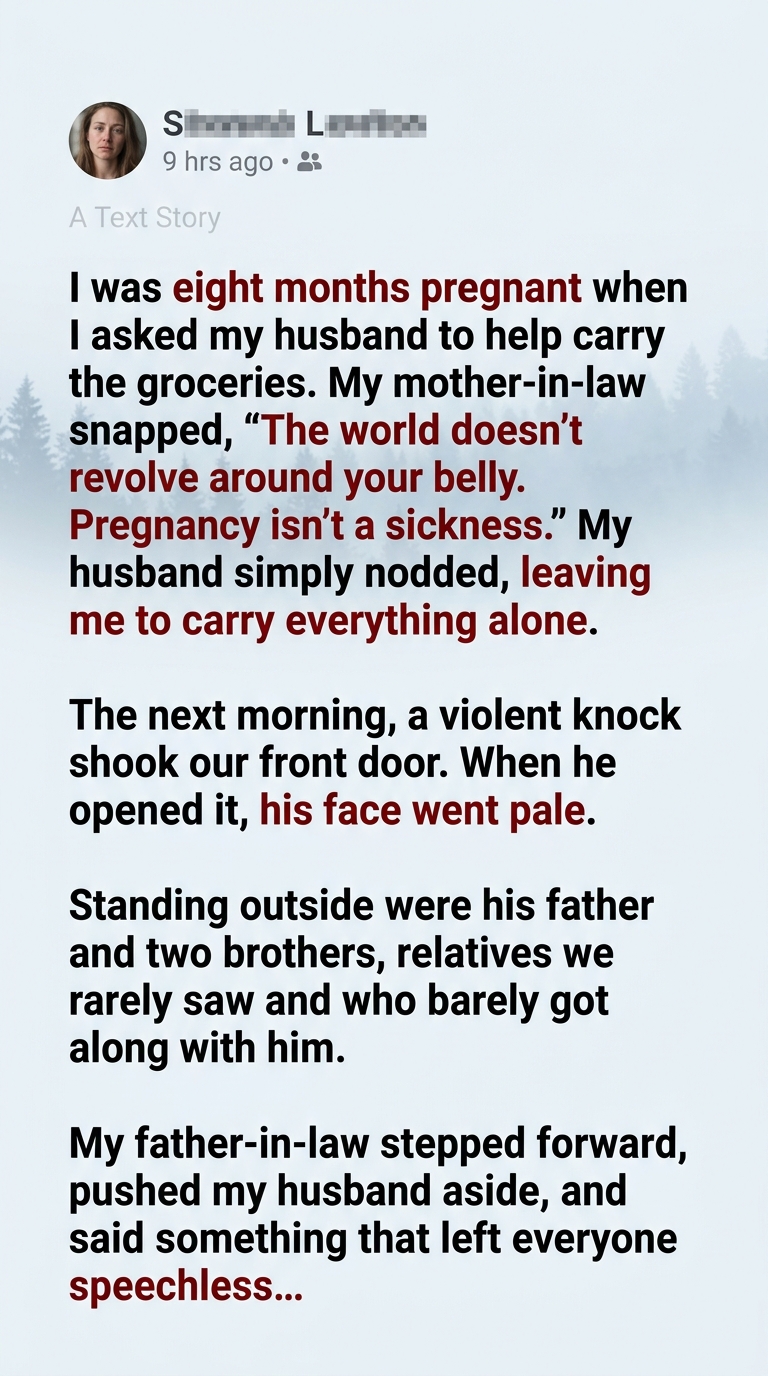
I was eight months pregnant when I asked my husband to help me carry the groceries.
It wasn’t a big request.
I had just returned from the supermarket with six heavy bags. My ankles were swollen, my lower back hurt, and the baby had been pressing against my ribs all afternoon.
I placed the bags near the kitchen counter and looked at my husband, Daniel.
“Could you help me bring the rest inside, please?”
Before he could answer, his mother, Margaret, spoke from the dining table.
“The world doesn’t revolve around your belly. Pregnancy isn’t a sickness.”
I turned toward her.
“I know it’s not. I’m just asking for help.”
She made a dismissive sound.
“Women have been having babies for thousands of years. We didn’t need everyone waiting on us.”
Daniel glanced at his mother.
Then he nodded.
“Mom’s right. You’re pregnant, not helpless.”
I stared at him.
He didn’t move.
So I carried the remaining bags myself.
One of them was particularly heavy, and I had to stop halfway through the hallway to catch my breath. My back tightened, and I felt a sharp pull across my abdomen.
I set the bag down.
Margaret looked at me.
“See? This is what happens when you make everything into a big performance.”
I didn’t answer.
I went upstairs, changed into comfortable clothes, and sat on the edge of the bed with my hands resting on my stomach.
My daughter kicked gently.
“It’s okay, sweetheart,” I whispered. “We’re going to be all right.”
But I wasn’t sure we were.
Daniel and I had been married for four years.
When we first met, he was thoughtful and affectionate. He used to bring me dinner when I worked late and call to make sure I had arrived home safely.
His mother, however, had always been difficult.
She believed a daughter-in-law should be available whenever the family needed something. She criticized my cooking, my clothes, and the way I managed our home.
Daniel usually told me to ignore her.
“She doesn’t mean anything by it,” he would say.
But over time, he stopped defending me.
When I became pregnant, I hoped things might change.
Instead, Margaret became more demanding.
She criticized the food I ate, questioned my doctor’s advice, and insisted I should continue doing everything I had done before.
When I asked Daniel to accompany me to an appointment, he said he had work.
When I asked him to help prepare the nursery, he said there was plenty of time.
When I told him I was struggling to sleep because of the discomfort, he suggested I stop complaining.
I began to feel as though I was carrying the pregnancy and the marriage by myself.
That evening, after the grocery incident, I went to bed early.
Daniel stayed downstairs with his mother.
I could hear them laughing at something on television.
I cried quietly into my pillow.
The next morning, I woke to a violent knock at the front door.
It was so loud that I sat upright in bed.
Another knock followed.
Then a man’s voice called out.
“Daniel! Open this door!”
My husband came rushing upstairs from the kitchen.
“Who is that?”
He looked through the window beside the door.
His face went pale.
Standing outside were his father, Arthur, and his two brothers, Michael and Peter.
I was surprised.
Daniel rarely saw them.
His parents had been separated for years, and the relationship between Daniel and his father was strained. His brothers also lived in different towns, and family gatherings were rare.
Arthur knocked again.
Daniel opened the door.
His father stepped forward, pushed past him, and said:
“Move aside, son. We need to talk about what you’ve been doing to your wife.”
Daniel froze.
Margaret appeared in the hallway.
“Arthur? What are you doing here?”
Arthur turned toward her.
“I came because I heard what happened yesterday.”
Daniel looked confused.
“Who told you?”
Michael stepped inside.
“Someone who was tired of watching you treat your pregnant wife like a servant.”
Peter looked toward the stairs.
“Where is she?”
I slowly walked down, holding the railing.
Arthur saw me and his expression softened.
“Good morning, sweetheart. How are you feeling?”
I tried to smile.
“I’m okay.”
He looked at my swollen feet, then at the grocery bags still sitting near the kitchen.
His jaw tightened.
“Did you carry all of those yourself?”
I nodded.
“Daniel was busy.”
Arthur turned toward his son.
“Busy doing what?”
Daniel looked irritated.
“Dad, this is none of your business.”
Arthur took a breath.
“Your wife is eight months pregnant. She asked you to help carry groceries, and you stood there while your mother insulted her?”
Margaret crossed her arms.
“She doesn’t need everyone treating her like she’s made of glass.”
Arthur turned toward her.
“Pregnancy isn’t a sickness, Margaret. But that doesn’t mean a pregnant woman should be treated like a pack animal.”
Michael let out a quiet laugh.
Peter shook his head.
Daniel’s face reddened.
“Why are you all here? Who told you this?”
Arthur pulled a folded sheet of paper from his jacket.
“Your brother did.”
Daniel looked at Peter.
Peter stepped forward.
“I came by yesterday afternoon to drop off the toolbox you borrowed. I heard Mom talking to you about the groceries. I saw your wife struggling with the bags, and I heard what you said.”
Daniel stared at him.
“You were spying on us?”
“No. I was standing in the kitchen. You were shouting loudly enough for the neighbors to hear.”
Arthur continued.
“But that’s not the only reason we’re here.”
He placed the paper on the table.
It was a copy of a message Daniel had sent to his brothers several days earlier.
I recognized the words immediately.
Daniel had written:
Once the baby arrives, she’ll have plenty to do. Mom can stay with us and help. Claire will take care of the cooking and cleaning while Mom handles the baby. It should work out perfectly.
I looked at my husband.
He had planned this without discussing it with me.
Arthur looked at Daniel.
“Did you ask your wife whether she wanted your mother moving in after the baby arrives?”
Daniel said nothing.
Margaret stepped forward.
“I was only trying to help. Someone needs to teach Claire how to be a proper mother.”
I felt my stomach tighten.
Arthur’s voice became firm.
“Your daughter-in-law doesn’t need to be taught how to be a mother by someone who can’t show her basic kindness.”
Margaret’s face turned red.
“How dare you speak to me like that?”
Arthur ignored her.
He looked at Daniel.
“Your wife is carrying your child. She should not have to beg you for help. And you certainly don’t get to arrange her life as though she has no say in it.”
Daniel shook his head.
“You don’t understand. Mom needs somewhere to stay. Her apartment is being renovated.”
Arthur looked at Margaret.
“Her apartment renovation finished three weeks ago. I know because I paid the final contractor’s bill.”
Margaret went silent.
I looked between them.
“I’m sorry. What?”
Arthur sighed.
“Margaret has been telling Daniel she needs to move in permanently. She asked him to arrange it without discussing it with you.”
Daniel looked uncomfortable.
“It’s temporary.”
Arthur shook his head.
“That’s not what you told your brothers.”
He turned to me.
“I want you to know that nobody has the right to decide who lives in your home without your agreement. Not me. Not Daniel. Not Margaret.”
I felt tears gathering in my eyes.
For months, I had been asking for small things.
Help with groceries.
A ride to an appointment.
Someone to listen when I was frightened.
And now my father-in-law, a man I barely saw, was standing in my kitchen defending my right to be treated with respect.
But Arthur wasn’t finished.
He reached into his jacket again and removed another document.
“There’s something else Daniel needs to explain.”
Daniel’s expression changed.
“Dad, don’t.”
Arthur placed the document beside the first.
It was a bank statement and a copy of a transfer request.
I recognized the account number.
It was our joint household savings account.
“What is this?” I asked.
Arthur looked at me.
“Your husband contacted me last week asking for money. He said he needed help covering some household expenses before the baby arrived.”
Daniel interrupted.
“I was going to pay it back.”
Arthur continued.
“But when I reviewed the details, I noticed that money had already been transferred from your joint savings into an account I didn’t recognize. Daniel asked me to help replace it before you noticed.”
I looked at Daniel.
“How much?”
He didn’t answer.
“How much, Daniel?”
Finally, he muttered, “Eight thousand dollars.”
My heart sank.
“That was our emergency savings.”
“I was going to put it back.”
“Where did it go?”
Daniel looked at his mother.
Margaret stared at the floor.
Arthur answered.
“Some of it went toward your mother’s expenses. The rest went toward debts your wife doesn’t know about.”
I felt dizzy.
Daniel reached for my arm.
“Claire, please. Let me explain.”
I stepped back.
“You used our savings without telling me?”
“I was going to replace it.”
“When?”
He looked down.
Arthur turned toward his son.
“That’s enough. You don’t get to keep hiding things and expecting your wife to absorb the consequences.”
Margaret suddenly spoke.
“I asked him for help. I didn’t know he was taking money from their savings.”
I looked at her.
“You asked him to use our money?”
She didn’t answer.
The room fell silent.
For the first time, Daniel seemed to understand that the problem was no longer about groceries or his mother’s comments.
It was about trust.
Arthur placed a hand on the table.
“Here’s what happens now. Daniel, you and Claire are going to sit down with an independent financial adviser. The money needs to be accounted for. You will not transfer anything else without her agreement.”
He looked at me.
“And sweetheart, you don’t have to decide anything today. You need to look after yourself and the baby.”
I nodded.
My eyes were full of tears.
“Thank you.”
Michael stepped closer.
“Claire, if you need anything, call us. You shouldn’t have to handle everything alone.”
Peter nodded.
“Even if it’s just someone to drive you to an appointment.”
I hadn’t expected kindness from the people Daniel rarely spoke to.
But I accepted it.
That afternoon, Arthur and his sons left.
Margaret went upstairs and stayed in her room.
Daniel tried to talk to me several times, but I told him I needed space.
Later, I called my doctor and explained the discomfort I had experienced while carrying the groceries. The doctor advised me to come in for an assessment. Fortunately, the examination was reassuring, although I was told to avoid heavy lifting and seek immediate care if certain warning symptoms developed.
That night, I slept in the guest room.
The next morning, Daniel came downstairs holding two cups of tea.
He placed one in front of me.
“I’m sorry,” he said.
I looked at him.
“For what?”
“For yesterday. For the money. For letting Mom treat you that way.”
I waited.
He continued.
“I thought I was keeping everyone happy. I didn’t realize how much I was hurting you.”
I looked at him for a long moment.
“You didn’t realize because you never asked.”
He nodded.
“I know.”
“Daniel, I’m about to become a mother. I need a husband who acts like a partner, not another person I have to look after.”
He sat down.
“I want to be that person.”
“Then show me.”
We agreed to meet with a counselor before our daughter arrived. We also arranged for an independent financial review so that the missing savings could be accounted for and repaid.
Margaret was told that she would not be moving into our home.
Daniel had to communicate that decision himself.
He was uncomfortable, but he finally did it.
A few weeks later, he also began taking responsibility for household tasks. He came to my medical appointments, prepared meals, and handled the shopping.
I didn’t suddenly forget what had happened.
Trust takes longer to rebuild than it takes to damage.
But I saw him making an effort.
When our daughter, Lily, was born, Daniel held her with tears running down his face.
He looked at me.
“Thank you,” he whispered.
I smiled weakly.
“She has your nose.”
He laughed through his tears.
Arthur and his sons visited a few days later, bringing flowers and a small knitted blanket.
Arthur stood beside the hospital bed and looked at his granddaughter.
“She has a strong family,” he said.
I glanced at Daniel.
“I hope she does.”
He understood what I meant.
Over the following months, Daniel continued working on our marriage. He kept his promise to repay the money, and we established clear boundaries around family visits and finances.
Margaret eventually apologized for her comments, although our relationship remained distant.
I didn’t force closeness.
I had learned that being family did not mean accepting every behavior.
Sometimes love meant helping someone.
Sometimes it meant saying no.
And sometimes, the people who surprise you most are the ones you barely expected to stand beside you.
I had asked my husband for help carrying groceries.
What I really needed was for him to understand that I wasn’t supposed to carry the whole marriage alone.
That morning, his father said something I would never forget:
“Your wife isn’t asking you to treat her like she’s helpless. She’s asking you to stop leaving her helpless.”
And for the first time, Daniel finally listened.