The One Thing I Did in the Delivery Room
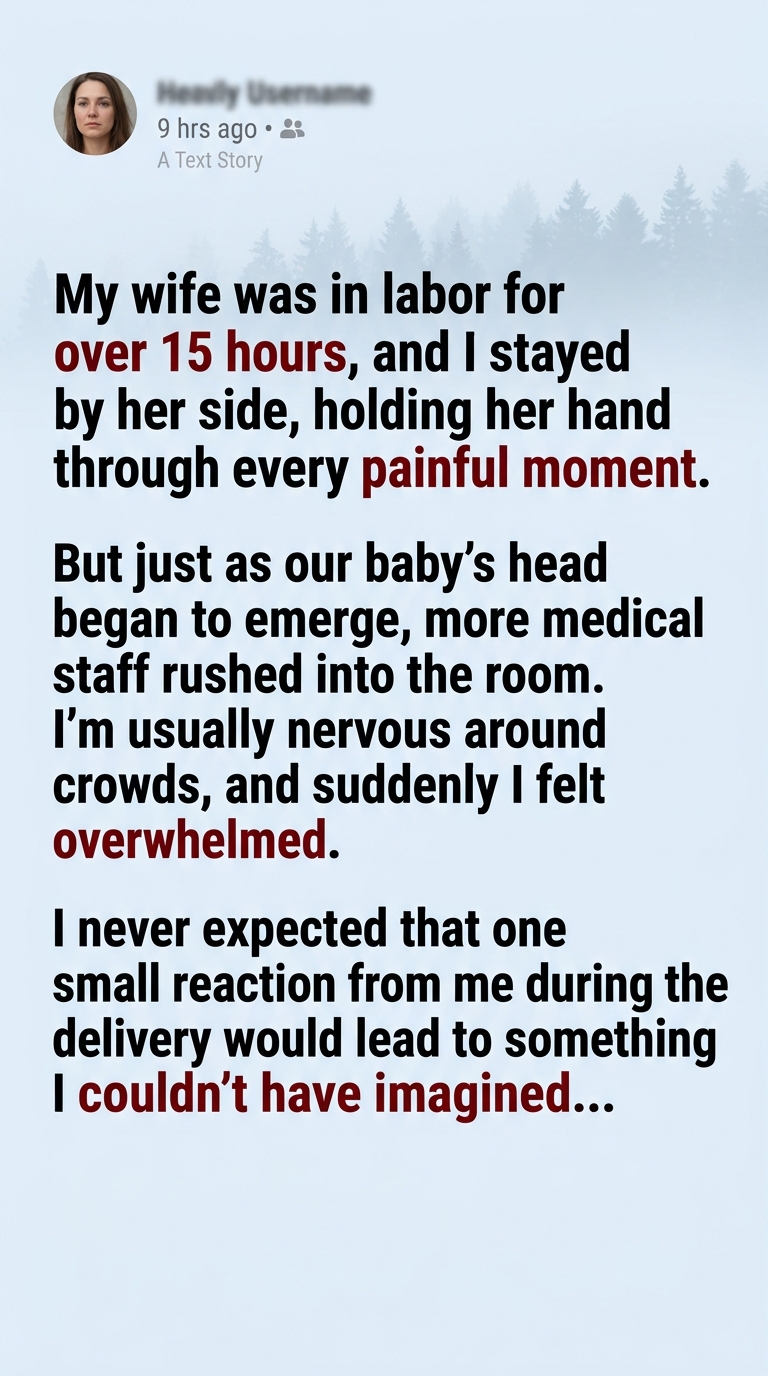
My wife had been in labor for more than fifteen hours.
I had held her hand through every contraction, wiped the sweat from her forehead, and whispered that she was doing amazingly, even when I was terrified myself.
Her name was Sophie.
We had been married for six years, and for almost all of that time, we had dreamed about becoming parents.
Now, our daughter was finally coming.
But just as the doctor told Sophie that the baby’s head was beginning to emerge, the delivery room suddenly filled with people.
A nurse hurried toward the equipment.
Another doctor entered.
Someone pulled a curtain around the bed.
Then I heard a monitor alarm.
“What’s happening?” I asked.
Nobody answered immediately.
I looked at Sophie.
Her face was pale, and she was gripping my hand so tightly that my fingers hurt.
“Daniel,” she whispered. “What’s wrong?”
“Nothing, sweetheart. They’re just checking everything.”
But I didn’t believe my own words.
I’m not good with crowds. Even a busy restaurant can make me uncomfortable. I become overwhelmed when several people talk at once, especially when I don’t understand what’s happening.
And suddenly, there were six medical professionals moving around the room.
The beeping became louder.
Someone asked for a medication.
Another person called out a number.
I felt my chest tighten.
My vision narrowed.
I tried to breathe, but it felt as if the air had disappeared.
Then I did something I never imagined I would do.
I let go of Sophie’s hand.
I stepped backward, covered my mouth, and stumbled toward the wall.
“I can’t—I need a minute.”
A nurse turned toward me.
“Sir, are you okay?”
I couldn’t answer.
Sophie looked at me with tears in her eyes.
“Daniel, please don’t leave me.”
Those words cut through the noise.
I wanted to move toward her, but my legs felt weak.
Then the doctor shouted, “We need everyone focused. The baby’s heart rate is dropping.”
My entire body went cold.
And suddenly, the one thing I had been afraid of all my life no longer mattered.
I pushed away from the wall and moved back toward my wife.
“I’m here,” I whispered, taking her hand again. “I’m not going anywhere.”
But what happened during the next few minutes changed our family forever.
The doctor explained later that our daughter had experienced a concerning drop in her heart rate during the final stage of labor.
The medical team had responded quickly, bringing in additional staff and preparing for an assisted delivery if necessary.
Sophie was exhausted.
I was terrified.
The doctor gave clear instructions, and the nurses moved with practiced urgency.
I held Sophie’s hand while she pushed.
“Look at me,” I whispered. “Just look at me.”
She squeezed my fingers.
“I can’t do this anymore.”
“Yes, you can. You’re almost there.”
The doctor encouraged her.
“One more push, Sophie. That’s it. Keep going.”
Then, at 8:42 p.m., our daughter was born.
For one terrible second, there was no cry.
I stared at the tiny body in the doctor’s hands.
“Why isn’t she crying?”
The doctor quickly checked her.
A nurse began providing assistance.
Then came a small sound.
A weak, unmistakable cry.
I felt my knees almost give way.
“She’s breathing,” someone said.
The baby was taken to the warmer for assessment while the team checked her breathing, color, and vital signs.
Sophie was crying.
I was crying.
And when the doctor finally told us that our daughter was responding well, I buried my face in my wife’s shoulder.
“She’s here,” I whispered. “Our little girl is here.”
Sophie smiled through her tears.
“What should we call her?”
I looked toward the tiny bundle being wrapped in a blanket.
“Grace.”
And that was how our daughter received her name.
The next morning, I apologized to Sophie.
We were in the recovery room. Grace was sleeping beside her in a hospital bassinet.
“I should never have let go of your hand,” I said.
Sophie looked at me.
“Daniel, you were frightened.”
“I left you alone.”
“For a few seconds. You came back.”
“But you needed me.”
She reached for my hand.
“I needed you to be there. And you were.”
I looked down.
“I thought I was going to faint.”
She gave a tired little laugh.
“I thought I was going to break your fingers.”
We both smiled.
But I still felt ashamed.
I had always imagined being the calm, dependable husband in the delivery room. I thought I would know exactly what to do.
Instead, I had panicked.
And I couldn’t stop wondering whether Sophie had seen me differently afterward.
Three days after Grace was born, the hospital arranged a follow-up conversation with the obstetric team.
The doctor who had delivered our daughter, Dr. Evans, came into the room.
She explained that Grace had experienced a brief period of fetal distress during labor, which was why the team had moved quickly.
Fortunately, she had responded to the immediate care she received.
They wanted to continue observing her, but there was no indication of a lasting injury at that point.
I thanked the doctor.
Then I apologized.
“I’m sorry I got in the way during the delivery.”
Dr. Evans looked surprised.
“You didn’t get in the way.”
“I stepped backward. I panicked.”
She pulled a chair closer.
“Daniel, I want you to understand something. Delivery rooms can be overwhelming. People hear alarms, see staff moving quickly, and assume something terrible is happening. Some partners become frightened. Some need to sit down. Some briefly leave the room.”
I looked at her.
“Does that happen often?”
“More often than you think.”
She smiled gently.
“You came back. You supported your wife. And when she needed you, you were holding her hand.”
I felt some of the tension leave my shoulders.
But then Dr. Evans said something unexpected.
“Actually, there’s another reason I wanted to speak with you.”
I looked up.
“What is it?”
She glanced toward Grace.
“During the delivery, one of our nurses noticed something about your reaction. It reminded her of a conversation we had during staff training.”
I frowned.
“I don’t understand.”
Dr. Evans smiled.
“Have you ever considered helping other expectant fathers prepare for what happens in the delivery room?”
I blinked.
“Me?”
“Yes. Not as a medical professional, of course. But as someone who has experienced the fear firsthand.”
I laughed nervously.
“I’m probably the last person you should ask.”
“That’s exactly why you might be useful.”
A few weeks later, Sophie and I brought Grace home.
Our house suddenly became a world of feeding schedules, tiny clothes, sleepless nights, and endless photographs.
I was terrified of doing something wrong.
I checked Grace’s breathing while she slept. I watched every movement and worried whenever she made an unfamiliar noise.
Sophie was more relaxed than I was.
“You know,” she said one morning, “you don’t have to stare at her every second.”
“I just want to make sure she’s okay.”
“She is. And so are you.”
I smiled.
But Dr. Evans’s suggestion stayed in my mind.
A month later, I attended a meeting at the hospital.
The maternity department was developing a short support program for partners who struggled with anxiety during labor.
They wanted someone to share a real experience—not a polished story about being brave.
I agreed to speak at one of the sessions.
The first time I stood in front of a group of expectant fathers, my hands were sweating.
I almost walked away.
Then I remembered the delivery room.
I remembered Sophie looking at me and saying, “Please don’t leave me.”
So I took a breath.
“My name is Daniel,” I began. “And when my daughter was being born, I panicked.”
A few men exchanged nervous smiles.
“I thought I would be the perfect support person. I imagined holding my wife’s hand, telling her everything would be fine, and never showing fear.”
I paused.
“Then the room filled with medical staff. The monitors started beeping. I heard the words ‘heart rate dropping,’ and I nearly collapsed.”
Nobody laughed.
One man near the back nodded slowly.
I continued.
“I stepped away. For a moment, I thought I had failed my wife. But I learned something important. Being supportive doesn’t mean you never feel afraid. It means you communicate, listen to the medical team, and do your best to return to the person who needs you.”
After the session, a young man approached me.
His wife was due to give birth in six weeks.
“I’ve been terrified,” he admitted. “I didn’t want to tell anyone because I thought they’d think I wasn’t ready to be a father.”
I smiled.
“I was terrified too.”
He looked relieved.
“Really?”
“Really.”
Over the next year, I helped with several of the hospital’s partner-support sessions.
I never pretended to be an expert.
I simply talked about what I had experienced, encouraged people to discuss their concerns with medical staff, and reminded them that they could ask for help if they felt overwhelmed.
Some men worried about fainting.
Others were afraid of seeing blood.
A few were terrified that something might happen to their wives or babies.
I understood them.
One evening, after a session, a nurse handed me a small card.
It was from a couple who had attended the previous month.
The message read:
Thank you for telling us that being scared doesn’t make someone a bad husband. My partner was afraid to admit he might panic during labor. Your story helped us talk about it.
I folded the card and put it in my wallet.
When I arrived home, Sophie was sitting on the sofa with Grace asleep against her chest.
“How was the session?” she asked.
I showed her the card.
She read it and smiled.
“You know what I think?”
“What?”
“I think Grace already changed your life.”
I sat beside them.
“She certainly changed my sleep schedule.”
Sophie laughed.
Then she looked at me seriously.
“I’m proud of you.”
I glanced down at our daughter.
“I wasn’t very brave in that delivery room.”
Sophie shook her head.
“You came back when you were scared. That’s what I remember.”
I kissed her forehead.
Then I gently touched Grace’s tiny hand.
Her fingers wrapped around mine.
And I thought about the moment she was born.
I had expected fatherhood to begin with a perfect photograph: me standing beside the hospital bed, holding my wife’s hand, smiling as our baby arrived.
Instead, it began with fear, confusion, and a few seconds when I didn’t know what to do.
But perhaps that was the lesson I needed.
Being a good father didn’t mean never being afraid.
Being a good husband didn’t mean always knowing the right thing to say.
Sometimes, it meant admitting that you were overwhelmed, accepting help, and choosing to return.
Grace’s birth had not made me fearless.
It had made me honest.
And that was a much better beginning than perfection.