The Most Expensive Mistake He Ever Made
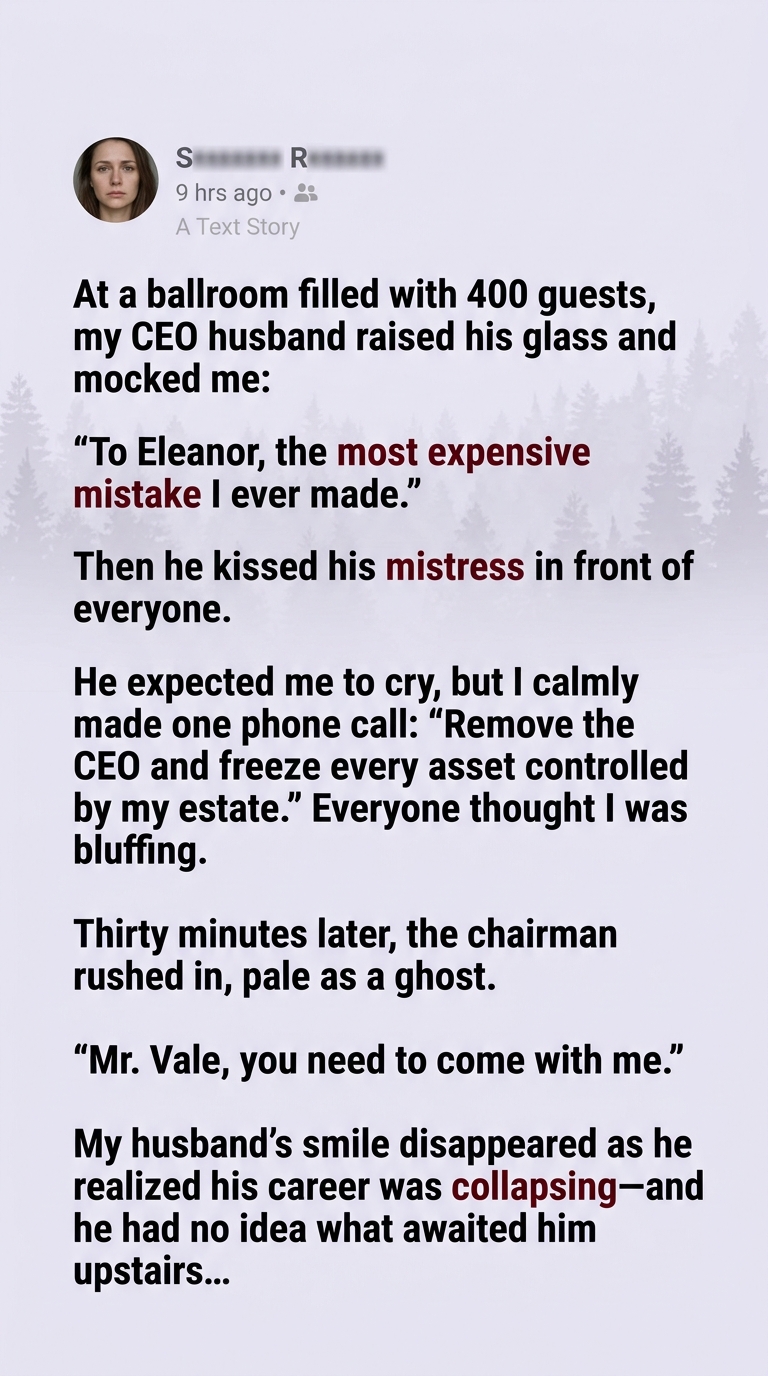
The ballroom was filled with four hundred guests when my husband decided to humiliate me.
He stood beneath the crystal chandeliers, holding a glass of champagne, surrounded by executives, investors, celebrities, and business partners.
My husband, Richard Vale, was the CEO of Vale International, a company he loved almost as much as he loved hearing people praise him.
I stood near the front table in a silver evening gown, watching him smile at the crowd.
Then he raised his glass.
“To my beautiful wife, Eleanor,” he announced.
People turned toward me.
I smiled politely.
Richard continued.
“To the most expensive mistake I ever made.”
For half a second, nobody reacted.
Then a few people laughed nervously.
I felt my stomach tighten.
Richard turned toward a woman standing beside him. Her name was Vanessa. She was his executive assistant, his rumored mistress, and apparently no longer interested in pretending otherwise.
He placed a hand around her waist.
Then, in front of four hundred guests, he kissed her.
The room erupted into whispers.
Someone dropped a fork.
A woman near the stage covered her mouth.
Richard pulled away and smiled as if he had just delivered the evening’s entertainment.
He expected me to cry.
He expected me to throw my champagne glass, scream at Vanessa, or run out of the ballroom.
Instead, I calmly placed my glass on the table.
I took out my phone.
And I made one call.
“It’s Eleanor,” I said quietly. “Activate the governance protocol. Remove Richard Vale from executive authority pending the board’s emergency review, and freeze any transactions involving assets controlled by my estate until the ownership and authorization records are verified.”
There was a brief silence.
Then I added:
“Yes. Follow the legal documents exactly. No exceptions.”
I ended the call.
Richard noticed.
He laughed.
“Calling your lawyer, sweetheart?”
I looked at him.
“No.”
“Then who was that?”
“Someone who can read the documents you never bothered to understand.”
His smile faded slightly.
But he still thought I was bluffing.
Thirty minutes later, the ballroom doors opened.
The chairman of Vale International, Arthur Bennett, rushed inside with two attorneys behind him.
His face was pale.
He scanned the room until he found Richard.
“Mr. Vale,” he said sharply. “You need to come with me.”
Richard frowned.
“What is this?”
Arthur glanced toward me.
Then back at Richard.
“Your position is no longer what you think it is.”
And for the first time that evening, my husband’s smile disappeared.
Richard and I had been married for eleven years.
When we first met, he was a talented but relatively unknown executive working for a struggling investment firm.
He was ambitious, intelligent, and charming in a way that made people want to believe in him.
I came from a different world.
My grandfather, Edward Sinclair, had built a substantial investment and industrial group over several decades. He believed in careful planning, long-term ownership, and keeping important decisions documented.
I had grown up around board meetings and financial reports, but I had never wanted to be introduced as someone’s wealthy granddaughter.
I studied business law, worked in private investment management, and eventually became the principal beneficiary of a family estate that held significant interests in several companies.
Richard knew I came from money.
What he never fully understood was how that money was structured.
When we married, I didn’t make him sign a humiliating agreement or demand that he give up his career.
I simply kept my inheritance separate.
My grandfather had established an independent estate structure with professional trustees, investment managers, and specific rules governing distributions and asset transfers.
Some of those holdings included a controlling shareholding in the parent company that owned Vale International.
Richard had become CEO through a combination of professional performance, board approval, and the confidence of major shareholders.
He had earned the position.
But he had never owned the company.
That distinction mattered.
For years, I supported his career without interfering.
I attended company functions, hosted dinners, and helped build relationships with investors.
When he needed introductions, I made them.
When the company faced a difficult financing period, my family’s investment office participated in a properly documented capital arrangement.
Richard began to believe that the company’s success was entirely his.
And slowly, he began treating me as though I were simply part of the expensive lifestyle attached to his title.
The first warning sign had been Vanessa.
At first, she was always present at business dinners.
Then she began accompanying Richard on trips that had nothing to do with the company.
He started hiding his phone.
He stopped coming home on time.
When I asked questions, he called me insecure.
Eventually, I hired an attorney to review our financial arrangements and began preparing for a possible separation.
I didn’t know how ugly things would become.
But I knew I needed to protect the estate’s interests.
The first major discovery came two months before the gala.
Our estate’s investment manager, David Collins, called me into a private meeting.
He placed a folder on the table.
“Eleanor, we found something concerning.”
Inside were records of several transactions involving company assets.
A consulting firm with no meaningful operating history had received substantial payments from Vale International.
The firm’s registered director was a former business associate of Vanessa.
There were also proposed transfers involving two properties that belonged to subsidiaries controlled by the parent company.
The documents didn’t prove that Richard had personally stolen money.
But they raised serious questions about conflicts of interest, authorization, and the use of company resources.
I looked at David.
“Has the board seen this?”
“Not yet. Our legal team is preparing a report.”
“Then follow the proper process.”
He nodded.
“There’s another issue. Richard has been discussing a restructuring that could affect the voting rights attached to the estate’s shares.”
I sat back.
“Can he do that?”
“Not unilaterally. The proposed structure would require approvals under the company’s governing documents and the estate’s investment agreements.”
I read the documents carefully.
Richard had been acting as though the company was his personal property.
He had apparently forgotten that major decisions required more than his signature.
I contacted the estate’s independent trustees.
They authorized a formal review and instructed the legal team to preserve relevant records.
No one was to make accusations without evidence.
No assets were to be seized without authority.
But any transaction involving the estate’s holdings would require the approvals specified in the governing documents.
Then came the gala invitation.
Richard had personally asked me to attend.
He said it was important for the company.
I accepted.
I had no idea he planned to turn the evening into a public announcement of his affair.
Back in the ballroom, Arthur Bennett was standing in front of Richard.
“Come with me,” the chairman repeated.
Richard looked around.
“Arthur, you’re making a mistake. This is a private family matter.”
“It stopped being private when you used a company event to publicly humiliate a shareholder and then received an emergency notice from the board’s legal committee.”
Richard’s expression hardened.
“What notice?”
Arthur handed him a document.
Richard scanned the first page.
His face changed.
“What is this?”
“An emergency governance resolution. Your executive authority has been suspended temporarily, pending review of the transactions identified by the independent audit team.”
Richard looked up.
“You can’t suspend me.”
“The board can, under the company’s bylaws, subject to the required procedures. The resolution was approved by the directors present and supported by the voting authorization attached to the controlling shareholding.”
He turned toward me.
“Eleanor?”
I said nothing.
Arthur continued.
“Additionally, the estate’s trustees have directed that transactions involving its controlled holdings be restricted until the review is complete. That does not mean the company itself has been frozen. It means nobody is authorized to move or encumber those specific assets without the required approvals.”
Richard’s eyes widened.
He had finally understood.
The phone call had not magically taken control of the company.
It had activated legal protections that had existed long before he became CEO.
“Who approved this?” he demanded.
Arthur glanced at the document.
“The board. Following the report from independent counsel.”
Richard shook his head.
“This is ridiculous. I built this company.”
Arthur’s voice was cold.
“You helped run it. You were not its owner.”
The guests were now openly watching.
Vanessa stepped closer to Richard.
“What does this mean?”
He ignored her.
He looked at me.
“You planned this.”
I shook my head.
“No, Richard. You planned the toast.”
Arthur asked Richard to accompany him to a private conference room upstairs.
Richard refused at first.
Then one of the attorneys quietly explained that the company would be documenting his response and arranging the required handover of executive responsibilities.
He finally followed them.
Vanessa remained in the ballroom, looking increasingly nervous.
A few minutes later, she approached me.
“Eleanor, can we talk?”
I looked at her.
“About what?”
“Richard and I—”
“You don’t need to explain your relationship to me.”
She blinked.
“I never meant to hurt you.”
I almost smiled.
“You kissed my husband in front of four hundred people.”
She looked down.
“I thought he was going to leave you.”
“That was a conversation you should have had with him. Not a performance you needed an audience for.”
She glanced toward the staircase.
“What’s going to happen to him?”
“I don’t know. The board will review the evidence.”
“Can you stop this?”
I studied her.
“Why would I?”
She had no answer.
I turned away.
For years, I had been the person who made Richard’s life easier.
I had protected his reputation, supported his ambitions, and quietly handled problems before they became public.
Now he would have to answer for his own decisions.
Upstairs, the emergency meeting lasted nearly two hours.
I didn’t attend the entire meeting. I was not an executive, and the investigation needed to remain independent.
But I received updates from the estate’s attorney.
The board had reviewed the preliminary findings.
Several transactions had been flagged for further investigation, including payments to the consulting firm linked to Vanessa’s former business associate.
The directors had also discovered that Richard had instructed staff to prepare documents for a restructuring that could have diluted the voting rights attached to the estate’s shares.
The proposal had not been completed.
However, the board considered the circumstances serious enough to suspend his authority while an independent investigation continued.
Richard was asked to surrender his company devices and cooperate with the review.
He was also instructed not to contact employees about the investigation outside approved channels.
He argued that the board was acting on personal information supplied by his wife.
The chair reminded him that the review was based on financial records, authorization documents, and internal communications—not my feelings about his marriage.
That distinction mattered.
A little after midnight, Arthur came downstairs.
He found me standing near the terrace doors.
“Eleanor.”
I turned.
“How did it go?”
“The suspension remains in place. The audit team will continue reviewing the transactions. We have also appointed an interim CEO to maintain operations.”
I nodded.
“And the company?”
“Operating normally. Payroll, suppliers, and customer contracts remain unaffected. The restrictions apply only to specific assets and transactions requiring trustee approval.”
“Good.”
Arthur studied me.
“I’m sorry about what happened tonight.”
“Thank you.”
He hesitated.
“Richard seemed to believe you would never use your voting rights.”
I looked through the glass at the empty ballroom.
“I never wanted to use them against him.”
“Perhaps that’s why he forgot they existed.”
I didn’t answer.
The next morning, Richard called seventeen times.
I answered the eighteenth.
“What did you do?” he demanded.
“Good morning, Richard.”
“Don’t play games. The board suspended me. My office is locked. My assistant won’t answer my calls.”
“The board made its decision.”
“You own those shares. You could have stopped them.”
“The estate holds the shares. The trustees exercised their responsibilities under the governing documents.”
“Don’t hide behind legal language!”
I was quiet for a moment.
Then I said, “You humiliated me in front of four hundred people. But that isn’t why you’re facing an investigation.”
“You’re destroying my career.”
“Your career is being reviewed because of the transactions the board identified. You should speak to your attorney.”
He laughed bitterly.
“After everything I’ve done for you?”
I couldn’t believe he had said it.
“Everything you’ve done for me?”
“I made you part of my world. I gave you a life.”
I closed my eyes.
“You didn’t give me my life, Richard. I had one before I met you.”
He fell silent.
Then his voice changed.
“Eleanor, listen. Vanessa means nothing. It was a mistake.”
I looked at the wedding photograph on my desk.
“Was the toast a mistake too?”
He didn’t answer.
“Was making me look foolish in front of your employees a mistake? Was telling people I was the most expensive mistake you ever made a mistake?”
“I’m sorry.”
“No, Richard. You’re frightened.”
He began to protest.
I ended the call.
The following weeks were difficult.
The investigation expanded.
Auditors reviewed contracts, emails, payment approvals, and the relationships between the company and outside vendors.
Richard’s suspension remained in place.
Eventually, the independent review found evidence that he had approved payments to a consulting company without adequate business justification and had failed to disclose a personal relationship that created a potential conflict of interest.
There was also evidence that he had attempted to advance a restructuring proposal without obtaining the necessary approvals.
The board determined that he had breached several executive responsibilities.
He was dismissed as CEO after the formal process was completed.
The company did not collapse.
In fact, it continued operating under interim leadership while the directors strengthened its internal controls.
The suspicious payments were referred for further legal review, and the company pursued recovery of funds where its lawyers believed there was a valid basis to do so.
Vanessa resigned before the internal review was completed.
She later became the subject of questions about her role in the consulting arrangements, although no final conclusion about her legal responsibility was announced at that stage.
Richard, meanwhile, began telling people that I had engineered everything because I was a jealous wife.
But the documents spoke for themselves.
Three months after the gala, Richard requested a meeting.
I agreed to meet him at our attorney’s office.
He looked different.
His expensive suit was still perfectly tailored, but his confidence had disappeared.
He sat opposite me.
“I didn’t think you’d actually do it,” he said.
“Do what?”
“Use the estate against me.”
I folded my hands.
“The estate wasn’t used against you. The board reviewed your conduct.”
“You know I could have fixed everything.”
“Then you should have followed the rules.”
He looked down.
“I loved you, Eleanor.”
I studied him.
“Did you?”
“Yes.”
“Then why did you make me the joke of the evening?”
He rubbed his forehead.
“I was angry. I felt like you were always watching me, judging me.”
“I was watching you because I had discovered questionable transactions involving assets connected to my family’s estate.”
He looked up sharply.
“So you knew?”
“I knew there were concerns. That’s why I asked for an independent review. I didn’t know every detail, and I didn’t control the outcome.”
He leaned back.
“Vanessa told me you would never challenge me publicly.”
I almost laughed.
“Vanessa was right about one thing. I never wanted to challenge you publicly. But you chose to make our marriage a public spectacle.”
He looked at me for a long time.
“Are you filing for divorce?”
I placed an envelope on the table.
“Yes.”
He didn’t open it immediately.
“After eleven years?”
“After eleven years of believing I was your partner, while you treated me like an accessory.”
He finally opened the envelope.
Inside were the documents prepared by my attorney.
Richard looked at them, then at me.
“Can we work this out?”
I shook my head.
“I don’t want to spend the rest of my life trying to convince someone to respect me.”
The divorce took several months to resolve.
Our attorneys handled the financial disclosures, property arrangements, and any questions involving the separate estate.
Because my inheritance had been structured independently, the estate’s holdings were not simply divided as marital property. The exact settlement was negotiated under the applicable law, with both sides receiving legal advice.
I didn’t try to take Richard’s personal belongings or interfere with his ability to rebuild his career.
I wanted a clean separation.
The board eventually appointed a permanent CEO with extensive operational experience.
The company strengthened its compliance procedures, improved conflict-of-interest disclosures, and required additional independent approval for related-party transactions.
The business recovered.
Employees kept their jobs.
Clients remained.
And the company became stronger because its governance no longer depended on one man’s ego.
A year after the gala, I attended another company event.
This time, I arrived alone.
The new CEO welcomed me as a representative of the estate’s controlling investment interests.
Nobody introduced me as Richard Vale’s wife.
Nobody made a joke about my expense.
I sat at the front table and listened to the presentation.
When the new CEO finished, he thanked the employees who had helped stabilize the company during a difficult period.
I applauded.
Later, Arthur approached me.
“Your grandfather would have been proud of how you handled everything.”
I smiled.
“I hope so.”
He looked toward the ballroom.
“Do you ever regret that night?”
I thought about Richard raising his glass.
The laughter.
The kiss.
The way he expected me to fall apart.
Then I thought about the woman I had been before him.
“No,” I said. “I regret staying silent for so long.”
That evening, I went home and placed my wedding ring in a small box.
I didn’t throw it away.
I didn’t need to.
It was simply a reminder of a chapter that had ended.
Richard had called me the most expensive mistake he ever made.
But the truth was much simpler.
I had never been his mistake.
I had been his partner.
And he had mistaken my patience for weakness, my silence for ignorance, and my love for permission.
The night he kissed Vanessa in front of four hundred people, he thought he was showing everyone who held the power.
Thirty minutes later, he learned the difference between holding a title and having the authority to keep it.
And I finally learned that walking away from a man who refuses to respect you isn’t a loss.
Sometimes, it’s the first decision that gives you your life back.