The $30,000 They Thought Would Never Stop
For years, my family treated me like their personal bank.
They never called to ask how I was feeling. They never asked whether I was happy, lonely, or exhausted.
But every month, like clockwork, they expected $30,000.
My name is Emily Carter. I’m thirty-six, and I built a successful financial technology company from a tiny rented office into a business with hundreds of employees.
It took twelve years of long nights, failed partnerships, personal sacrifices, and more stress than I care to remember.
My family liked telling people they had raised a successful daughter.
What they never mentioned was how much of that success they believed belonged to them.
My mother, Linda, lived in a beautiful house I paid for. My father, Robert, drove a luxury car purchased through my company account. My younger brother, Jason, had additional credit cards connected to my personal account, even though he had never held a steady job for more than six months.
Every month, I transferred $30,000 into an account my parents used for household expenses, investments, travel, and whatever else they wanted.
I also covered their insurance, property taxes, and several other bills.
At first, I had offered to help.
My father had retired early after a health scare, and my mother had struggled to manage the household expenses. I wanted them to enjoy their later years without worrying about money.
Then Jason started asking for help.
He needed money for a business idea.
Then a new car.
Then an apartment deposit.
Then a vacation because he was stressed.
Every request came with the same explanation.
“Emily can afford it.”
Eventually, helping became an expectation.
And expectations became obligations.
The moment I finally understood that my family didn’t love me nearly as much as they loved what I provided came during my mother’s birthday dinner.
I had flown home after a demanding business trip, hoping to spend a quiet evening with everyone.
Instead, I arrived to find a table full of relatives and family friends.
Jason was telling everyone about his upcoming business venture.
“I’m finally going to open my own luxury fitness club,” he announced. “I’ve already found the perfect location.”
My mother clapped.
“That boy has always had ambition.”
I smiled politely.
“That’s exciting. Have you worked out the financing?”
Jason waved his hand.
“I’m still figuring out the details.”
My father laughed.
“Don’t worry. Your sister will help you get started.”
I put down my fork.
“Actually, I haven’t agreed to fund anything.”
The table went quiet.
My mother looked at me as if I had insulted her.
“Emily, don’t be difficult. Your brother is trying to build something.”
“So am I. I run a company. I can’t keep financing every idea he has.”
Jason rolled his eyes.
“It’s not like you’re going to miss thirty thousand dollars.”
I stared at him.
“Do you know how many people work for that money?”
He shrugged.
“That’s your business. This is family.”
My mother leaned toward me.
“You’ve become so selfish since you got rich.”
I looked around the table.
Nobody asked how my business was doing.
Nobody asked how exhausted I was.
They were angry because I had questioned another payment.
Then my aunt Patricia said something that made everything painfully clear.
“Linda always says she raised you so well. At least you remember where you came from.”
My mother smiled.
“Yes. And I hope Emily never forgets that family comes first.”
I looked at her.
“Does family come first when I’m the one who needs something?”
Her smile disappeared.
“What could you possibly need? You have everything.”
That was the moment.
Not when Jason demanded money.
Not when my father told me to pay his car insurance.
Not even when my mother called me selfish.
It was when she looked at me and genuinely couldn’t imagine that I might need anything at all.
I finished dinner quietly.
Then I went back to my hotel.
And I made a decision.
The next morning, I called my attorney and financial adviser.
I didn’t want to act out of anger. I wanted to understand every financial connection and end the ones that were unnecessary.
We reviewed the mortgage payments, credit-card arrangements, insurance policies, automatic transfers, and accounts where I had provided financial support.
Some payments were contractual. Others were informal arrangements I had allowed to continue for years.
We separated them carefully.
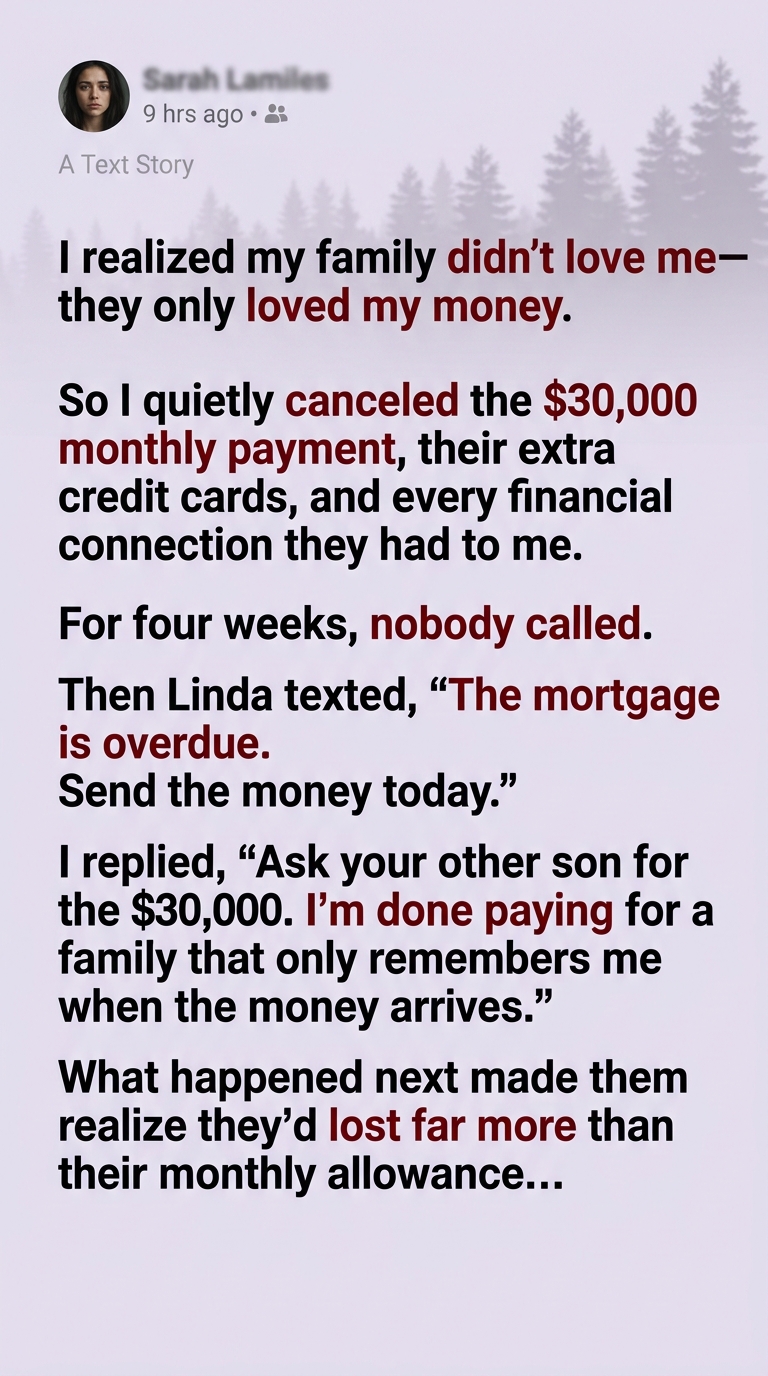
I canceled the automatic $30,000 monthly transfer.
I contacted the credit-card issuers to remove my responsibility for Jason’s additional cards, following their procedures and making sure any outstanding balances were handled appropriately.
I reviewed the family expenses I had been covering and gave notice where a transition period was required.
I also made sure that I wasn’t leaving anyone without access to essential documents or information.
My attorney reminded me to keep everything documented.
“Don’t make threats,” she said. “Don’t argue over text. Just end the financial arrangements you no longer wish to maintain.”
So that’s what I did.
I didn’t announce it.
I didn’t send a dramatic family message.
I simply stopped paying for things that were no longer my responsibility.
For four weeks, nobody called.
Not once.
I had expected at least one message asking whether I had arrived home safely.
Nothing.
Then, on a Tuesday morning, my phone lit up.
It was my mother.
The mortgage is overdue. Send the money today.
No greeting.
No question about my work.
No mention of the fact that we hadn’t spoken in a month.
I stared at the message for a few seconds.
Then I replied:
Ask your other son for the $30,000. I’m done paying for a family that only remembers me when the money arrives.
She called immediately.
I let it ring.
Then came another message.
How dare you speak to me like that? This is your parents’ home!
I answered:
The home is yours. The mortgage payments were mine. Those are two different things.
She sent three more messages, each angrier than the last.
I put my phone face down.
For the first time in years, I felt no obligation to fix the situation.
But I had no idea how quickly the rest of the family would react.
Two days later, Jason showed up at my office.
He walked past reception without waiting and entered my conference room while I was reviewing a quarterly report.
“Are you serious?” he demanded.
I looked up.
“Good morning to you too.”
“Mom says you cut off everything.”
“I ended the financial arrangements.”
“You canceled my cards!”
“I removed my financial responsibility for them. The card issuer handled the account changes.”
He threw his hands up.
“How am I supposed to pay for anything?”
“With your own income.”
He laughed bitterly.
“You know I don’t have a job right now.”
“You told everyone you were about to open a fitness club.”
“That takes money!”
“Then you’ll need a business plan and financing.”
He stared at me.
“You’re my sister.”
“And you’re thirty-two years old.”
His expression hardened.
“You’ve changed.”
I closed my laptop.
“No, Jason. I’ve stopped confusing love with unlimited financial support.”
He shook his head.
“Mom says you’re punishing the whole family because of one argument.”
“I’m not punishing anyone. I’m no longer funding expenses I never agreed to pay forever.”
He leaned across the table.
“You’ll regret this when something happens to them.”
That sentence made me sit very still.
“Are you threatening me?”
“No! I’m saying they’re your parents!”
“And I’m saying they’re adults. They can make their own financial decisions.”
He left without saying goodbye.
My assistant later told me he had complained at reception that I had become impossible to deal with.
I almost smiled.
Apparently, the moment a bank stops giving someone money, it becomes a personality problem.
A week later, my father called.
His voice was quieter than my mother’s.
“Emily, we need to talk.”
“Okay.”
“Your mother is very upset.”
“I imagine she is.”
“You’ve put us in a difficult position.”
I took a breath.
“Dad, I paid thirty thousand dollars every month. I covered the house, insurance, travel, and Jason’s expenses. What exactly did you think would happen if I stopped?”
He was silent.
“We never asked you to pay forever,” he finally said.
I almost laughed.
“Then why did Mom demand the money as if I were late with a bill?”
“She’s worried.”
“About the mortgage?”
“Yes.”
“Then you should sit down together and work out a budget.”
He sighed.
“We can’t maintain our lifestyle on our income.”
That was the first honest thing anyone had said.
I looked at the office window.
“Then your lifestyle needs to change.”
My father didn’t respond.
After a moment, he said, “Your mother thinks you should help us until Jason gets established.”
“Jason has been getting established for ten years.”
“He just needs one opportunity.”
“Then he can find one that doesn’t depend on my money.”
My father sounded tired.
“Your mother and I raised you.”
“I know. And I appreciate that. But raising a child isn’t a loan that comes due when she becomes successful.”
He went quiet.
I ended the call politely.
For the next few days, I heard nothing.
Then the family group chat exploded.
My aunt Patricia wrote that I was abandoning my parents.
A cousin said I should be grateful I had been given a good childhood.
Jason posted a long message about how money had changed me.
My mother added a photograph of the family house with the caption:
Some people forget where they came from.
I didn’t reply.
Instead, I saved the messages and muted the group.
The biggest surprise came three weeks later.
I received an email from a property management company.
My parents had contacted them about renting out a portion of their house to generate additional income.
That was reasonable.
What wasn’t reasonable was the next paragraph.
They had listed me as a financial guarantor without my permission.
I immediately contacted the company and provided documentation showing that I had never agreed to guarantee any rental obligations or new financing.
The company removed my name from the preliminary paperwork and confirmed that no binding agreement had been made in my name.
I was furious.
I called my attorney.
She reviewed the documents and advised me to send a formal notice stating that I had not authorized anyone to use my financial information or represent me as a guarantor.
I did exactly that.
Then I called my father.
“Did you put my name on a financial guarantee?”
He sounded confused.
“Your mother was trying to arrange something.”
“Did you authorize someone to use my name?”
“We thought it would help us get a better arrangement.”
“You cannot use my financial information without my permission.”
“We weren’t trying to hurt you.”
“Intent doesn’t make it acceptable.”
He apologized.
It was the first time in months that I heard him use the word without adding an excuse afterward.
But the incident changed something.
I realized that ending the monthly payment wasn’t enough.
I needed to make sure my family understood that my finances were no longer available for them to use, promise, or negotiate.
My attorney sent the appropriate notices.
I reviewed my credit reports, changed account permissions, and removed any remaining access that relatives had been given.
There would be no more informal financial arrangements.
A month later, my mother requested a meeting.
She said she wanted to talk without shouting.
I agreed to meet at a quiet restaurant.
When I arrived, she was already sitting at a table.
She looked older than I remembered.
“Thank you for coming,” she said.
I sat down.
“What did you want to discuss?”
She folded her hands.
“Your father and I have been struggling.”
“I understand.”
“We sold the second car.”
I nodded.
“And Jason has moved into a smaller apartment.”
“That’s probably sensible.”
She looked offended.
“You sound pleased.”
“I’m not pleased that you’re struggling. I’m glad you’re making decisions that fit your income.”
She looked down at the menu.
“We didn’t realize how much we depended on you.”
I waited.
“Your father and I thought you enjoyed helping us.”
“I did, at first.”
“Then why did you stop?”
I looked directly at her.
“Because I started feeling like I had to pay to remain part of the family.”
Her eyes filled.
“That’s not true.”
“Mom, you didn’t call me for four weeks. Then the first thing you said was that the mortgage was overdue.”
She wiped her eyes.
“We were worried.”
“You could have asked how I was.”
She didn’t answer.
I continued.
“I don’t mind helping people I love. But I won’t pay for affection. I won’t finance Jason’s choices. And I won’t be treated like an obligation that happens to have a bank account.”
My mother stared at the table.
After a long silence, she asked, “Are you never going to help us again?”
I considered the question.
“I didn’t say that. I said the old arrangement is over.”
She looked up.
“If there is a genuine emergency, we can discuss it. If you need help understanding your finances, I can help you find a qualified adviser. But there will be no automatic thirty-thousand-dollar payment, no extra credit cards, and no promises made in my name.”
She nodded slowly.
It wasn’t a perfect conversation.
She didn’t suddenly understand everything.
But for once, she listened without demanding an immediate transfer.
Two months later, something unexpected happened.
Jason got a job.
It wasn’t glamorous. He joined a regional fitness company as a sales manager, earning a regular salary and commission.
He called me one evening.
“I got the job,” he said.
“Congratulations.”
“Thanks.”
There was a pause.
Then he added, “I know you probably think I’m useless.”
“I don’t think that.”
“You just stopped helping me.”
“Because I believed you were capable of building your own life.”
He was quiet.
“I didn’t like hearing that.”
“I know.”
After another pause, he said, “I’m sorry I showed up at your office and spoke to you like that.”
I leaned back in my chair.
“Thank you for saying that.”
He didn’t ask for money.
It was the first conversation we’d had in years where his plans weren’t followed by a request for funding.
Over time, he began paying his own bills and saving for his future.
My parents adjusted too.
They downsized their expenses, sold unnecessary belongings, and began managing their money with the help of an adviser.
Their lives were less extravagant.
But they were still their lives.
And I discovered that I could love my family without managing every part of it.
Six months after I canceled the payments, I received a handwritten card from my father.
It said:
Emily, I owe you an apology. We treated your success as something the family was entitled to. We forgot that you were a person, not a solution to every financial problem. I don’t expect you to restore anything. I just wanted you to know that I understand.
I read it twice.
Then I placed it in my desk drawer.
My mother later called to invite me to dinner.
This time, she asked whether I was free.
She asked what I had been working on.
And when I arrived, nobody mentioned the mortgage.
Jason was there too.
He told me about his new job, and for once, he didn’t turn the conversation toward what I could do for him.
We were still a complicated family.
Trust wasn’t repaired in one dinner.
But something had changed.
I no longer felt responsible for keeping everyone comfortable.
And they were slowly learning that my love wasn’t measured by the amount of money I transferred.
That night, when I drove home, I thought about the thirty thousand dollars.
For years, I had believed that paying it was proof that I was a good daughter.
Now I understood the difference between generosity and surrender.
I hadn’t lost my family by canceling the payments.
I had simply stopped paying to keep a place in it.
And the most important thing they lost wasn’t the monthly allowance.
It was the assumption that my life, my success, and my future belonged to them.