“Who Exactly Are You to This Family?”
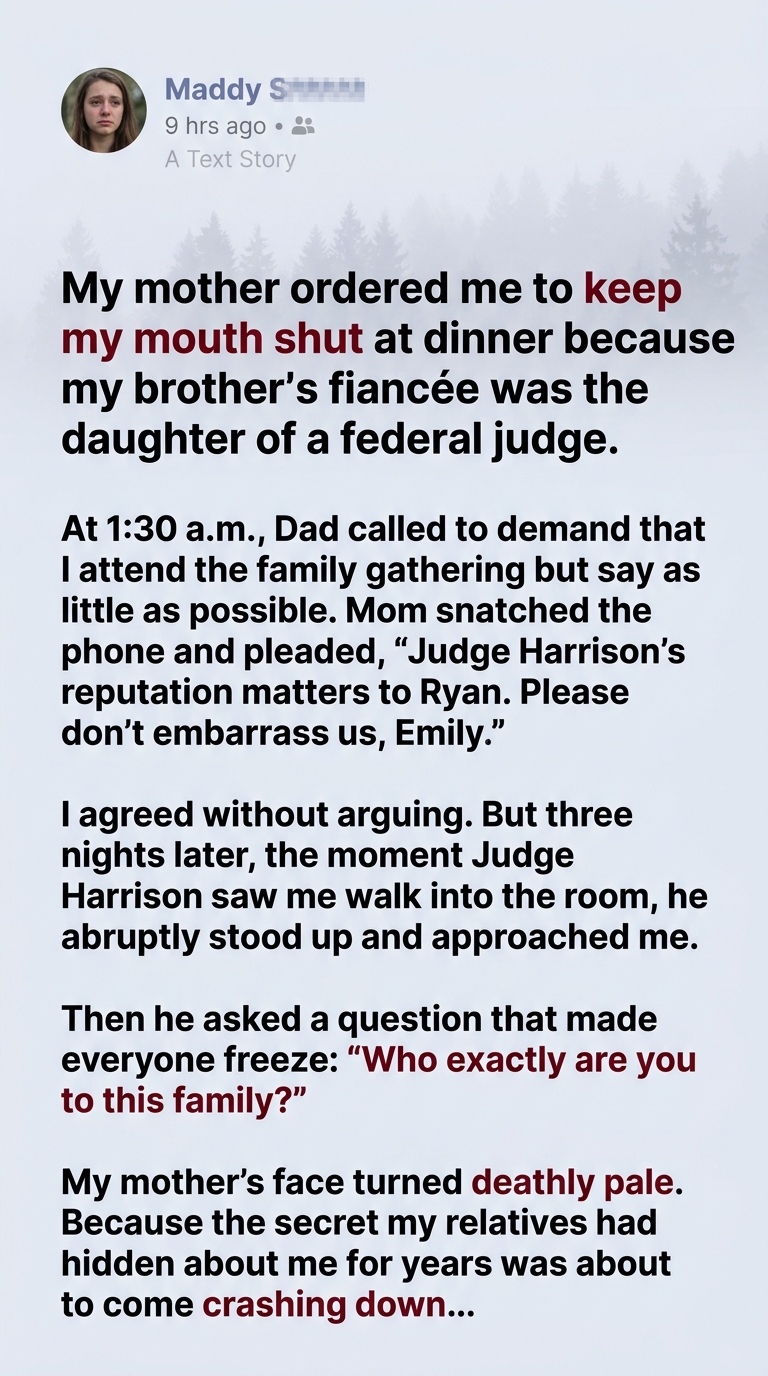
My mother told me to keep my mouth shut because my brother’s fiancée was the daughter of a federal judge.
She didn’t ask.
She ordered.
“Emily, when Judge Harrison arrives, don’t talk about your job, your past, or anything that might make this family look bad. Just smile and let Ryan have his evening.”
I stared at her across the kitchen counter.
“I’m thirty-one, Mom. I’m not a child you can put in a corner.”
Her lips tightened.
“Then stop behaving like one.”
My brother Ryan was getting engaged to Olivia Harrison, the only daughter of Judge Thomas Harrison, a respected federal judge. My parents had spent weeks preparing for the family gathering, polishing silverware, ordering expensive wine, and reminding everyone how important the evening would be.
Apparently, my presence was the one thing they hadn’t planned for.
At 1:30 a.m. that night, my phone rang.
It was Dad.
“Emily, you need to come to the gathering on Friday.”
“I never said I wasn’t coming.”
“Good. But listen carefully. Keep your opinions to yourself. Don’t bring up old family problems. Don’t discuss your work. Just let Ryan enjoy this.”
Before I could answer, I heard Mom grab the phone.
“Emily, please,” she said, suddenly sounding almost desperate. “Judge Harrison’s reputation matters to Ryan. Please don’t embarrass us.”
I looked at the ceiling.
“Fine,” I said quietly.
I agreed without arguing.
What they didn’t know was that I had no intention of embarrassing anyone.
But I also had no intention of hiding who I was.
Three nights later, I walked into my parents’ house wearing a simple black dress and carrying a small gift for Olivia.
The living room was full of relatives.
Ryan stood beside Olivia, looking more confident than I’d seen him in years. My father was pouring drinks. My mother was adjusting flowers near the fireplace.
Then Judge Harrison entered.
He was a tall man in his early sixties, with silver hair and the kind of calm expression that made people instinctively lower their voices.
He greeted my parents, shook Ryan’s hand, and exchanged pleasantries with the relatives.
Then his eyes landed on me.
He stopped.
His glass lowered.
For several seconds, he simply stared.
Then he abruptly stood up and walked toward me.
“Emily?”
I nodded politely.
“Good evening, Your Honor.”
He looked from me to my parents.
Then he asked a question that made every conversation in the room disappear.
“Who exactly are you to this family?”
My mother’s face turned deathly pale.
Ryan frowned.
“Dad, what are you talking about?”
Judge Harrison didn’t look at him.
He was still staring at me.
And I knew, in that moment, that the secret my parents had buried for years was about to come crashing down.
To understand what happened next, you need to understand the family I grew up in.
My brother Ryan was the golden child.
He was handsome, charming, and good at making people believe he could do anything. My parents celebrated every achievement, from his first school award to his university graduation.
I was different.
I loved books, asked too many questions, and spent hours studying things nobody in my family understood.
When I was seventeen, I told my parents I wanted to study law.
My father laughed.
“Law school is expensive. Ryan needs our support more.”
Ryan was only two years older than me, but somehow his future always came first.
I worked part-time, earned scholarships, and eventually paid my own way through university.
My parents rarely attended my academic events.
When I graduated near the top of my class, my mother said she was proud—but only after asking whether I could help Ryan prepare for his next interview.
I learned early that expecting recognition from them was a waste of energy.
After law school, I joined the public sector.
I didn’t tell my family much about my work. My parents thought I was an ordinary government attorney, reviewing paperwork and attending meetings.
That was partly my fault.
I had learned to keep my professional life private.
But there was another reason.
Four years earlier, I had been assigned to a sensitive federal matter involving financial misconduct and a network of shell companies. The investigation required cooperation between several agencies, and strict confidentiality rules meant I couldn’t discuss the details with relatives or friends.
I never told my family the names of the people involved.
I never told them the case had become one of the most significant assignments of my career.
And I never told them that Judge Thomas Harrison had presided over a related proceeding.
He knew me professionally.
He knew my work.
But my parents had no idea.
They had never asked.
Back in the living room, Judge Harrison was still waiting for an answer.
My mother rushed forward.
“Thomas, I’m sure there’s some misunderstanding.”
He turned toward her.
“Is there?”
She forced a smile.
“Emily is our daughter.”
Judge Harrison looked at me again.
“Your daughter?”
“Yes,” my father answered quickly. “Our youngest. She works in government.”
The judge’s expression changed.
“Works in government?”
He paused.
“Emily was the lead counsel on the federal task force that coordinated the financial misconduct proceedings I reviewed last year.”
The room went completely silent.
Ryan stared at me.
Olivia’s mouth fell open.
My father slowly put down his glass.
Judge Harrison continued.
“She handled an extraordinarily difficult assignment with professionalism and discretion. I remember her because she was one of the few attorneys in the room who could explain complicated financial evidence without turning it into a performance.”
I felt my cheeks warm.
“Thank you, Your Honor.”
He shook his head.
“You don’t need to thank me. You earned the recognition.”
My mother looked as though someone had pulled the floor out from beneath her.
“But… Emily never told us.”
Judge Harrison glanced at her.
“Perhaps she had her reasons.”
He wasn’t finished.
He turned back to me.
“I also wanted to ask whether you’re still involved in public integrity work. Our professional association has been discussing a new training initiative, and your experience would be valuable.”
“I am,” I replied. “I’d be happy to review the proposal through the appropriate channels.”
He nodded.
Then Ryan finally spoke.
“Wait. You know Judge Harrison?”
I looked at him.
“Professionally, yes.”
“Since when?”
“For several years.”
His face tightened.
“Why didn’t you tell us?”
I almost laughed.
“Because you never asked what I did.”
My mother stepped between us.
“Emily, don’t start.”
I looked at her.
“You told me to keep my mouth shut tonight. I have barely said ten words.”
“That’s not what I meant.”
“Then what did you mean?”
She glanced around the room, clearly aware that everyone was listening.
“I meant you shouldn’t discuss things that could make Ryan uncomfortable.”
Ryan looked embarrassed.
“Mom, stop.”
But she continued.
“We just wanted the evening to go smoothly. Olivia’s family is important.”
I looked at Olivia.
She seemed uncomfortable, but she wasn’t looking down at me.
Instead, she stepped closer.
“Emily, I had no idea. I’d actually love to hear more about your work sometime.”
I smiled.
“Thank you. I’d like that.”
Then Judge Harrison asked another question.
“Emily, may I ask something?”
“Of course.”
“Does your family know about the scholarship program you established?”
My mother’s face changed again.
“What scholarship program?”
I sighed.
I hadn’t planned to discuss it that evening.
But the truth had already started coming out.
Three years earlier, I had created a small scholarship fund for students from low-income families who wanted to study law or public service.
It began with my own savings and a few donations from colleagues.
I had grown up watching talented students lose opportunities because their families couldn’t afford tuition, books, or transportation.
I wanted to make that a little easier for someone else.
The fund was modest at first.
Over time, several former classmates and professional contacts contributed. We established clear eligibility requirements, an independent review committee, and an annual reporting process.
I never used my family’s name.
I didn’t want attention.
Judge Harrison had learned about the program through a professional event and had later referred a few applicants to its publicly advertised application process.
My parents had never heard of it.
Not because I had hidden it.
Because they had never shown much interest in what I did outside the family.
“I helped establish a scholarship fund,” I explained. “It’s still small, but we’ve supported several students.”
Ryan blinked.
“How much money?”
“Ryan,” Olivia said quietly.
“What? I’m just asking.”
I answered calmly.
“The amount isn’t important. It’s about the students.”
Judge Harrison smiled.
“That’s exactly the kind of answer I expected.”
My father looked uncomfortable.
“Why didn’t you tell us about this?”
I turned toward him.
“I did tell you I was working with students. You said I should focus on finding a better-paying job.”
He looked away.
My mother crossed her arms.
“This is ridiculous. We have always supported both our children.”
Nobody responded.
Because everyone in that room knew it wasn’t true.
Dinner continued, but the atmosphere had changed.
My mother tried to restore the evening by discussing the engagement plans. My father asked Judge Harrison about his travel schedule. Ryan barely touched his food.
Eventually, Olivia leaned toward me.
“Can I ask you something privately?”
We stepped into the kitchen.
She looked genuinely apologetic.
“I didn’t know your parents treated you this way.”
I gave a small smile.
“It’s not your responsibility.”
“I heard your mother telling my father that you were difficult. That you had a habit of making things uncomfortable.”
I closed my eyes briefly.
“That sounds familiar.”
Olivia hesitated.
“Ryan told me you two weren’t close because you were jealous of him.”
I looked at her.
“I’m not jealous of Ryan.”
“I know that now.”
She looked down at her engagement ring.
“I need to talk to him.”
I nodded.
“That’s between you two.”
When she returned to the living room, she sat beside Ryan but didn’t take his hand.
I knew the evening was no longer about celebrating an engagement.
It was about what people had been saying when they thought I wasn’t there.
After the guests left, my mother cornered me near the front door.
“Why did you have to let him talk about your work like that?”
I stared at her.
“Judge Harrison asked a question. I answered.”
“You could have been more modest.”
“Would you have said that if Ryan had been praised?”
She didn’t respond.
My father approached.
“Emily, we need to talk about the way you’ve handled this family.”
I let out a tired breath.
“I think we’ve spent enough years talking about how I’ve handled this family.”
He frowned.
“Don’t be dramatic.”
I reached for my coat.
“You called me at 1:30 in the morning to tell me not to embarrass my brother. Mom told me to keep quiet because Olivia’s father was important. Neither of you asked whether I was happy, whether I was doing well, or whether I needed anything.”
My mother looked offended.
“We were trying to protect Ryan.”
“From what? Having a sister with a career?”
She opened her mouth, then closed it.
I continued.
“I didn’t come here to compete with him. I came because he’s my brother and Olivia invited me. But I won’t pretend to be less than I am just to make someone else feel important.”
My father shook his head.
“You’ve changed.”
“No,” I said. “I just stopped waiting for you to notice me.”
Then I left.
Two weeks later, Ryan called.
I almost didn’t answer.
“Emily,” he said. “Can we talk?”
I was sitting at my desk, reviewing a case file.
“What is it?”
“Olivia and I postponed the engagement announcement.”
I sat back.
“I’m sorry to hear that.”
“It’s not because of you.”
I said nothing.
He continued.
“Olivia asked me why I always talked about you like you were a problem. I didn’t have an answer.”
I looked out the window.
“Maybe you should think about that.”
He sighed.
“Mom and Dad always said you were difficult. That you were jealous because they supported me more.”
“Did you believe them?”
A long silence followed.
“Yes,” he admitted. “I think I did.”
That hurt more than I expected.
“Ryan, I never wanted what you had. I wanted you to be happy for me once in a while.”
“I know.”
“Do you?”
He didn’t answer immediately.
Then he said, “I’m sorry.”
It wasn’t a dramatic apology. It didn’t erase years of being overlooked.
But it was the first time he had taken responsibility without blaming me.
We agreed to meet for coffee.
It was awkward.
We talked about our childhood, our parents, and the resentment that had quietly grown between us. Ryan admitted that he had enjoyed being the favored child and had never questioned why our parents treated us differently.
I told him I wasn’t interested in punishing him for something he hadn’t created.
But I wasn’t going to keep carrying the consequences either.
Over time, we began rebuilding a relationship.
Olivia and Ryan eventually resumed their engagement plans after working through their own concerns. She and I developed a genuine friendship, separate from our connection to Ryan.
My parents were slower to change.
My mother sent messages about family dinners and holidays, but I stopped accepting invitations that came with conditions about what I could say or how I should behave.
My father eventually admitted that he had underestimated me.
I appreciated the admission.
I didn’t mistake it for a complete transformation.
Several months after that dinner, I attended a public service awards ceremony.
I wasn’t expecting my family to be there.
But when I walked into the hall, I saw Ryan and Olivia sitting near the front.
My brother stood and waved.
I smiled.
Then I noticed my parents beside them.
My mother looked uncertain.
My father gave me a small nod.
I walked over and sat down.
No one told me to keep quiet.
No one asked me to make myself smaller.
And when my name was called, my family stood and applauded.
It wasn’t a perfect moment.
It didn’t repair every wound.
But it was a beginning.
Later, Judge Harrison congratulated me and mentioned that the professional training initiative had been approved. He asked whether I would consider helping with the first session.
“I’d be honored,” I said.
As he walked away, Ryan leaned toward me.
“You know, I never realized how much you had accomplished.”
I smiled faintly.
“I know.”
He looked down.
“I wish I’d asked.”
“Me too.”
For years, I had thought the most painful part of being overlooked was that my family didn’t recognize my achievements.
But I eventually understood something deeper.
I didn’t need a federal judge to validate my worth.
I didn’t need a prestigious title, a public award, or a room full of impressed relatives.
I had built a life I was proud of without their approval.
And the night Judge Harrison stood up and asked, “Who exactly are you to this family?” wasn’t the moment I became someone important.
It was simply the moment my family could no longer pretend I wasn’t.