My Family Tried to Give My Apartment to My Brother—Then the Mortgage Company Revealed Who Had Applied
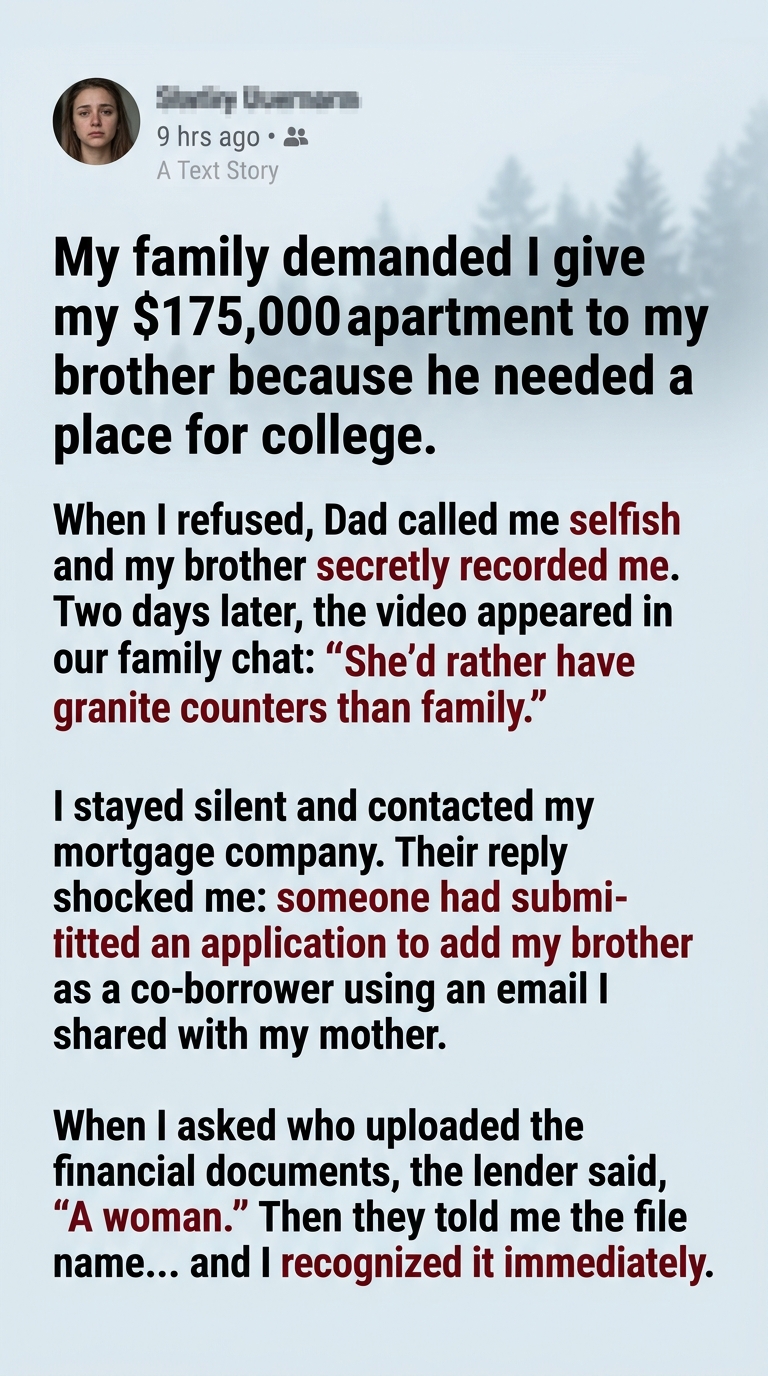
My family demanded that I give my $175,000 apartment to my younger brother because he needed somewhere to live while attending college.
When I refused, my father called me selfish.
My mother said I cared more about granite countertops than my own family.
And my brother secretly recorded me during an argument, then posted the video in our family group chat with the caption:
“She’d rather have granite counters than family.”
I didn’t respond.
I didn’t defend myself.
Instead, I contacted my mortgage company to ask a question about my account.
Two days later, a representative called me back.
“There’s something unusual we need to discuss,” she said.
Apparently, someone had submitted an application to add my brother as a co-borrower on my mortgage.
I froze.
“Who submitted it?”
“The application was uploaded using an email address associated with your family.”
I recognized the address immediately.
It was the shared email account my mother and I had used for years to organize family paperwork.
Then I asked who had uploaded the financial documents.
The representative paused.
“A woman.”
My stomach tightened.
“Can you tell me the file name?”
She read it aloud.
MOM_APPROVED_TRANSFER_FINAL.pdf
I knew that file name.
Because I had created a document with almost exactly the same name months earlier.
But I had never approved any transfer.
And when the mortgage company sent me the uploaded document, I discovered something that made me realize this wasn’t just another argument about my brother needing a place to stay.
Someone in my family had been preparing to take control of my apartment.
My name is Rachel, and I was thirty years old when everything happened.
I bought my apartment three years earlier.
It wasn’t enormous, but it was mine.
It had two bedrooms, a small balcony, a modern kitchen, and a beautiful granite countertop I had spent months saving for.
The purchase price was $175,000.
I had worked hard for the down payment, maintained a steady job, and qualified for the mortgage independently.
Every monthly payment came from my salary.
I was proud of that apartment because it represented something important.
I had built a life without depending on anyone.
My younger brother, Tyler, was twenty-one and attending college.
He was intelligent, charming, and accustomed to getting help whenever he needed it.
My parents had always treated him differently.
When he wanted a car, Dad helped him buy one.
When he struggled with tuition, Mom found a way to cover the difference.
When he lost a part-time job, they paid his phone bill.
I wasn’t jealous.
I understood that parents sometimes helped children differently depending on their circumstances.
But there was one difference between Tyler and me.
When I was his age, I worked two jobs and paid my own expenses.
Nobody offered me an apartment.
Nobody called me selfish when I couldn’t afford something.
I had learned to manage without expecting anyone to rescue me.
Unfortunately, my family seemed to believe that because I had succeeded, I was now responsible for solving everyone else’s problems.
The apartment argument began during Sunday dinner.
My mother, Diane, had invited everyone over to discuss Tyler’s next semester.
He had been accepted into a college program closer to my apartment, but his current commute was expensive and exhausting.
Dad suggested that Tyler move into my second bedroom.
I didn’t immediately object.
“How long would he stay?” I asked.
Mom smiled.
“Until he finishes college.”
I nearly dropped my fork.
“That’s potentially four years.”
“He’s your brother,” Dad said.
“I know he’s my brother. But I work from home, and I use that room as an office.”
Tyler rolled his eyes.
“You can work in the living room.”
I looked at him.
“That’s not practical.”
Dad leaned back.
“Then maybe you should give him the apartment.”
I stared at him.
“What?”
“You have a good salary. You can buy another place eventually. Tyler needs somewhere to live now.”
I thought he was joking.
He wasn’t.
Dad continued.
“The apartment is worth around $175,000. You’ve already built equity. You could transfer it to your brother, and he’d have a stable place while he studies.”
I looked at my mother.
She nodded as though the idea were perfectly reasonable.
“Your brother has a future ahead of him. You should want to help.”
I put down my fork.
“I am not giving him my apartment.”
Dad’s expression hardened.
“Why not?”
“Because I bought it. I pay the mortgage. It’s my home.”
Tyler laughed.
“You’re acting like I’m asking you to give me your entire life.”
“You’re asking me to give you a property worth $175,000.”
He shook his head.
“You’re so obsessed with money.”
I looked directly at him.
“Then buy your own apartment.”
Dad slammed his hand on the table.
“That’s enough, Rachel. You’re being selfish.”
I stood up.
“I worked for this. I saved for it. I pay for it. Nobody handed it to me.”
Mom sighed.
“All we’re asking is that you put family first.”
I shook my head.
“Family doesn’t mean I have to give away everything I’ve worked for.”
Tyler reached for his phone.
I noticed him pointing it toward me.
“Are you recording me?” I asked.
He lowered it quickly.
“No.”
But I knew what I had seen.
I left shortly afterward.
Two days later, the family group chat exploded.
Tyler had posted a short video of me from Sunday dinner.
The clip began with me saying:
“I’m not giving him my apartment.”
It ended with me telling him to buy his own place.
Everything in between had been cut out.
His caption read:
“She’d rather have granite counters than family.”
Mom added a crying emoji.
Dad wrote:
“One day you’ll understand what family means.”
An aunt commented that I had become arrogant since buying property.
A cousin said I should be grateful I had a brother who wanted to live near me.
Nobody asked what had actually happened.
Nobody asked why my brother believed he was entitled to my apartment.
I stared at the messages for several minutes.
Then I closed the chat.
I wasn’t going to argue with a video that had been deliberately edited to make me look cruel.
Instead, I decided to check my mortgage account.
Something about the way Tyler had recorded me bothered me.
It felt too deliberate.
I opened the lender’s website and reviewed my account activity.
At first, everything looked normal.
Then I noticed a notification about a recent inquiry.
It referred to a change-of-borrower application.
I hadn’t requested one.
I called the mortgage company immediately.
The representative who answered was named Melissa.
I explained that I had noticed an application inquiry and wanted to confirm whether anyone had attempted to make changes to my mortgage.
She asked me to verify my identity.
After checking the account, she became quiet.
“Ms. Carter, I can see an application submitted recently to add another individual as a co-borrower.”
My hands went cold.
“Who?”
She read the name.
“Tyler Carter.”
I stared at the screen.
“That’s my brother.”
“Are you aware of this application?”
“No. I never authorized it.”
Melissa placed me on hold.
When she returned, she explained that the application had not been approved or processed. It had been flagged because the authorization information did not match the account holder’s verified instructions.
I felt a wave of relief.
Then I asked how it had been submitted.
“The application was uploaded using an email address associated with your account correspondence.”
I recognized the address.
It was an old shared family email account.
My mother and I had used it years earlier when she helped me organize paperwork during the apartment purchase.
I had changed my primary contact information since then, but I hadn’t realized that the old address was still connected to some archived documents.
“Who uploaded the documents?” I asked.
Melissa checked.
“The submission was made by a woman.”
My stomach tightened.
“Can you tell me the file name?”
She read it aloud.
“MOM_APPROVED_TRANSFER_FINAL.pdf.”
I closed my eyes.
I knew that name.
Six months earlier, my mother had asked me to prepare a document explaining the difference between a property transfer, a mortgage assumption, and adding someone as a co-borrower.
She said she wanted to understand the terms because a friend was going through a housing dispute.
I had created a simple comparison document and emailed it to her.
I had named it:
MOM_APPROVED_TRANSFER_GUIDE.pdf.
The file uploaded to the mortgage company had a different name.
Someone had taken my educational document and renamed it to look like an authorization.
I asked Melissa to send me the complete application record through the lender’s secure portal.
She agreed.
Then she advised me to secure my account, change the email address, and submit a written notice that I disputed the application.
I did all three.
I also contacted my attorney.
The uploaded document arrived that afternoon.
I opened it carefully.
The first page looked like a standard mortgage authorization.
It included my full name, the apartment address, and my loan reference number.
There was a section stating that I consented to Tyler being added as a co-borrower.
At the bottom was a signature.
My signature.
Or at least, something that looked like it.
I stared at it.
The letters were almost right.
But the final stroke was different.
I knew because I had signed thousands of documents over the years.
Then I noticed the date.
It was a date when I had been out of the country on a business trip.
I remembered that trip clearly because my phone had been stolen at the airport.
I had spent two days recovering my accounts and changing passwords.
I immediately sent the document to my attorney.
She called me within an hour.
“Rachel, don’t contact anyone about this yet.”
“Do you think my mother did it?”
“I don’t know. The lender’s records may help establish who submitted it, but we need to distinguish between the person who uploaded a document and the person who created or signed it.”
She reminded me not to accuse anyone publicly.
“We need evidence. Preserve the original email, the document, the lender’s notices, and any messages about the apartment.”
I agreed.
Then she asked me a question.
“Did anyone have access to your old email account?”
I thought about it.
“My mother knew the password. She used the account when she helped me with paperwork.”
“Anyone else?”
“Tyler sometimes used the family laptop.”
My attorney paused.
“Then we need to secure everything. Don’t delete anything.”
I changed every password associated with my financial accounts.
I enabled additional verification, contacted the credit bureaus about protective measures available in my jurisdiction, and asked the lender to place a restriction on any account changes without direct confirmation from me.
I also filed a formal identity-misuse report with the relevant authorities after receiving legal advice.
For the first time, I began to understand how serious this was.
My family hadn’t simply been pressuring me to help Tyler.
Someone had tried to use my identity to alter my mortgage.
A few days later, the mortgage company’s fraud department contacted me.
They had reviewed the submission records.
They confirmed that the application had been uploaded through the old email account, but they could not conclusively identify the person who created the document from the information available.
However, they had discovered something else.
The uploaded file contained metadata showing that it had been edited using a computer with the device name:
DIANE-HOME-LAPTOP.
My mother’s laptop.
I stared at the screen.
I felt sick.
The evidence didn’t prove everything, but it was a significant lead.
I forwarded it to my attorney.
She contacted the lender’s fraud department and requested that all records be preserved.
Then she asked me to avoid confronting my mother until we understood the full picture.
I tried.
I really did.
But that evening, my mother called.
“Rachel, why are you making such a big deal about the apartment?”
I was silent.
She continued.
“Tyler is under a lot of pressure. You could make his life so much easier.”
I finally asked, “Did you submit an application to add him to my mortgage?”
Silence.
Then she laughed nervously.
“What are you talking about?”
“Someone uploaded a document using my information and a signature I didn’t authorize.”
“Well, maybe Tyler was just trying to see what was possible.”
“Did you help him?”
Her voice became sharp.
“Don’t accuse me of anything. We’re your family.”
I closed my eyes.
“That’s exactly why this hurts.”
She hung up.
The next day, Tyler sent me a message.
Mom says you’re threatening to report us.
I didn’t respond.
He sent another.
You know we were only trying to help me get settled. You don’t have to be so dramatic.
I forwarded the messages to my attorney.
A few hours later, Dad called.
He sounded furious.
“Your mother is crying because of you.”
I took a breath.
“Did you know someone tried to add Tyler to my mortgage?”
He paused.
“She said it was just paperwork.”
“Did she have my permission?”
“You’re making this sound criminal.”
I felt my throat tighten.
“Someone submitted a document with my name and a false signature.”
Dad became quiet.
Then he said something I will never forget.
“Well, if you hadn’t been so selfish, none of this would have happened.”
I ended the call.
That was the moment I stopped hoping they would understand.
The mortgage company’s investigation continued.
Eventually, they confirmed that the application had been rejected before any change was made to the loan.
No ownership rights had been transferred.
No additional borrower had been added.
The lender’s records showed the old email account had been used to submit the application, and the device metadata was consistent with the laptop used at my parents’ home.
My attorney requested further review through the appropriate channels.
The investigation later established that my mother had prepared the application using documents she had access to, while Tyler had provided his financial information and encouraged her to submit it.
They claimed they thought it was only a preliminary application.
But neither had my authorization.
And neither had the right to use my signature.
The matter was referred for formal review.
I did not need to exaggerate what had happened or make public accusations. The records spoke for themselves.
My attorney sent my family a formal notice stating that no one had permission to access my mortgage account, submit applications, or use my financial documents.
She also advised me to revoke all remaining shared access and keep future communication in writing.
For the first time, my parents understood that I was no longer going to solve the problem quietly.
Several weeks later, my father asked to meet.
I agreed to meet him at a coffee shop.
He arrived looking tired.
“Your mother says she didn’t mean to hurt you.”
I stirred my coffee.
“Did she know she was submitting a document with a signature that wasn’t mine?”
He looked uncomfortable.
“She thought it would help Tyler.”
“That’s not an answer.”
He sighed.
“Your brother is struggling. College is expensive. He doesn’t have much.”
I looked at him.
“And I worked for years to buy my apartment. Why does his struggle mean my property becomes his solution?”
Dad didn’t respond.
I continued.
“I would have helped Tyler look for affordable housing. I would have helped him compare rental options. I might even have contributed a reasonable amount if I could afford it. But nobody asked me for help. You demanded my apartment, and when I refused, someone tried to change my mortgage without my permission.”
He rubbed his face.
“We’re still family.”
“Then you should have treated me like family before trying to use my identity.”
He looked down.
For the first time, he didn’t have an argument.
Tyler eventually found a room in a shared student apartment.
It wasn’t luxurious, but it was close to campus and within his budget.
My parents helped him with the deposit.
I didn’t interfere.
The mortgage company permanently removed the old email address from my account, strengthened the account security, and confirmed in writing that no changes had been made to my loan.
My attorney continued handling the identity-misuse matter.
I also made one final decision.
I stopped sharing financial information with my family.
No account details.
No property documents.
No passwords.
No explanations about my salary or savings.
Some relatives accused me of being cold.
I stopped responding.
Months later, I finally replaced the small dining table I had been planning to upgrade.
I bought a beautiful wooden table with four chairs.
Not because I wanted to show anyone what I could afford.
Because I wanted to enjoy my home.
One evening, I sat at that table with a cup of tea and looked around my apartment.
The granite countertop was still there.
The mortgage was still in my name.
And the home I had worked so hard to buy was still mine.
I thought about the video Tyler had posted.
“She’d rather have granite counters than family.”
I smiled sadly.
He had been right about one thing.
I did choose my apartment.
I chose the place I had worked for, saved for, and paid for.
But I hadn’t chosen granite over family.
I had chosen not to let my family take something that belonged to me.
And if they believed that made me selfish, I could live with that.
Because family should be the people who respect your boundaries—not the people who try to sign your name when you say no.