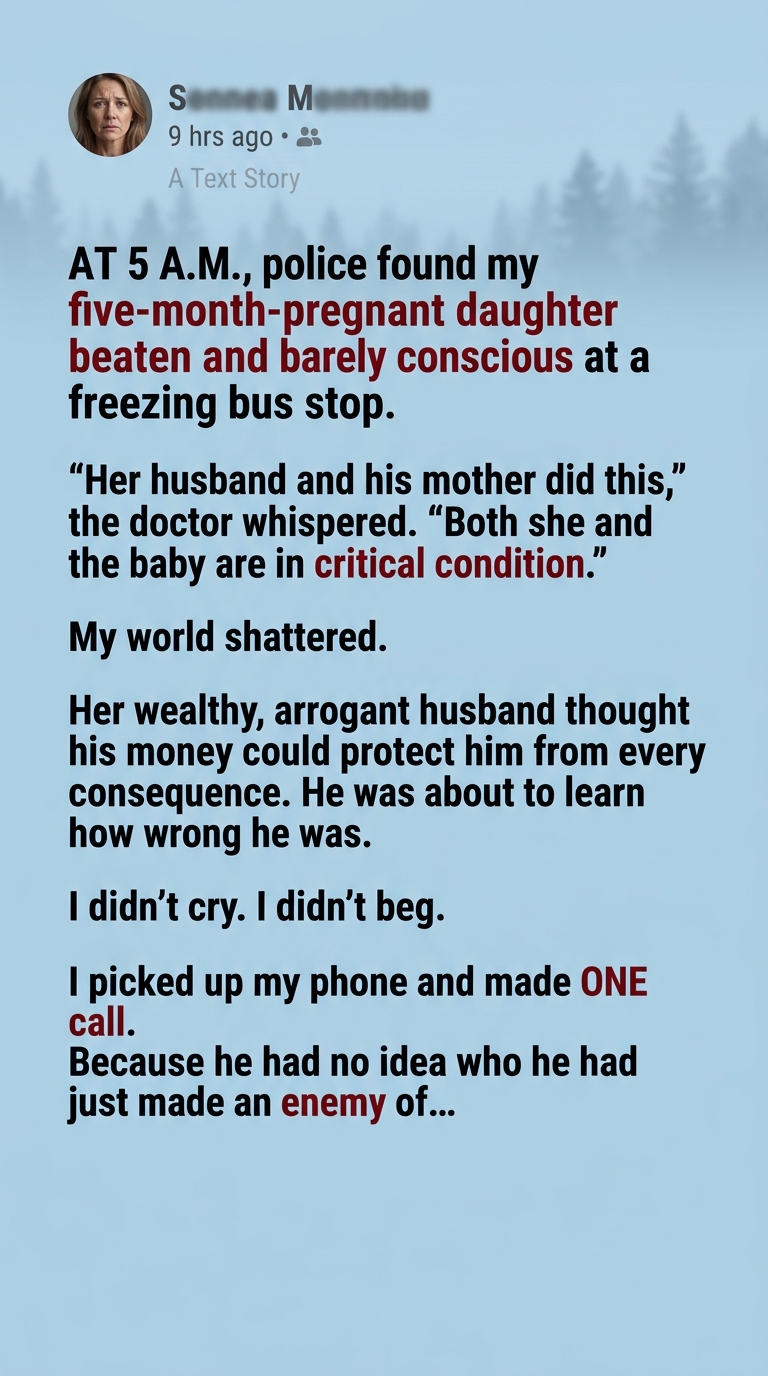
They Left My Pregnant Daughter to Die in the Cold—But Her Husband Made One Fatal Mistake
At 5:03 a.m., a police officer called me and asked if I was sitting down.
I wasn’t.
I was standing in my kitchen, making coffee, when he told me that my five-month-pregnant daughter had been found beaten and barely conscious at a freezing bus stop.
For a moment, I couldn’t understand the words.
Then he said, “Sir, she’s been taken to the hospital. You need to come immediately.”
I drove through the darkness with my hands gripping the steering wheel so tightly my fingers hurt.
My daughter, Emily, was twenty-nine years old. She had been married to Richard Hayes for three years, and until that morning, I had tried desperately to believe that the problems in their marriage were ordinary problems that two adults could work through.
Richard came from a wealthy family. His father owned several commercial properties, his mother, Victoria, sat on the boards of charitable organizations, and Richard himself drove cars that cost more than my first house.
He had always been arrogant, but Emily had insisted that he loved her.
“He’s under pressure, Dad,” she’d tell me whenever I asked about his temper. “You know how his family is.”
I knew enough to dislike them.
Victoria had once told Emily that pregnancy was an excellent opportunity to learn how to become a more obedient wife. Richard had laughed when Emily repeated the story to me.
I had wanted to confront him then.
Emily begged me not to.
“He’ll change when the baby comes,” she said.
I prayed she was right.
When I arrived at the hospital, a nurse led me to a consultation room. A doctor entered a few minutes later, his expression grave.
“Your daughter has sustained multiple injuries,” he explained. “She’s unconscious, and we’re monitoring her very closely. The baby is also in serious danger. Our obstetric team is doing everything possible to assess and stabilize both of them.”
I sat down because my legs no longer felt capable of holding me.
“Will she survive?”
“We’re doing everything we can. I can’t promise you an outcome yet.”
I stared at him.
Then he lowered his voice.
“Police have informed us that your daughter identified her husband and his mother as the people who assaulted her, before she lost consciousness. Investigators are looking into what happened.”
The room seemed to go silent.
Richard.
And Victoria.
My daughter’s husband and mother-in-law.
The people who had promised to protect her.
I looked through the glass toward the intensive care unit. Emily lay motionless beneath a white blanket, surrounded by monitors. Her face was swollen, and one of her hands rested beside her stomach.
My granddaughter—or grandson.
I hadn’t even had the chance to learn whether we were having a girl or a boy.
I had spent months imagining the day I would hold that child.
Now I was afraid I might lose them both before I ever got the chance.
I didn’t cry.
Not because I wasn’t devastated.
Because something inside me had gone very still.
I took out my phone and made one call.
“Martin,” I said when the other man answered. “It’s Daniel. I need you to activate the emergency plan.”
There was a brief silence.
Then he asked, “Is Emily alive?”
“Yes. But she and the baby are in critical condition.”
“I’ll be there in twenty minutes.”
I ended the call.
For the first time that morning, I allowed myself to breathe.
Richard Hayes had spent years believing that wealth made him untouchable. His family donated to hospitals, sponsored charity galas, and knew people in places where ordinary families struggled to get their calls returned.
He thought money could smooth over any problem.
He had forgotten something important.
My name was Daniel Mercer.
And before I retired, I had spent thirty-one years working as a prosecutor.
I knew the difference between an accusation and evidence. I knew that influence could complicate an investigation, but it could not lawfully erase facts. And I knew that if my daughter had been assaulted, the worst thing I could do was let anger make me careless.
So I didn’t call a newspaper.
I didn’t threaten Richard.
I didn’t send men to his house.
I called the person who had helped me navigate difficult cases for decades and asked him to make sure my family had the support it needed.
Martin Cole was a retired investigator who now worked as a consultant on complex criminal cases. He had been my closest professional friend for twenty-five years.
When he arrived, he found me sitting outside the intensive care unit.
He placed a hand on my shoulder.
“Tell me everything you know.”
I told him about the phone call, the doctor’s statement, and Emily’s history with Richard. I showed him the messages she had sent me over the preceding months, including one from two weeks earlier that read:
Dad, if anything ever happens to me, please make sure my baby is safe.
I had replied by asking whether everything was all right.
She had answered that she was just being emotional.
I had accepted that explanation.
I would regret that for a long time.
Martin read the message twice.
“Have you contacted the police?”
“They’re already investigating.”
“Good. Then let them work. We need to preserve everything Emily sent you, and we need to make sure nobody pressures you into confronting the suspects.”
I nodded.
“Can you help me find out what’s happening?”
“I can help you understand the process and make sure the right people have the information. We won’t interfere with evidence or try to run the investigation ourselves.”
That was why I trusted him.
He never promised miracles.
He promised to do the work properly.
By seven o’clock, I had spoken with the lead detective. She confirmed that officers were investigating an alleged assault and that they would be interviewing witnesses and examining the available evidence.
She also warned me that Emily’s statement would need to be considered alongside other evidence. I understood.
I had spent decades in courtrooms. I knew that even the most horrifying accusation had to be investigated carefully.
But I also knew that a pregnant woman lying unconscious in an intensive care unit deserved every protection the law could provide.
At 8:12 a.m., Richard arrived.
He wore an expensive dark coat and carried a leather briefcase. Victoria followed behind him, dressed in a cream-colored suit. Neither looked as though they had spent the night worrying about Emily.
Richard approached me.
“Where is my wife?”
I stood.
“Your wife is fighting for her life.”
His jaw tightened.
“I heard there was an incident.”
“An incident?”
He glanced toward the nurses’ station.
“This isn’t the place to discuss family matters.”
I stared at him.
“Family matters? Your pregnant wife was found beaten at a bus stop.”
His face hardened.
“Be careful what you say, Mr. Mercer.”
Victoria stepped forward.
“Daniel, this is a terrible misunderstanding. Emily has been emotional lately. The pregnancy has been difficult, and she has a tendency to exaggerate.”
I felt my hands curl into fists.
Then I remembered Martin’s warning.
Do not let anger make you careless.
I relaxed my fingers.
“The police will speak to everyone involved,” I said. “Until then, I suggest you direct any questions to the investigating officer.”
Richard leaned closer.
“You don’t know who you’re dealing with.”
I looked directly into his eyes.
“No, Richard. I think you’re the one who doesn’t understand.”
A security officer approached and asked them to step away from the intensive care entrance while staff clarified visiting arrangements. They protested, but eventually left the corridor.
As they walked away, Victoria turned back.
“You’ll regret humiliating this family.”
I watched her disappear around the corner.
Then I sat down beside Martin.
“Tell me something,” I said quietly. “If they did this, can money make it disappear?”
Martin shook his head.
“Money can buy lawyers. It can influence how people present themselves. It can make a case complicated. But it doesn’t make evidence vanish, and it doesn’t give anyone permission to hurt another person.”
He paused.
“The strongest thing you can do for Emily is make sure the truth is documented and that she has the best support available.”
So that’s what I did.
I arranged for a family liaison officer to keep me informed, with the investigators’ permission. I provided Emily’s messages and contact details for people who might have relevant information. I made sure her medical team knew about the pregnancy and the circumstances under which she had been found.
And I waited.
The hours passed painfully slowly.
At noon, the obstetric specialist came to speak with me.
“Your daughter is still in critical condition,” she said, “but we’re seeing some signs that allow us to continue treatment. The baby remains at significant risk. We need to take this hour by hour.”
I thanked her.
Then I went into the family room and cried for the first time.
I cried for Emily, for the child she had carried for five months, and for every moment when she had tried to tell me something was wrong without finding the words.
I cried because I had spent so much time respecting her request not to interfere that I hadn’t realized how frightened she might have been.
When I returned to the corridor, Martin was waiting with a cup of coffee.
“The detective called,” he said.
I straightened.
“What did she say?”
“She can’t share every detail yet, but she confirmed that officers are examining evidence and speaking to people who may have seen or heard something. They’re treating the allegations seriously.”
I nodded.
I didn’t need him to promise that Richard would be arrested.
I needed him to tell me the investigation was moving forward.
That evening, Emily briefly regained consciousness.
The nurse called me into her room.
I approached the bed slowly, afraid that even my footsteps might hurt her.
“Emily?”
Her eyelids fluttered.
“Dad?”
“I’m here, sweetheart.”
She began crying.
“The baby?”
“The doctors are doing everything they can. You’re both getting care.”
She tried to lift her hand, and I gently held it.
“Richard said nobody would believe me,” she whispered.
My heart broke.
“Why would he say that?”
She swallowed painfully.
“Because everyone believes him. His mother said I would lose everything if I ever told anyone what happened at home.”
I leaned closer.
“You don’t have to decide anything right now. You need to rest. The doctors are taking care of you, and the police are investigating. You don’t have to face this alone.”
She closed her eyes.
Then she whispered, “I’m sorry I didn’t tell you.”
I pressed her hand against my cheek.
“You have nothing to apologize for.”
She drifted back to sleep.
I remained beside her until a nurse asked me to let her rest.
Outside, Martin was waiting.
I told him what Emily had said.
He listened carefully, then reminded me that her account needed to be recorded by investigators when her medical team believed she was well enough. We would not press her for details before she was ready.
That night, I made a second call.
This time, I called an attorney who specialized in family law and protective orders.
I asked what steps might be available if Emily wanted protection from Richard after leaving the hospital. The attorney explained that any protective order would depend on the facts and the applicable law, but we could begin preparing the necessary information without forcing Emily to make decisions while she was medically unstable.
We also discussed how to protect her access to money, documents, and personal belongings.
I wasn’t trying to punish Richard through the legal system.
I was trying to make sure he couldn’t use financial pressure to control my daughter if she survived and chose to leave.
For the next two days, I barely left the hospital.
Emily remained critically ill, but she gradually became more responsive. The medical team continued to monitor her closely, and the pregnancy required careful assessment. No one could yet promise that the baby would survive.
On the third day, a detective asked to speak with me privately.
She explained that investigators had obtained information that was consistent with parts of Emily’s account, though the investigation was ongoing. They had identified witnesses who might be able to describe events before and after she was found.
They were also reviewing relevant communications.
I listened without interrupting.
“Can I ask whether Richard has been arrested?” I said.
“I can’t discuss every investigative step, but I can tell you that we’re following the evidence. We aren’t treating his family’s financial position as a reason to give him special treatment.”
I thanked her.
That was all I needed to hear.
Later that afternoon, Richard’s attorney contacted me.
He wanted to discuss “a private resolution.”
I declined to negotiate anything concerning the alleged assault. I told him that any communication about the criminal investigation should go through the appropriate channels, and that Emily’s medical care and safety were my immediate priorities.
The attorney said his client denied the allegations.
I acknowledged the denial and ended the call.
I wasn’t going to trade my daughter’s safety for money, and I wasn’t going to accept a private agreement as a substitute for a proper investigation.
A week after Emily was admitted, the doctors finally gave us some cautiously encouraging news.
Her condition was improving.
The baby was still at risk, but the team had been able to monitor the pregnancy and continue supportive treatment. They emphasized that there was still a long road ahead.
I sat beside Emily’s bed and told her what the doctors had said.
She began to cry.
“Does that mean the baby might be okay?”
“It means they’re still fighting for you both,” I said. “We’ll take it one day at a time.”
She squeezed my hand.
For the first time since that awful morning, I allowed myself to hope.
Over the next several weeks, Emily’s recovery continued. She needed rehabilitation, follow-up appointments, and emotional support. Her doctors arranged appropriate counseling resources, and her legal team helped her explore protective measures and a safe place to stay after discharge.
She eventually told the investigators more about what had happened in the days leading up to the assault. Her account was considered alongside the evidence they had gathered, rather than treated as the sole basis for any conclusion.
The investigation continued through formal interviews and review of records. Richard and Victoria denied wrongdoing, and the case moved through the proper legal process.
There was no instant courtroom victory.
No dramatic confession.
No miraculous moment when the powerful suddenly became powerless.
There was evidence to review, legal procedures to follow, and a young woman trying to recover from an experience that had nearly cost her life.
That was what mattered.
Months later, Emily was living in a secure apartment with support from people she trusted. Her relationship with Richard was being handled through legal counsel, and the family-law proceedings were separate from the criminal investigation.
The baby survived the pregnancy and was born under close medical supervision.
When I first held my granddaughter, I couldn’t speak.
She was tiny, warm, and very much alive.
Emily watched me from the hospital bed, tears slipping down her cheeks.
“Dad,” she whispered, “we made it.”
I kissed her forehead.
“You did, sweetheart. You fought your way back.”
I named no victory over Richard that day.
I didn’t think about his money, his cars, or the people he knew.
I thought about Emily’s first breath after she woke in the ICU. I thought about the doctors who refused to give up, the nurse who sat with me when I couldn’t stop shaking, and the detective who kept returning my calls.
I thought about the fact that my daughter was alive.
The legal proceedings took time. The investigators continued their work, and any findings or charges had to rest on evidence and due process. Emily’s safety and recovery remained our focus regardless of the outcome.
Richard had believed his wealth could protect him from every consequence.
But the most important consequence was one he couldn’t control.
My daughter had survived.
She had people around her who believed she deserved safety, dignity, and a future free from fear. She had access to legal advice and medical support. She no longer had to depend on her husband to decide whether she could ask for help.
And I had learned something, too.
When someone you love is in danger, anger can make you feel powerful. But anger alone cannot protect them.
What protects them is patience, careful action, good medical care, evidence preserved properly, and a willingness to let the law do its work.
I made that one phone call because I knew I needed help.
I kept making the right calls because my daughter deserved more than revenge.
She deserved a chance to live.
And when I look at my granddaughter now, sleeping peacefully in her mother’s arms, I know that was the only outcome that ever truly mattered.