My Stepmother Threw Me Out After Dad’s Funeral—Then Five Black SUVs Arrived
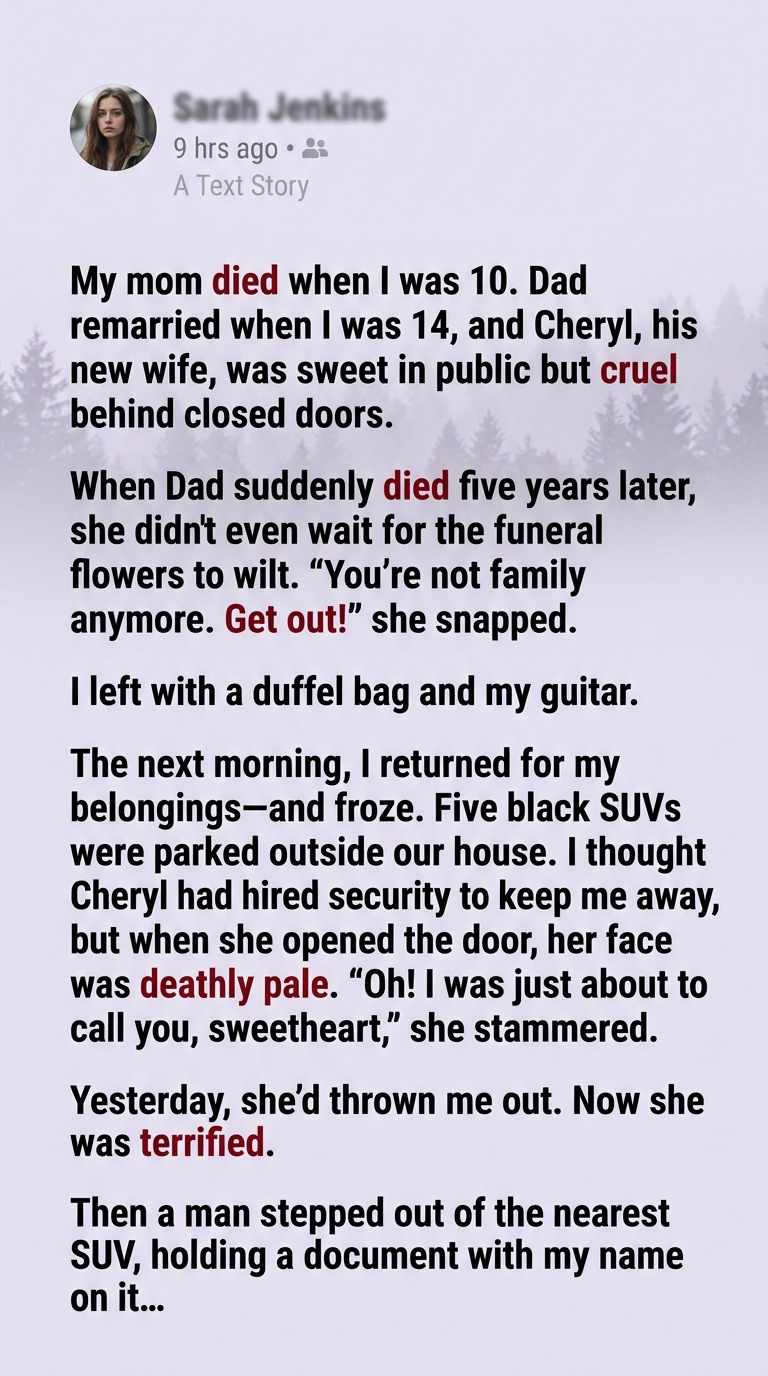
My mom died when I was ten.
For a long time, it was just my dad and me against the world. He worked long hours as a mechanic, packed my lunches every morning, and sat through every school concert even when I was too embarrassed to look at him from the stage.
When I turned fourteen, he married Cheryl.
At first, she seemed like the answer to every prayer I had ever whispered. She smiled at my teachers, brought cookies to school events, and called me her “handsome stepson” whenever other people were around.
But behind closed doors, she was different.
She criticized the way I ate, complained about the money Dad spent on my guitar lessons, and reminded me that I wasn’t her responsibility.
“Your father spoils you,” she’d whisper whenever he left the room. “You should be grateful someone puts up with you.”
I learned to keep my head down.
I was fifteen when she threw away the birthday card my mother had written to me before she died. When I found it in the trash, Cheryl shrugged and said the house didn’t need to be cluttered with things from the past.
I never told Dad. I was afraid that if I did, he would have to choose between us.
And I couldn’t bear the thought of losing him, too.
Then, when I was nineteen, Dad died suddenly.
A heart attack.
One moment, he was in the garage working on an old truck. The next, I was standing in a hospital corridor while a doctor explained that there was nothing more they could do.
I don’t remember much about the funeral. I remember the smell of lilies, the weight of people’s hands on my shoulders, and Cheryl crying loudly whenever someone looked at her.
I remember thinking that we were both grieving, and perhaps we could finally lean on each other.
I was wrong.
The morning after the funeral, I walked into the kitchen and found Cheryl sorting through a stack of papers.
“Can we talk?” I asked.
She didn’t look up.
“There’s nothing to talk about.”
“I was wondering what happens now. I mean, with the house and—”
She slapped a folder onto the counter.
“You’re not family anymore. Get out!”
I stared at her.
“What?”
“You heard me. Your father is dead, and I am not responsible for you. You’re nineteen. You’re an adult. Figure it out.”
“Cheryl, I just buried my dad yesterday.”
“And I just lost my husband! Do you think I want to spend my time taking care of a grown man who can’t even pay his own bills?”
I looked around the kitchen, at the table where Dad and I used to eat pancakes on Sunday mornings.
“Where am I supposed to go?”
She pointed toward the front door.
“Not my problem.”
I wanted to scream. I wanted to remind her that Dad had paid for the roof over her head, that I had helped around the house, that I had never asked her to love me—only to stop treating me like I was a burden.
Instead, I went upstairs.
I packed a duffel bag with clothes, my guitar, a few photographs of my mother, and the old watch Dad had given me when I turned sixteen.
I stood in my bedroom for several minutes, staring at the walls.
Then I walked downstairs.
Cheryl was already on the phone.
“It’s taken care of,” she said to whoever was listening. “He’ll be gone by tonight.”
I stepped outside without saying goodbye.
That night, I slept on the sofa of my friend Marcus’s apartment. I barely closed my eyes. Every time I drifted off, I saw Dad’s face and heard Cheryl’s words.
By morning, I had decided to return to the house for the rest of my belongings. I didn’t know where I would go next, but I couldn’t leave behind everything that reminded me of my father.
Marcus drove me there shortly after eight.
As we turned onto my street, I noticed the vehicles first.
Five black SUVs were parked in front of the house.
They were large, polished, and identical, with dark windows that reflected the morning sky. Two men in dark suits stood beside the driveway, speaking quietly into their phones.
I sat up straight.
“Marcus, what is that?”
He slowed the car.
“I have no idea.”
My stomach tightened.
For one terrible moment, I thought Cheryl had hired security to keep me away. Maybe she’d already changed the locks. Maybe she’d decided that even my guitar and my mother’s photographs belonged to her now.
I stepped out of the car.
One of the men looked at me, spoke briefly into his phone, and nodded toward the house.
The front door opened.
Cheryl appeared on the porch.
But she didn’t look angry.
She looked terrified.
Her face was deathly pale, and she clutched the doorframe as though she needed it to stand.
“Oh!” she stammered when she saw me. “I was just about to call you, sweetheart.”
Yesterday, she’d thrown me out.
Now she was smiling as if nothing had happened.
I stopped at the bottom of the steps.
“What’s going on?”
She glanced toward the nearest SUV.
“There’s been a misunderstanding.”
Before I could ask another question, the rear door of the closest vehicle opened.
A tall man stepped out, holding a thick document folder. He wore a charcoal suit and carried himself with the calm confidence of someone accustomed to being listened to.
He approached me.
“Are you Daniel Bennett?”
I nodded.
“My name is Robert Hayes. I’m an attorney representing the estate of your late father.”
I felt the ground shift beneath my feet.
“His estate?”
The man opened the folder and checked a page.
“I’m looking for Daniel Bennett, son of Richard Bennett and Margaret Bennett.”
“That’s me.”
He looked at me carefully.
“Then I need you to know that your father left instructions that require us to speak with you in person.”
Cheryl hurried down the steps.
“Robert, I can explain everything. Daniel is upset. He’s grieving, and he doesn’t understand the arrangements.”
The attorney turned toward her.
“Mrs. Bennett, I think it’s best if we let Daniel hear this directly.”
Her mouth opened, then closed.
I looked from her to the attorney.
“What arrangements?”
Mr. Hayes held out the folder.
“Your father made several estate-planning decisions before his death. Some of those documents require verification, and there are matters we need to review with you privately. I also need to make clear that no one should pressure you into signing anything today.”
Cheryl’s face drained of what little color remained.
“That’s unnecessary,” she said quickly. “Daniel has nowhere to go. He’s emotional. We can sort this out as a family.”
I almost laughed.
“Yesterday, you told me I wasn’t family.”
She flinched.
Mr. Hayes didn’t react. He simply asked whether I would be comfortable speaking with him inside.
I looked at the house.
For five years, I had walked through that front door wondering which version of Cheryl I would find. Now I wasn’t sure I wanted to enter it again.
But the attorney had my father’s name on his documents.
So I followed him inside.
The five SUVs remained outside. The men in suits stayed near the driveway, and Marcus waited in his car.
Cheryl paced near the kitchen island, wringing her hands.
Mr. Hayes placed the folder on the table.
“Daniel, before we discuss the estate, I need to ask you something. Did your father ever tell you about a company called Bennett Industrial?”
I shook my head.
“No. Dad was a mechanic. He worked at a repair shop for most of his life.”
The attorney nodded slowly.
“That is what most people knew him as.”
Cheryl stared at the floor.
Mr. Hayes continued.
“Your father inherited a minority interest in a manufacturing business from his grandfather. Over the years, that interest became more valuable. Richard kept his involvement private and continued working as a mechanic because he enjoyed the work and preferred a modest life.”
I stared at him.
“How much more valuable?”
“I can’t give you a final figure until the valuation and estate administration are complete. But the interest is substantial.”
Cheryl suddenly spoke.
“Richard told me everything. We were married. I helped him manage the household. I should be included in every decision.”
“You will be included in matters affecting your legal interests,” Mr. Hayes replied. “But we must follow the documents and applicable law.”
He turned back to me.
“Your father also created a trust for your benefit when you were younger. It was intended to protect certain assets until you reached adulthood. The trust documents were updated several times, most recently a few months ago.”
I thought of Dad’s long hours, his old truck, the way he repaired broken appliances instead of buying new ones.
He had never seemed wealthy.
He had seemed like a man who wanted to give his son a decent life.
“Why didn’t he tell me?” I asked.
Mr. Hayes folded his hands.
“I can only tell you what he wrote. He believed that money would complicate your life while you were still growing up. He wanted you to learn to work, make decisions, and build your own identity without expecting an inheritance.”
I looked down at the folder.
“What does this have to do with Cheryl?”
The attorney paused.
“Your father’s latest documents named you as the primary beneficiary of certain assets, subject to the terms of the trust and the administration of his estate. They also addressed the house.”
Cheryl gripped the counter.
“The house is mine,” she said. “Richard promised me I would always have a home.”
Mr. Hayes looked at her.
“The house is titled in Richard’s name. The will and related documents need to be reviewed together, and your rights as his surviving spouse must be considered. No one is making an immediate determination about possession today.”
Then he turned to me.
“However, your father left a letter specifically for you. He instructed me to give it to you after his death, once your identity had been verified.”
He handed me a sealed envelope.
My name was written across the front in Dad’s handwriting.
My knees nearly buckled.
I sat down and opened it.
Danny,
If you’re reading this, then I wasn’t able to tell you everything myself.
I know I haven’t always been good at talking about difficult things. After your mother died, I was afraid of making another mistake. I worked, I worried, and sometimes I convinced myself that providing for you was the same as being there for you.
I need you to know that you were never a burden. Not once.
I pressed the letter against my chest.
The next lines blurred through my tears.
I know Cheryl has struggled to understand you. I have tried to believe that things would improve, and I may have made excuses for behavior I should have confronted sooner. If you have ever felt alone in this house, I am sorry.
I looked up at Cheryl.
She was staring at the letter, her lips pressed together.
I continued reading.
There is something else you need to understand. I didn’t keep my business interest a secret because I didn’t trust you. I kept it private because I wanted you to have a life of your own.
The trust is there to give you choices—not to tell you what kind of person to become.
Finish your education if you want to. Travel. Make music. Find work you care about. Help people when you can, but never believe you have to sacrifice your dignity to deserve a place in someone’s home.
My eyes filled.
Dad knew.
He had known that I felt unwanted, even if I had never found the courage to tell him how bad things had become.
The final paragraph read:
If Cheryl is still in the house when you read this, I hope she treats you with kindness. But if she doesn’t, remember that you are my son, and no one can take that away from you.
I love you, Danny. Always.
I couldn’t speak.
For years, I had been afraid to tell Dad the truth about Cheryl because I thought it might break his heart. Now I wondered how many moments he had sensed something was wrong and blamed himself for not knowing how to fix it.
I folded the letter carefully.
“What happens now?” I asked.
Mr. Hayes explained that the estate would be administered according to the will, the trust documents, and the relevant law. The business interest would need a formal valuation. Any claims concerning the house or other assets would be reviewed, and no one would be asked to sign away rights without independent advice.
He also confirmed that I could collect my personal belongings without being pressured to leave them behind.
Cheryl suddenly began crying.
“Daniel, please. I was upset yesterday. I didn’t mean it the way it sounded.”
I stared at her.
“You told me to get out.”
“I was grieving.”
“So was I.”
“I didn’t know about all this,” she whispered.
The words slipped out before she could stop them.
Mr. Hayes looked at her.
“About the trust?”
She froze.
I noticed it immediately.
“You knew Dad had assets he hadn’t told me about?”
Cheryl swallowed.
“I knew he had investments. I didn’t know the details.”
“Then why did you throw me out before the funeral flowers had even wilted?”
She looked away.
“I thought you were going to demand everything.”
I stared at her in disbelief.
“I hadn’t demanded anything. I asked what was going to happen to the house.”
“You were asking questions.”
“Because my father had just died!”
She began crying harder.
“I was scared. I thought if you stayed, everything would become a fight. I thought you would try to take the house from me.”
Mr. Hayes calmly interrupted.
“Mrs. Bennett, any concerns about the estate need to be handled through the legal process. Threatening or pressuring Daniel won’t resolve them.”
For the first time in five years, someone had drawn a clear boundary around Cheryl’s behavior.
And I didn’t have to be the one to do it.
I collected my duffel bag and the rest of my belongings that afternoon. Mr. Hayes arranged for an inventory of items that might be disputed, but my personal photographs, clothes, and guitar were returned to me.
I took the old watch Dad had given me and placed it around my wrist.
Before I left, Cheryl stood by the front door.
“Where are you going to live?”
“Marcus has offered me his spare room while I figure things out.”
“You can’t just leave.”
I looked at her.
“Yesterday, you said I wasn’t family anymore.”
She lowered her eyes.
“I was wrong.”
I wanted to believe her.
But an apology offered only after a person discovers your inheritance isn’t the same as an apology offered because they understand the harm they’ve caused.
“I hope you find peace, Cheryl,” I said. “But I’m not moving back in.”
Then I walked out.
The estate process took months. The lawyers reviewed the documents, obtained the required valuations, and addressed the surviving spouse’s legal interests. The trust was administered according to its terms, and I received independent advice before making decisions about the assets.
The inheritance was substantial, but it wasn’t a magic solution to grief.
Money couldn’t bring Dad back. It couldn’t return the years I had spent trying to earn kindness from someone who treated me as an inconvenience.
Still, it gave me choices.
I enrolled in a music program I had postponed for years. I bought a modest apartment after my financial adviser helped me understand what I could responsibly afford. I kept working, because I liked having a routine and wanted to build a life that wasn’t defined by the money Dad had left me.
I also began writing songs again.
For a long time, my guitar had been the one place I could say things I didn’t know how to explain. I wrote about my mother, my father, and the strange ache of being nineteen and suddenly feeling like an orphan in a house where I had grown up.
One evening, I played a new song at a small local venue.
It was called “The Place I Belong.”
The lyrics were simple. They were about a father who couldn’t stay forever but had found a way to leave his son a message: that love was never supposed to be earned by giving up your own dignity.
After the performance, a woman approached me and told me the song reminded her of her late father.
I thanked her, then stepped outside into the cool night air.
I thought about Dad’s letter.
Help people when you can, but never believe you have to sacrifice your dignity to deserve a place in someone’s home.
For five years, I had mistaken silence for strength. I had tolerated Cheryl’s cruelty because I believed standing up for myself would hurt Dad. After he died, I had allowed her to make me feel as though my place in the family had disappeared with him.
But she had been wrong.
My father had made mistakes. He hadn’t told me everything, and he hadn’t always protected me from what was happening under his roof. Yet he had loved me, and he had made plans to ensure that his death wouldn’t leave me without choices.
The five black SUVs were only the visible part of that plan.
The real gift was the letter.
It reminded me that I didn’t have to beg for the right to grieve my father, to keep my memories, or to build a future.
I was his son before the inheritance existed.
I was his son when Cheryl threw me out.
And I would be his son long after the money had been spent.
That night, I went home, set my guitar beside the sofa, and placed Dad’s letter in the drawer of my bedside table.
Then I called Marcus and thanked him for letting me stay with him during the first weeks after the funeral.
He laughed.
“You don’t have to thank me. That’s what friends are for.”
I smiled.
For the first time since Dad died, I believed that I might be all right.
I had lost my parents, my childhood home, and the future I thought I would have.
But I hadn’t lost myself.
And no amount of money, no legal document, and no cruel stepmother could take away the one thing my father had given me that mattered more than everything else.
The knowledge that I had always belonged.