The Blind Woman Who Knew My Husband’s Secret
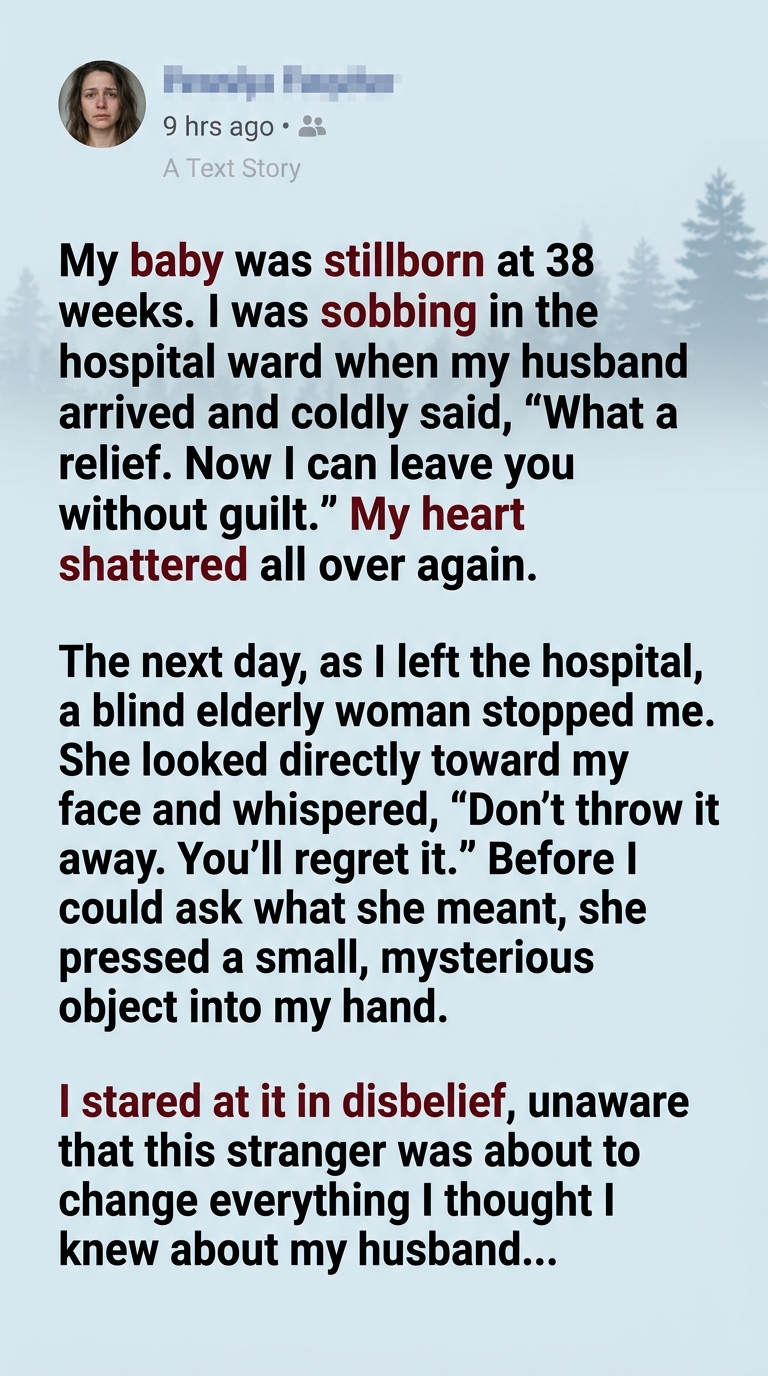
My baby was stillborn at thirty-eight weeks.
I had spent nine months imagining the sound of his first cry, the warmth of his tiny body against my chest, and the moment my husband would finally hold his son.
Instead, I lay in a hospital bed with empty arms, staring at a pale blue blanket folded at the foot of the bed.
I had named him Noah.
I had whispered that name to my belly every night, telling him about the little house we would live in, the dog we might adopt, and the father who had promised to teach him how to ride a bicycle.
But Noah never came home.
I was still sobbing when my husband, Daniel, finally arrived.
I expected him to hold me. I expected him to sit beside me and cry with me. Even if he couldn’t find the right words, I thought he would at least take my hand.
Instead, he stood at the foot of my bed with his arms crossed.
Then he said the words that broke what little remained of my heart.
“What a relief. Now I can leave you without guilt.”
For a moment, I couldn’t understand what I had heard.
“What?”
He glanced toward the door, as though he were already impatient to leave.
“You heard me, Claire. I didn’t want to abandon you while you were pregnant. Now there’s nothing tying us together.”
I stared at him.
Our baby had died less than a day earlier, and my husband was talking about our marriage as if it were an inconvenient contract that had finally expired.
“Daniel,” I whispered, “our son just died.”
His jaw tightened.
“Don’t make this harder than it has to be.”
Then he turned and walked out.
I didn’t chase him.
I couldn’t.
I curled onto my side, pressed my face into the hospital pillow, and cried until my throat hurt.
The nurses were kind. One brought me warm tea I barely touched. Another sat beside me without asking me to explain anything. When I apologized for crying so much, she gently told me I didn’t need to apologize for grieving my child.
But I kept thinking about Daniel.
For three years, I had believed I was married to a man who loved me. We had planned for Noah together. Daniel had painted the nursery a soft shade of blue, assembled the crib, and insisted that we buy a little wooden rocking horse.
He had rested his hand on my belly and told our son that he couldn’t wait to meet him.
Now I wondered whether any of it had been real.
The following morning, the hospital discharged me.
I left carrying a small bag of belongings and the folded blue blanket the nurses had given me. My mother was supposed to collect me, but she had been delayed by a problem with her car.
So I sat outside the hospital entrance beneath a gray sky, waiting for her.
That was when an elderly woman approached me.
She carried a white cane and wore a long charcoal coat. Her silver hair was tucked beneath a knitted hat, and her eyes were clouded with age. She moved slowly, tapping her cane against the pavement.
Yet when she stopped in front of me, she turned her face directly toward mine.
“Don’t throw it away,” she whispered. “You’ll regret it.”
I looked around, wondering whether she was speaking to someone else.
“I’m sorry?”
She reached into her coat pocket and placed something in my palm.
It was a small brass key attached to a faded blue ribbon.
I stared at it.
“Why are you giving me this?”
The woman closed my fingers around the key.
“Because he doesn’t know that you know.”
My blood ran cold.
“Who doesn’t know what?”
Her expression tightened.
“Your husband.”
Before I could ask another question, she stepped away, tapping her cane along the pavement.
“Wait!” I called.
She paused but didn’t turn around.
“Who are you?”
“My name is Evelyn,” she replied. “And I promised someone I would find you if the day ever came.”
“What day?”
She lowered her head.
“The day you needed the truth more than you needed another lie.”
Then she continued down the sidewalk.
I sat frozen, the little brass key digging into my palm.
When my mother arrived, I slipped it into my purse without telling her about the encounter. I was exhausted, grieving, and barely able to process what had happened with Daniel.
I didn’t know what the key opened.
But something about the woman’s words frightened me enough that I couldn’t bring myself to throw it away.
Three days later, I found out why.
Daniel hadn’t come home.
He sent one message through a lawyer, saying he wanted to separate and that his belongings would be collected later. There was no apology, no acknowledgment of Noah, and no offer to help me through the funeral arrangements.
My mother stayed with me, helping me make phone calls and reminding me to eat. We arranged a small memorial for Noah, and I placed his blue blanket beside a framed photograph of the ultrasound.
I couldn’t bear to put anything else in the nursery away.
Every evening, I sat in the rocking chair Daniel had assembled and wondered how a man could turn so cruel overnight.
Then, on the fourth day, I noticed the blue ribbon around the brass key had a tiny tag attached to it.
I had overlooked it in the hospital.
On the tag was a handwritten number: 214.
Beneath it were two words.
Riverside Storage.
I stared at the tag for a long time.
I knew Riverside Storage. It was a storage facility on the edge of town, not far from the old railway station. I had passed it hundreds of times.
The next morning, I drove there.
The woman at the front desk explained that she couldn’t disclose private information about a unit’s owner. But when I showed her the key and the number, she examined the tag carefully.
“Unit 214,” she said. “The key may still work, but I can’t tell you what’s inside unless you’re authorized to access it.”
I understood. I couldn’t simply assume that a stranger’s key gave me permission to enter someone else’s property.
I asked whether there was any way to identify the owner or establish my right to access the unit. After checking the tag and consulting her manager, she told me the facility had a procedure for that. I left my contact information and waited while they reviewed their records.
Two days later, I received a call.
The storage account had been opened under a name I recognized immediately.
Daniel Carter.
The account records indicated that I was listed as an authorized contact.
I drove back with my identification and the paperwork the facility requested.
The manager accompanied me to the unit.
My hands trembled as the door rolled upward.
Inside were cardboard boxes, a battered suitcase, several old photographs, and a metal filing cabinet. Nothing looked particularly extraordinary. For a moment, I wondered whether I had misunderstood the woman entirely.
Then I noticed a white envelope on top of the filing cabinet.
My name was written across it.
CLAIRE. OPEN THIS ONLY WHEN YOU ARE READY TO KNOW THE TRUTH.
I sat on the concrete floor and opened it.
Inside was a letter from a woman named Evelyn.
It began:
Claire, if you’re reading this, then Daniel has done what I feared he might do. I am sorry that you have been hurt. You deserve to know what happened before you met him.
I read the first paragraph twice.
Evelyn explained that she had been married to Daniel’s father, Thomas, for more than thirty years. She had lost most of her sight in her sixties, but she remembered people by their voices, their footsteps, and the details they shared with her.
Daniel had been her stepson.
For years, she had tried to maintain a relationship with him. But after Thomas died, Daniel began pressuring her to sign documents concerning the family property and an inheritance.
Evelyn refused.
She believed the documents did not accurately reflect Thomas’s wishes. She sought independent legal advice and discovered discrepancies between the paperwork Daniel had presented and the estate records.
When she challenged him, he accused her of being confused because of her blindness.
She wasn’t.
She had kept copies of the documents and correspondence.
Then I reached the paragraph that made my hands go numb.
Before you married Daniel, he told me he wanted a family because it would make him look settled and dependable. He said he didn’t know whether he wanted children, but he knew you did. He asked me to keep quiet because he feared you would leave him if you knew how uncertain he was.
I pressed the letter against my chest.
I remembered the conversations Daniel and I had before our wedding. I remembered him saying he could imagine being a father, that he wanted to build a home, that he was ready to try.
Had he lied about everything?
I continued reading.
Evelyn wrote that she had confronted Daniel about his behavior. He told her that their disagreement was none of her business and stopped speaking to her. She had tried to contact me once, but the letter was returned. Later, she learned that Daniel had changed his telephone number and moved.
She had never known how to find me.
Until she saw my name in a hospital visitor notice.
The final paragraph read:
I do not know what happened between you and Daniel this week. I only know that you deserve the truth, and I fear he may have left you believing that your baby’s death was somehow the reason your marriage ended. It wasn’t. His choices were his own.
I couldn’t breathe.
For days, I had been blaming myself.
I had wondered whether I had missed a warning sign, whether I should have noticed something wrong, whether losing Noah had somehow exposed a failure in me that made Daniel stop loving me.
Evelyn’s letter didn’t answer every question. It couldn’t tell me exactly what Daniel had felt or why he had chosen such a cruel moment to leave.
But it made one thing painfully clear.
His decision was not proof that I had failed.
I searched the filing cabinet and found folders of correspondence, copies of estate documents, and a notebook containing dates and descriptions of conversations. I didn’t know which records were significant, and I wasn’t about to accuse anyone based on a single letter.
I took photographs of the documents, left everything where it was, and contacted a solicitor for advice about preserving the records and protecting myself during the separation.
The solicitor was careful.
“Some of this may be relevant,” she said after reviewing the first group of documents. “But we need to verify the records and understand the legal context before drawing conclusions. Don’t confront him alone, and don’t remove anything that may belong to someone else.”
I followed her advice.
Over the next several weeks, the documents were reviewed. Some raised legitimate questions about Daniel’s dealings with Evelyn, while others required clarification from the people and institutions involved. The process was slow, and no one promised me a dramatic revelation or an immediate resolution.
But I finally had something I hadn’t possessed since the day Daniel walked out of my hospital room.
A direction.
I also found a contact number for Evelyn inside the envelope.
When I called, a woman answered.
“Hello?”
“Evelyn? My name is Claire. We met outside the hospital.”
There was a long silence.
Then she exhaled shakily.
“You found the key.”
“Yes. I found your letter, too.”
“I am so sorry,” she whispered.
I sat at my kitchen table and cried again, but these were different tears.
“Why did you approach me at the hospital?” I asked. “How did you even know I was there?”
Evelyn explained that she had been visiting a friend in the hospital that morning. She had overheard staff discussing a discharge and heard my name when a nurse called my mother. She recognized it from the correspondence she had once tried to send.
She had not known whether I would believe her.
She had simply recognized an opportunity to give me information she feared I might otherwise never find.
“And when you told me not to throw it away,” I said, “what did you mean?”
“The key,” she replied. “I thought you might think it was worthless and toss it into a bin. I didn’t know how much time I had left to make sure you received it.”
Her voice faltered.
“I didn’t mean that you should hold on to your marriage. I meant you shouldn’t throw away the chance to know the truth.”
I closed my eyes.
For the first time since Noah died, I felt something other than grief and shock.
I felt understood.
Evelyn and I met in a quiet café the following week. She was smaller than I had imagined, with delicate hands and a voice that grew stronger when she spoke about the past.
She apologized for the pain the letter had brought me.
I told her she hadn’t caused it.
Daniel had made his choices. She had simply given me the chance to see them more clearly.
Over coffee, we talked about Thomas, about the family Daniel had grown up in, and about the years when Evelyn had tried to help him. She didn’t pretend to know everything about her stepson, and she didn’t ask me to hate him.
“I loved him as my own,” she said. “That doesn’t mean I can defend everything he does.”
I understood that more than she knew.
I had loved Daniel, too. I had loved the man I thought he was, the future we had planned, and the child we had expected to raise together.
Losing those things didn’t mean I had to pretend they had never mattered.
But love could not make me accept cruelty.
In the months that followed, I continued my separation with the help of my solicitor. The documents connected to Evelyn were handled through the appropriate channels, and any claims that needed further investigation were left to the people responsible for examining them.
Daniel eventually sent a message asking whether we could talk.
I agreed to one meeting in a public place.
He looked tired. He told me he had been under pressure and that he had panicked when the reality of fatherhood became overwhelming. He said he had been unhappy for some time but hadn’t known how to tell me.
I listened.
Then I asked him why he had chosen the day after our son’s death to tell me he felt relieved.
He stared at the table.
“I didn’t know what else to say.”
“You could have said you were sorry,” I replied. “You could have sat beside me. You could have admitted that you were afraid. You could have let me grieve my son without making his death about your freedom.”
His eyes filled with tears.
“I know.”
I waited for an explanation that might somehow make those words less cruel.
None came.
I didn’t need him to be a monster to understand that he had hurt me. I didn’t need to prove every suspicion about his past to know that I could no longer trust him with my future.
I told him I wanted the separation to continue.
He nodded, and we left without making promises about reconciliation.
Some endings don’t arrive with shouting or slammed doors.
Sometimes, they come when you finally stop asking someone to become the person you needed them to be.
A year after Noah’s death, Evelyn and I visited a small garden near the hospital. I had chosen a quiet memorial stone bearing Noah’s name, and I brought a white rose to place beside it.
Evelyn stood with her cane resting against her arm.
“I wish I could have done more for you,” she said.
“You did something important,” I replied. “You reminded me that what happened wasn’t my fault.”
She reached for my hand.
“Your son mattered, Claire. Even though he didn’t get to live the life you imagined for him, he mattered.”
I began to cry.
For a long time, I had felt as if the world expected me to move on because Noah had never taken a breath in my arms. People sometimes spoke carefully around me, unsure whether to mention him. Others stopped mentioning him altogether, as though silence could erase the loss.
Evelyn never did that.
She listened when I talked about the nursery, the name I had chosen, and the future I had imagined. She let me grieve without asking me to make the grief easier for anyone else.
I kept the brass key in a small box on my dresser.
Not as a reminder of Daniel.
Not as a symbol of the secrets I had uncovered.
But as a reminder of the day a stranger gave me the courage to stop blaming myself for someone else’s choices.
I still miss Noah every day.
I still have moments when I wake in the night and reach instinctively toward the empty space beside me. There are days when the smallest things—a baby blanket in a shop window, a lullaby on the radio—bring the pain rushing back.
Healing hasn’t meant forgetting him.
It has meant learning to carry his memory without believing that his death, or Daniel’s cruelty afterward, defined my worth.
And sometimes I think about Evelyn, the blind woman who stopped me outside the hospital.
She couldn’t see my face clearly.
But she saw something I couldn’t see for myself.
I was a grieving mother who had been abandoned at the worst moment of her life. I thought I had lost everything: my child, my marriage, and the future I had spent years preparing for.
Evelyn couldn’t return my son or undo what Daniel had said.
She couldn’t make the pain disappear.
But she gave me a key.
And with it, she opened the door to a truth I desperately needed to hear:
Someone else’s decision to leave you does not mean you were the reason they failed to love you well.
Noah will always be my son.
Daniel will always be part of my history.
But neither his cruelty nor the secrets of his past will decide what the rest of my life becomes.
That choice belongs to me.