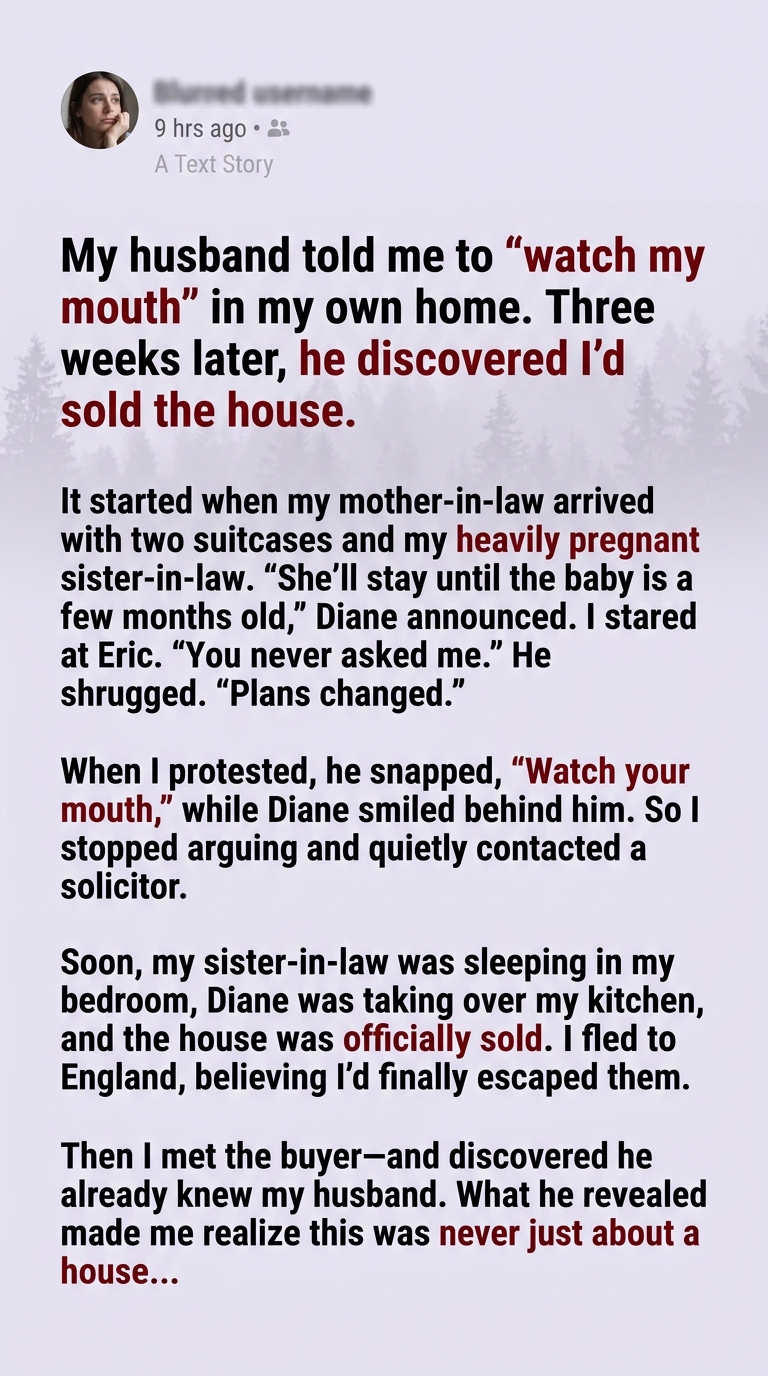
My Husband Told Me to “Watch My Mouth” in My Own Home—Three Weeks Later, I Sold the House
“Watch your mouth, Claire.”
My husband said it in front of his mother, his heavily pregnant sister, and two suitcases that had somehow become permanent fixtures in my hallway.
I stared at him, waiting for him to take it back.
He didn’t.
Behind him, his mother, Diane, smiled as though she had just witnessed a long-overdue correction.
His sister, Melissa, lowered herself onto my sofa and rubbed her swollen belly.
“She’ll stay until the baby is a few months old,” Diane announced. “Obviously, she’ll need help.”
I looked at Eric.
“You never asked me.”
He shrugged. “Plans changed.”
“This is my house too. I work from home, and we barely have enough room for ourselves.”
Diane gave a theatrical sigh. “Some women understand family. Others think a house is more important than a newborn.”
“I never said that.”
Eric stepped closer.
“I said, watch your mouth.”
Something inside me went quiet.
Not broken. Not defeated.
Quiet.
For seven years, I had been married to a man who treated every disagreement as a personal insult. His mother made decisions, his sister received whatever she wanted, and I was expected to smile while accommodating everyone.
I had paid the deposit on our house before the wedding. I had covered most of the mortgage during Eric’s periods between jobs. I had renovated the kitchen with my savings and spent countless weekends turning the neglected garden into a place I loved.
Yet somehow, in my own home, I had become the person who needed permission to speak.
That evening, I watched Diane unpack my kitchen cupboards while Melissa settled into the spare room.
By bedtime, Diane had decided which meals I would cook, which furniture needed moving, and when I should take time off work to help with the baby.
Eric didn’t ask what I thought.
He simply told me to be reasonable.
So I stopped arguing.
The next morning, while Eric was at work and Diane was busy criticizing my coffee machine, I called a solicitor.
Three weeks later, my husband discovered that I had sold the house.
And by then, I was already on my way to England.
What I didn’t know was that the man who bought my home had been waiting for Eric to make a mistake.
And the house wasn’t the only thing my husband stood to lose.
The Woman Who Paid for Everything
My name is Claire Bennett. I was thirty-six when I married Eric.
At the time, I owned a small house on the edge of town. It wasn’t glamorous, but it was mine. I had bought it after years of working as a project manager, saving carefully, and refusing to spend money I didn’t have.
Eric moved in after we married.
We agreed that he would contribute to the household expenses, and for a while, he did. Then his work became irregular. His mother needed help with bills. Melissa went through a difficult relationship. There was always another emergency.
I covered the shortfalls because I believed marriage meant supporting each other.
When Eric suggested that we sell my little house and buy something larger together, I agreed, provided the new property was purchased in both our names according to our respective contributions.
But the purchase was structured differently than I expected.
The new house was bought using the proceeds from my original property and additional savings I had accumulated before the marriage. Eric contributed some money, but substantially less.
Our solicitor advised us to document the arrangement properly. We signed the relevant paperwork, and I believed our interests were protected.
For years, I didn’t think about it.
Then Diane began visiting every weekend.
At first, she criticized small things.
The curtains were too plain. The dining table was too modern. I spent too much on groceries and not enough on family.
Then she began rearranging furniture without asking.
Eric laughed when I complained.
“She’s just trying to help.”
“She moved my desk into the garage.”
“You don’t need to make everything a problem.”
When Melissa’s relationship ended, Diane announced that she would be staying with us for a few weeks.
Those weeks became months.
Eventually, Melissa found a rental and moved out, but not before Diane had made it clear that she considered my home a family resource rather than a private space.
I thought that chapter was over.
Then Melissa became pregnant.
Her relationship with the baby’s father was complicated, and Diane decided that the only sensible solution was to move Melissa into our home before the baby arrived.
She didn’t discuss it with me.
She informed me.
And when I objected, Eric told me to watch my mouth.
That was the moment I finally understood something painful: I wasn’t going to persuade my husband to respect boundaries he had no intention of recognizing.
So I decided to protect myself.
The Solicitor’s Office
The solicitor, Mr. Harris, listened without interrupting as I explained the situation.
I told him about the house, the paperwork, the original purchase, and the money I had contributed.
Then I told him what Eric had said.
Mr. Harris folded his hands.
“Before we discuss selling anything, Claire, we need to establish exactly what you own, what rights your husband may have, and whether there are any restrictions on a sale.”
I was grateful that he didn’t promise me an easy victory.
He reviewed the property documents, the purchase records, our financial arrangements, and the applicable legal requirements. He explained that marriage and property rights could be complicated, and that I shouldn’t assume my contributions automatically gave me the right to sell the property without considering Eric’s interests.
The review took several days.
Eventually, Mr. Harris confirmed that the title and supporting documents gave me a lawful route to sell, subject to the necessary disclosures, conveyancing requirements, and the resolution of the interests documented in the purchase paperwork.
He also warned me that selling the property would not automatically settle every financial issue arising from the marriage.
“Are you certain this is what you want?” he asked.
I looked out of his office window.
For seven years, I had tried to make my marriage work by becoming more accommodating. I had given up quiet evenings, private space, weekends, savings, and the simple comfort of making decisions without a family meeting.
Now my sister-in-law was moving into my bedroom because Diane had decided that the baby needed the spare room.
Eric had called me unreasonable for asking to be consulted.
“Yes,” I said. “I want to sell.”
Mr. Harris helped me arrange a proper valuation and identify a suitable buyer. Everything proceeded through the appropriate legal channels, with the ownership and disclosure issues addressed before completion.
I didn’t forge anything. I didn’t hide a sale from a legal owner. I didn’t transfer property I wasn’t entitled to sell.
I simply stopped allowing my husband’s family to decide what happened to an asset I had the legal right to dispose of.
And I made another decision.
I would leave the country.
My employer had an office in England, and I had been offered a transfer the previous year. At the time, I had declined because Eric said he couldn’t imagine living apart from his family.
Now, for the first time, I considered what I wanted without asking what everyone else would think.
I accepted the transfer.
I booked a flight.
And I started packing.
The Three Weeks That Changed Everything
The house sold faster than I expected.
The buyer was a private investor represented by a solicitor. The valuation was fair, the paperwork was reviewed, and the completion date was set.
I didn’t tell Eric immediately.
I wasn’t trying to create a dramatic surprise. I simply wanted to avoid another shouting match before the arrangements were secure.
Meanwhile, Diane took over the kitchen.
Melissa moved into my bedroom because she wanted the downstairs room for the baby’s changing station. My clothes were transferred into boxes, and Eric told me I could use the smaller room until I found somewhere else to live.
“You’re making this difficult for everyone,” he said.
I stared at him.
“It’s my bedroom.”
“Melissa needs it more than you do right now.”
“And where am I supposed to sleep?”
He shrugged.
“Don’t start again, Claire.”
That night, I slept in the smaller room with my suitcase beside the bed.
I could hear Diane and Melissa laughing downstairs.
Eric joined them later.
Nobody asked whether I was all right.
The next morning, I received confirmation that the sale had completed. The proceeds were being handled according to the agreed legal arrangements, including any relevant obligations and documented interests.
I sat in my car outside the solicitor’s office and cried.
Not because I regretted selling the house.
Because I had finally accepted how lonely I had been inside my marriage.
I returned home, finished packing the things I needed, and left a letter on the kitchen table.
It was brief.
Eric,
The house has been sold through the proper legal process. The completion documents and relevant information are with the solicitors.
I am leaving for England. I need space to make decisions about my life without being ordered to remain silent in my own home.
Please communicate with me through the solicitors while we resolve the remaining financial and marital matters.
Claire.
I left the keys where the buyer’s representative had instructed me to leave them.
Then I called a taxi to the airport.
I didn’t wake Eric.
I didn’t argue with Diane.
I didn’t explain myself to Melissa.
For once, I left without asking anyone’s permission.
The Phone Call
I had been in England for nine days when Eric called.
I was standing outside a small rented flat in Manchester, holding a takeaway coffee and trying to remember which direction led to the tram stop.
His name flashed across my phone.
I nearly let it ring.
Then curiosity got the better of me.
“Where are you?” he demanded.
“England.”
There was a long silence.
“What?”
“I’ve moved to England.”
“You can’t just leave!”
“I can, actually.”
He took a sharp breath.
“What do you mean, the house has been sold?”
“It means the sale completed.”
“You sold our house without telling me?”
I closed my eyes.
“Eric, the property and our respective interests were reviewed by the solicitors. The sale was completed through the proper process. Your solicitor has the relevant information.”
“You had no right!”
“I followed the advice I was given.”
“You’ve made me look like an idiot. Mum is furious. Melissa is crying. We have nowhere to go!”
I felt a familiar tug of guilt.
Then I remembered sleeping in the small room while my husband gave my bedroom to his sister.
“Your mother and sister will need to make their own arrangements,” I said.
“That’s your family too!”
“No, Eric. They’re your family. I was your wife. There is a difference between being part of a family and being treated like the family servant.”
He started shouting.
I let him finish.
Then I said, “I’m not discussing this over the phone. Please speak to your solicitor.”
I hung up.
My hands were trembling, but for the first time in months, I could breathe without feeling as though I was waiting for the next insult.
I thought that would be the end of it.
I was wrong.
Two days later, my solicitor emailed me.
The buyer had asked whether I would be willing to meet him briefly. He had learned that I had relocated to England and had a question about the transaction.
The message included his name.
Nathan Cole.
I stared at the screen.
I knew that name.
And when I finally met him, I discovered that he knew my husband far better than I had ever imagined.
The Buyer
Nathan suggested a quiet café near my new office.
He was in his early forties, neatly dressed, and spoke with the measured calm of someone accustomed to difficult conversations. He didn’t look like the kind of person who would buy a house simply to make a point.
He stood when I arrived.
“Mrs. Bennett. Thank you for agreeing to meet.”
“Please, call me Claire.”
He ordered tea and asked how I was settling into England.
I answered politely, wondering when he would get to the reason for the meeting.
Finally, he placed a folder on the table.
“I want to be very clear about something,” he said. “I bought your house because it was a sound investment. I didn’t arrange the purchase to hurt your husband.”
“Then why did you ask to see me?”
“Because I recognized Eric’s name when it appeared in the transaction documents.”
My stomach tightened.
“How do you know him?”
Nathan leaned back.
“About four years ago, Eric approached a company I was involved with. He wanted funding for a property development project. He presented himself as someone with strong local connections and access to several promising opportunities.”
I remembered Eric’s brief obsession with property development. He had spent months talking about buying neglected houses, renovating them, and selling them for a profit.
He had eventually abandoned the idea, blaming the market.
“What happened?” I asked.
Nathan opened the folder.
“The project didn’t proceed. During our due diligence, we found discrepancies in the figures Eric had presented. We asked for supporting records. Some never arrived, and several claims couldn’t be independently verified.”
“Did you accuse him of fraud?”
“No. We withdrew from the proposed investment because we weren’t satisfied with the documentation. I don’t want to make allegations I can’t substantiate.”
I appreciated his caution, but I could feel my pulse accelerating.
“Why does any of this matter now?”
“Because after your house was listed for sale, someone contacted a business associate of mine. They asked whether I would be willing to withdraw my offer if Eric promised to cooperate with a separate property deal.”
I stared at him.
“Who contacted them?”
“Nobody identified themselves clearly. But the message included information about your house and a suggestion that the sale could be made difficult if I refused.”
“Was it Eric?”
“I can’t prove that. I won’t tell you it was him when I don’t know.”
Nathan closed the folder.
“But there was something else. During the earlier funding proposal, Eric mentioned a property he claimed would become available through his wife’s family. He suggested that the ownership situation could be arranged to support his project.”
I frowned.
“My family doesn’t own property here.”
“That’s what puzzled us. He said the house was effectively a family asset and that you would eventually agree to use it as security.”
I felt sick.
“My house was never offered as security.”
“Not to us. We never received a valid authorization from you, and no loan was made against it through our company.”
I stared at my tea.
Eric had not merely expected me to surrender my home to his family. He had apparently discussed using it to support a business venture without my agreement.
Nathan didn’t claim that this proved criminal wrongdoing. He simply showed me the correspondence and records that his company had retained from the earlier proposal.
I looked at him.
“Why are you telling me this?”
“Because I think you should know that your husband may have viewed the house as an asset he could use, rather than a home you owned together. And because I suspect the pressure you’ve described may not have started with your mother-in-law moving in.”
He paused.
“There is one more document you should ask your solicitor to review.”
He slid a copy across the table.
It was an email from Eric to a former business associate, dated six months earlier.
The subject line read: Family property plan.
My hands went cold as I began to read.
The Plan I Was Never Meant to See
The email did not contain a confession or an explicit threat.
It was worse in a quieter way.
Eric described the house as an asset that could be “repositioned” to free up capital for his next project. He wrote that he expected me to resist at first, but that “once Mum and Melissa are settled in, Claire will have to accept the new arrangement.”
Another line read:
She won’t want to look like the person who puts a pregnant woman out on the street.
I read it again.
Then I read the next paragraph.
Eric had suggested that his mother and sister move into the house before he raised the idea of using the property to support his business plans. He believed that once they were living there, I would find it too difficult to insist that they leave.
Diane’s announcement had not necessarily been part of a carefully coordinated scheme, but Eric had already considered using family pressure to make me surrender control of the house.
Nathan watched me quietly.
“I can’t tell you what he intended to do with the property after that,” he said. “But I thought you should see the email.”
I felt a strange, hollow calm settle over me.
All those arguments about family.
All those comments about being selfish.
All those moments when Eric told me I was making things difficult.
They had not been about the baby, the spare room, or Diane’s need for help.
At least in part, they had been about making me give in.
I asked Nathan whether he had sent the document to my solicitor.
“Not yet. I didn’t want to share private correspondence without checking what I was entitled to disclose. I’ve asked my own legal adviser to review it.”
“Thank you for being careful.”
“I know this is upsetting. I don’t want to create problems by making assumptions.”
We ended the meeting shortly afterward.
I walked back to my flat through the gray Manchester afternoon, barely noticing the rain.
For years, I had thought Eric’s greatest flaw was that he couldn’t stand up to his mother.
Now I wondered whether he had simply learned how to use her as an excuse.
The Final Confrontation
I sent Nathan’s information to Mr. Harris and asked him to review it alongside the documents from the sale.
His advice was measured.
The email could be relevant evidence of Eric’s intentions, but it did not automatically establish that he had committed a crime. The property sale remained subject to the legal arrangements already completed, and any remaining disputes would need to be handled through the appropriate process.
He also advised me to preserve every message and avoid making public accusations.
I followed his advice.
Eric continued calling.
At first, he alternated between anger and pleading.
“You’ve destroyed everything.”
“Please come home. We can fix this.”
“Mum says you’re being cruel to Melissa.”
Then came the threats.
He said he would challenge the sale. He said I had embarrassed him. He said I had abandoned his family when they needed me.
Each time, I directed him to the solicitors.
Eventually, he sent a message that made me stop in the middle of my lunch.
You think you’ve won, Claire? You have no idea what I was trying to protect you from.
I stared at the words.
For a moment, I felt the old fear returning.
Then I forwarded the message to Mr. Harris and did not respond.
Several days later, Eric requested a formal conversation through the solicitors to discuss our separation and financial arrangements. I agreed to a meeting with appropriate legal support.
When I saw him on the video call, he looked exhausted.
He began by accusing me of humiliating him.
I let him speak.
Then I asked one question.
“Did you plan to use my house to support your business?”
He looked away.
“I was trying to build something for us.”
“Did you plan to move your mother and sister in so I would find it harder to refuse?”
He said nothing.
“Did you tell people I would eventually agree to use my property as security?”
His jaw tightened.
“I never actually borrowed against it.”
“That isn’t what I asked.”
He rubbed his face.
“I thought you’d understand eventually.”
I felt the last thread connecting me to our old life loosen.
“You never wanted me to understand,” I said. “You wanted me to give in.”
Eric’s expression hardened.
“You’ve always made me feel like I wasn’t good enough.”
I thought about the mortgage payments, the renovations, the extra bills, and the years of trying to keep everyone happy.
“I was your wife, Eric. I was never supposed to be your investor, your mother’s housekeeper, or your sister’s spare bedroom.”
He had no answer.
We ended the meeting without resolving every issue. Those matters would continue through the legal process, with both sides receiving advice and the relevant documents being reviewed.
But I no longer needed him to admit everything for me to know why I had left.
I had spent years trying to earn respect from someone who treated my boundaries as obstacles.
I wasn’t going to spend another year waiting for him to understand.
A Home That Belonged to Me
Six months later, I was living in a small flat in England with a view of a row of trees and a bakery across the street.
My new job was demanding, but I enjoyed it. Nobody rearranged my desk without asking. Nobody announced that relatives would be moving into my bedroom. Nobody told me to watch my mouth.
I made friends with a colleague named Hannah, who invited me to Sunday lunches and helped me explore the city.
Some evenings, I still felt lonely.
I missed the garden I had planted, the kitchen I had renovated, and the version of my marriage I had once believed in.
But I didn’t miss the constant tension.
I didn’t miss checking Eric’s expression before speaking.
And I didn’t miss the feeling that peace in my own home was something I had to earn.
The sale proceeds were handled according to the legal arrangements, and my solicitor continued helping me resolve the remaining matters connected to the marriage. The email and other records were retained in case they became relevant to any formal dispute.
I didn’t know what Eric would do next.
I couldn’t control whether Diane blamed me or whether Melissa believed I had abandoned her. I hoped the baby would be born healthy, and I hoped Melissa would find the support she needed.
But I finally understood that wishing someone well did not require surrendering my home, my savings, or my dignity.
One Saturday, I bought a small potted rose plant for my balcony.
It wasn’t the same as the garden I had left behind, but it was mine to care for. I placed it near the window, watered it, and watched the leaves move in the breeze.
Then I received a short email from Nathan.
He said his company had completed the initial preparations for the house, and the property would soon be put to its next use. He wished me well and hoped my new life was treating me kindly.
I thanked him.
I never learned every detail of Eric’s business plans, and I didn’t need to. The evidence had raised serious questions, but the legal process—not speculation—would determine what those records meant.
What I did know was this: the house had been sold lawfully, my decision to leave was my own, and Eric could no longer use the walls around me to make me feel trapped.
He had told me to watch my mouth in my own home.
Three weeks later, he discovered I had sold it.
He thought I had acted out of spite.
He was wrong.
I sold the house because I finally understood that a home is not a home when you have to ask permission to belong there.
And when I left for England, I didn’t take revenge with me.
I took my freedom.
That was worth more than any property I had ever owned.