I Found Labeled Bundles of Women’s Hair Sewn Inside My Husband’s Pillow—Then He Walked In Carrying More
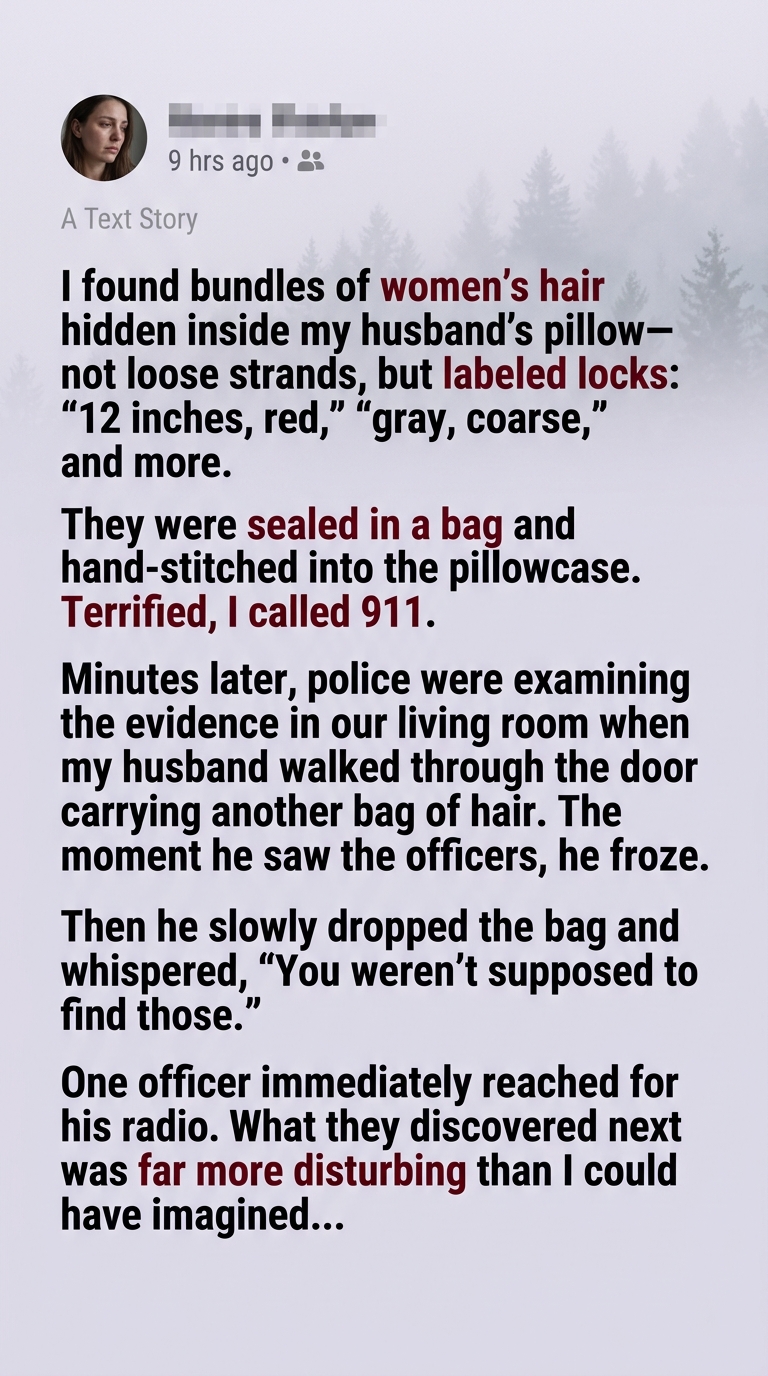
I found the first bundle of hair on a Thursday afternoon.
At first, I thought it was stuffing coming loose from my husband’s pillow. A few strands of red hair poked through a tiny tear near the seam, so I grabbed my sewing kit to repair it before bedtime.
But when I pulled the seam apart, my fingers touched plastic.
Something had been carefully tucked inside the pillowcase.
I cut two more stitches and pulled out a sealed bag containing a thick lock of red hair, bound with a white thread. A small paper label was attached.
“12 inches, red.”
My stomach tightened.
I opened the pillow a little farther.
There were more bags.
Gray hair, coarse.
Black hair, straight.
Brown hair, wavy.
Each bundle had its own label. Each was sealed separately, then stitched into the lining as if someone had gone to extraordinary lengths to keep the contents hidden.
These weren’t a few loose strands collected by accident. They were deliberate collections, carefully sorted and preserved.
I stood in our bedroom holding the pillow, listening to the refrigerator hum downstairs.
My husband, Daniel, had always been private. He worked long hours as a restoration technician, repairing damaged furniture and antiques. He sometimes brought home odd objects from estate clearances, but he had never behaved in a way that made me fear him.
At least, not until that moment.
I checked the other pillows.
Nothing.
Then I remembered the locked storage cabinet in his workshop, the one he said contained delicate restoration supplies. I’d never questioned it because I trusted him.
Now I couldn’t stop wondering what else he might be hiding.
I put the pillow on the bed, backed away, and called 911.
The dispatcher asked whether I was in immediate danger.
“I don’t know,” I whispered. “I found something in my husband’s pillow, and I’m frightened. I need someone to come look at it.”
She instructed me to avoid handling the contents any further and to wait somewhere safe.
I went downstairs and sat at the kitchen table, staring at the front door.
Twenty minutes later, two officers arrived.
I showed them the pillow and explained exactly what I’d found. They photographed the bags, examined the labels, and asked whether I recognized any of the hair.
I didn’t.
One officer, a woman named Officer Ramirez, asked me whether my husband had ever threatened me or behaved violently.
“No,” I said. “That’s why I don’t understand this.”
She nodded, but her expression remained serious.
“We don’t know what these items mean yet. We’re going to document everything carefully.”
One officer was taking notes while the other photographed the stitched lining.
Then I heard a key in the front door.
Daniel walked into the house carrying a brown paper bag.
He looked at the officers.
Then he looked at the pillow on the table.
His face drained of color.
The bag slipped from his hand and hit the floor. Several smaller plastic packets spilled across the entryway.
For a moment, nobody moved.
Then Daniel whispered five words that changed everything.
“You weren’t supposed to find those.”
Officer Ramirez immediately reached for her radio.
“Sir, don’t move. Keep your hands where I can see them.”
Daniel stared at me, his eyes wide with something I had never seen before.
Not anger.
Not embarrassment.
Pure, unguarded fear.
And as the officers secured the room, I realized that the bags inside his pillow were only the beginning.
The Bag He Brought Home
Daniel obeyed the officers’ instructions. He kept his hands visible while Officer Ramirez asked him to explain what he had brought into the house.
He swallowed.
“It’s not what you think.”
“What is it?” she asked.
He looked at me instead of answering.
“Claire, please. You need to listen to me.”
“Then tell me why you have bags of women’s hair.”
His mouth opened, but nothing came out.
Officer Ramirez asked him to step away from the spilled packets. Her partner secured the entryway and photographed the items before anyone disturbed them.
Daniel looked as though he wanted to run, but he didn’t move.
Finally, he said, “They’re samples.”
“Samples of what?” the officer asked.
“Hair. From restoration projects.”
I stared at him.
“What kind of restoration project requires you to sew hair into a pillow?”
He flinched.
Daniel rubbed his forehead. “I can explain. Just not like this.”
Officer Ramirez told him that he could explain, but he needed to be clear and truthful. The officers would determine what further steps were necessary based on the evidence.
Then she asked him whether he had collected the hair himself.
He hesitated.
That hesitation was enough to make my hands begin shaking.
“Yes,” he finally said. “Some of it.”
“And the rest?”
He looked down.
“Some came from other people.”
“Which people?”
“I don’t know all their names.”
I felt as though the room were tilting.
For twelve years, Daniel and I had shared a home, a bed, and a life. I knew the way he took his coffee, the songs he hummed while working, and the precise spot where he kept his spare keys.
Now I was looking at a man who couldn’t explain why he had hidden labeled locks of women’s hair inside our bedroom pillow.
The officers separated us so they could speak to us individually.
I told Officer Ramirez everything I knew: Daniel’s job, the locked workshop cabinet, the occasional estate-clearance items, and the fact that I had never seen the hair before.
I also told her something I had nearly forgotten.
Three weeks earlier, a woman had called our home asking for Daniel. When I answered, she went quiet.
“Is he there?” she had asked.
I told her he was at work.
She hung up without giving her name.
When I mentioned the call, Officer Ramirez asked if I still had the number.
I did.
She wrote it down.
Then she returned to Daniel.
The questions continued for nearly an hour.
Eventually, Daniel admitted that the hair had come from a private collection he had been maintaining for years. He claimed it was connected to an old project involving wigs and theatrical costumes.
But when Officer Ramirez asked why the samples were hidden inside a pillow rather than stored with his other materials, he had no answer.
And when she asked about the labels, he looked toward the brown bag on the floor.
“Some of those women were important to the collection,” he said.
“Important how?”
Daniel closed his eyes.
“I need to talk to a lawyer.”
Officer Ramirez nodded. She did not force him to answer questions he declined to answer, and she explained that the officers would follow the appropriate procedures for handling the items.
Daniel was taken aside while the evidence was documented.
I remained at the kitchen table, trying to understand how my ordinary Thursday had turned into a police investigation.
Then an officer came back from the front room.
“Mrs. Claire,” he said, “we need to ask you something about your husband’s work.”
He showed me a photograph of one of the labels.
Under the words gray, coarse was a date.
The date was from sixteen years earlier.
And beneath it were two initials.
E.M.
I knew those initials.
They belonged to my older sister, Emily.
The Sister I Hadn’t Seen in Sixteen Years
Emily and I had once been inseparable.
We shared a bedroom as children, traded clothes as teenagers, and spent our early twenties promising that nothing would ever come between us.
Then, when I was twenty-six, she disappeared from my life.
There was no dramatic argument. No final confrontation. Just a series of missed calls, unanswered messages, and a growing distance neither of us knew how to cross.
Our mother said Emily had moved away after a difficult relationship. My father refused to discuss it. Eventually, I stopped asking because every question seemed to reopen a wound.
I hadn’t seen her in sixteen years.
Now her initials were attached to a lock of gray hair hidden inside my husband’s pillow.
I stared at the photograph.
“That’s impossible,” I whispered. “Emily was thirty-two when I last saw her. She had dark brown hair.”
Officer Ramirez didn’t speculate.
“Do you know whether she ever cut or dyed her hair?”
“Yes. She changed it all the time.”
“Could the initials refer to someone else?”
“Possibly.”
I wanted that to be true.
But I remembered the date.
The label had been marked four months before Emily vanished.
I asked Daniel to explain the initials.
He refused to answer without legal advice.
That evening, I stayed with my friend Melissa while the officers continued their work. I couldn’t bear to sleep in the house, not knowing what else might be hidden there.
The next morning, I called my mother.
I told her about the hair, the labels, and the initials.
At first, she said nothing.
Then I heard her begin to cry.
“Your sister asked me to keep something from you,” she whispered.
My entire body went cold.
“What?”
“She told me Daniel had been asking questions about her. She said he was collecting things from people who had trusted him.”
“Why didn’t you tell me?”
“Because she begged me not to. She was frightened, Claire. She said she didn’t know what he wanted.”
I gripped the phone so tightly my fingers hurt.
“Where is Emily?”
“I don’t know.”
“Mom, it’s been sixteen years.”
“I know.”
She told me that Emily had contacted her only twice after leaving. The first time, she said she was safe. The second time, she asked our mother not to reveal where she lived.
Then, about a year later, the letters stopped.
My mother had spent years wondering whether Emily was alive and well. She had never told me the full story because she feared that Daniel might somehow be involved.
I couldn’t understand why she had allowed me to marry him.
But before I could ask, she said something that made my heart pound.
“Claire, your sister wasn’t the only woman who disappeared from his life.”
The Women in the Labels
By the end of the week, investigators had found more labeled bags in Daniel’s workshop.
Some contained hair. Others held old photographs, handwritten notes, and small personal items. The materials were stored in boxes marked with dates, initials, and brief descriptions.
The collection was not proof of a crime by itself. People collect unusual objects for many reasons, and the investigators were careful not to jump to conclusions.
But several items appeared to be connected to women Daniel had known through his work.
One photograph showed a young woman standing outside a theater. On the back, someone had written a date and the words before the cut.
Another showed a woman with long red hair, smiling beside a wooden cabinet Daniel had restored.
The third photograph made my stomach turn.
It showed Emily.
She was standing in our childhood garden, her hair falling over her shoulders. She looked directly into the camera with a cautious smile.
On the back, in Daniel’s handwriting, were the words:
She trusted me.
I handed the photograph to Officer Ramirez.
“That’s my sister.”
She studied it, then placed it carefully into an evidence sleeve.
“Do you know when this was taken?”
“Not exactly. But the garden was sold fourteen years ago, and Emily was gone long before that.”
The investigators began comparing the dates and initials with records they could lawfully obtain. They contacted people who had worked with Daniel and checked whether any of the items could be connected to reported thefts, stalking complaints, or missing-person investigations.
Several women were located and interviewed.
Their accounts differed.
One had donated her hair to a charity that made wigs for people undergoing medical treatment. She had never met Daniel and had no idea how her hair ended up in his possession.
Another had given him a lock of hair after a theater production, believing he was creating a historical costume display.
A third said Daniel had repeatedly asked her to preserve her hair after she cut it. She had found the request strange and eventually stopped communicating with him.
None of those facts alone established a pattern of criminal conduct.
But the investigators discovered something more troubling.
Daniel had been keeping personal records about some of the women, including details about where they lived, when they worked, and when they changed their appearance.
Some of the information was harmless. Other entries appeared to have been gathered without their knowledge.
The officers began investigating whether Daniel had used his professional access to obtain private information or personal belongings.
Then a woman contacted the police after seeing a public request for information about the collection.
Her name was Rachel.
She said she had worked with Daniel at a restoration company years earlier. She remembered him asking for a lock of her hair after she cut it short.
She had refused.
A few weeks later, she discovered that a small envelope containing hair from her brush was missing from her locker.
At the time, she had assumed it was a prank.
Now she wondered whether the two incidents were connected.
Rachel also remembered Emily.
“She was scared of him,” Rachel told investigators. “She said he kept showing up in places where she hadn’t told him she’d be.”
That was the first independent account suggesting Emily’s disappearance might have been connected to Daniel’s behavior.
It was not proof that he had harmed her.
But it gave investigators a reason to keep looking.
The Locked Cabinet
With the appropriate legal authorization, investigators examined the locked cabinet in Daniel’s workshop.
Inside, they found wigs, costume pieces, old photographs, and boxes of carefully labeled materials. Some items were consistent with his restoration and theatrical work.
Others were harder to explain.
There were copies of letters, notes about women’s routines, and photographs taken from a distance. Several women later said they had never given Daniel permission to photograph them in those settings.
One folder contained a list of names and dates.
Emily’s name appeared near the top.
Beside it was a note:
Refused. Left town. Need to know why.
I read that line in the police station and felt a wave of nausea.
Daniel had not merely kept a lock of my sister’s hair. He had tracked her after she left.
The investigators also found correspondence between Daniel and a man who had once managed a small theater company. The messages discussed hair samples, costume materials, and private information about former performers.
Some messages suggested that Daniel had been using his work as a reason to contact women long after their professional relationships had ended.
The man was interviewed and provided additional records.
He said he had believed Daniel was maintaining a historical costume archive. He denied knowing that personal information was being collected without consent.
Investigators would have to determine which items were obtained legitimately and whether any laws had been broken.
Meanwhile, Daniel’s attorney contacted the police to arrange a formal interview.
Daniel finally agreed to explain the collection.
He said he had become fascinated with the way hair could preserve a person’s identity over time. He claimed that some women had donated locks for his costume archive, while others had given them to him as keepsakes.
When asked about the notes and photographs, he admitted that he had sometimes become too interested in people.
“I wanted to remember them,” he said.
“Why track their routines?” an investigator asked.
Daniel looked down.
“I told myself I was protecting the collection.”
That answer explained nothing.
Then the investigator showed him the photograph of Emily.
Daniel’s face changed.
“Where did you get that?”
“Why does that matter?”
He stared at the table for a long time.
Finally, he said, “Emily found out what I was doing.”
“What were you doing?”
“I had been keeping things that people hadn’t given me. I told myself they didn’t matter. Hair, photographs, notes. I never thought of it as hurting anyone.”
“But Emily found out?”
Daniel nodded.
“She said she would tell you. She said I wasn’t the person you thought I was.”
“What happened after that?”
“She left.”
“Did you follow her?”
Daniel didn’t answer.
The investigator repeated the question.
After a long pause, Daniel said, “I tried to find her.”
That was all he would say without further legal advice.
It was not a confession to harming Emily, and investigators did not treat it as one. But it confirmed that he had continued trying to locate her after she had cut contact.
For me, it was enough to understand why my sister had been frightened.
I had spent sixteen years believing she had simply abandoned me.
Now I wondered whether she had been trying to protect me.
The Letter Emily Left Behind
Two weeks later, my mother called again.
She had found an old envelope in a box of family photographs. It had been tucked inside the cover of a book Emily left behind before she disappeared.
The envelope was addressed to me.
My mother had never opened it because Emily had written my name across the front and added a note: Only if I cannot contact Claire myself.
I drove to my mother’s house with Melissa.
Inside the envelope was a letter dated sixteen years earlier.
Claire,
If you’re reading this, I couldn’t find a safe way to explain what happened.
I know you love Daniel. I know you see the good in him. I saw it too, which is why I ignored the warning signs for so long.
He began by asking for small things. A photograph. A lock of hair. A note I had written. He said they helped him with his work and that I was being sentimental when I hesitated.
Then I discovered he had kept things I never gave him.
When I confronted him, he told me I was overreacting. He said I should be flattered that someone wanted to remember me.
But I found a notebook with details about women he knew. Where they lived. Who they dated. When they changed jobs. Things they had never told him.
I was frightened, Claire.
I wanted to tell you, but I worried you wouldn’t believe me. He was already your boyfriend, and I thought you would defend him.
I tried to speak to you twice. Both times, he was there before I could explain.
So I left.
I don’t know whether he will ever do something worse than this. I hope he won’t. But I know that I cannot make him stop by asking nicely.
Please don’t confuse my leaving with abandoning you.
I love you.
Emily
I read the letter twice.
Then I pressed it to my chest and cried.
For sixteen years, I had blamed my sister for leaving without explanation. I had told myself she was selfish, that she had chosen a new life over her family.
All along, she had been afraid.
And I had married the man she had tried to warn me about.
Melissa held me while I cried until my face hurt.
When I could finally speak, I said, “I need to find her.”
The police explained that they could not disclose private information about Emily without a lawful basis or her consent. They could, however, pass along a message if they located her through the investigation.
I gave them a copy of the letter and asked them to let Emily know that I wanted to hear from her, but only if she felt comfortable contacting me.
Then I waited.
The Truth About the Hair
The investigation continued for several months.
Forensic examination helped establish that some of the samples were consistent with hair belonging to women who had been identified through records or voluntary reference samples. Not every bundle could be identified, and the labels were not reliable proof of ownership or origin.
Investigators also found evidence that Daniel had kept certain personal items without permission. Some women came forward with complaints about unwanted contact and missing belongings. Authorities reviewed those reports individually rather than assuming every item in the collection had been stolen.
Daniel was ultimately charged in connection with several alleged offenses involving unauthorized possession of personal property, unlawful surveillance, and repeated unwanted contact. The precise charges depended on the evidence and applicable law, and the case would proceed through the courts.
He was not charged with Emily’s disappearance. There was no evidence establishing that he had abducted or killed her, and the investigators continued treating her whereabouts as a separate concern until they could confirm she was safe.
When I learned that, I felt two emotions at once.
Relief that there was no evidence proving the worst possibility.
And anger that the truth about my own marriage had taken a police investigation to uncover.
Daniel’s attorney asked whether I would speak to him.
I agreed to one conversation, with appropriate arrangements in place and no expectation that I would forgive him.
He looked older than I remembered. His hair had grown longer, and his face seemed thinner.
“I never wanted to hurt you,” he said.
I stared at him.
“You hid bags of women’s hair in our bed.”
“I know.”
“You kept things that women never gave you. You tracked them. You frightened my sister until she felt she had to disappear.”
“I didn’t think of it that way.”
“That doesn’t make it less frightening.”
He rubbed his hands together.
“I thought if I kept pieces of people’s lives, they couldn’t completely leave me.”
For a moment, I felt something like pity.
Then I remembered Emily’s letter.
“You don’t get to keep pieces of people because you’re afraid they’ll leave,” I told him. “They are not yours to keep.”
He began to cry.
I did not comfort him.
I told him I was ending our marriage and that any further communication would go through the appropriate legal channels. I would not help him minimize what had happened, and I would not let him turn his explanation into an excuse.
Then I left.
The Call I Had Been Waiting For
Nearly five months after I found the first bundle, my phone rang while I was sitting on the balcony of my temporary apartment.
The number was unfamiliar.
“Hello?”
A woman’s voice answered.
“Claire?”
I stopped breathing.
It was older than I remembered, a little rough around the edges, but unmistakable.
“Emily?”
There was a long silence.
Then she began to cry.
We spoke for nearly two hours.
Emily was alive. She had built a quiet life in another part of the country and had avoided contact because she feared Daniel would find her. She had changed her number more than once and had been reluctant to reconnect with anyone who might accidentally reveal her location.
She had not known that Daniel was still collecting personal items or that some of the women he knew had been affected in similar ways.
When she learned about the police investigation, she had agreed to speak with investigators and provide the information she remembered.
“I wanted to tell you,” she said. “I wanted to tell you so many times.”
“Why didn’t you?”
“Because I thought you wouldn’t believe me. And because I was scared he would make things worse if he knew I had spoken to you.”
I wiped my eyes.
“I wish I had asked more questions.”
“You were in love with him. I understood that.”
“No. I should have listened.”
We didn’t repair sixteen years of silence in one conversation. There were too many unanswered questions, too much grief, and too much time between us.
But we made a plan to meet in a public place when she felt ready.
Two weeks later, I saw my sister for the first time in sixteen years.
She wore her hair short, cut just above her shoulders.
I noticed it immediately, then hated myself for noticing.
Emily saw my expression.
“It’s okay,” she said gently. “I still like my hair. I just like deciding what happens to it.”
I started crying.
She reached for my hand.
We sat together for a long time, talking about our childhood, our parents, and all the things we had missed. She told me about the life she had built. I told her about the marriage I was leaving.
We didn’t promise that everything would be fine.
We promised to stop disappearing from each other’s lives without explanation.
That was enough for the beginning.
What I Learned About the Things We Hide
The house felt different after Daniel was gone.
For a while, I couldn’t sleep on the same pillows. I replaced them all, then changed the bedding, then repainted the bedroom because I needed the room to feel like mine again.
I kept the letter Emily had written, but I did not keep the photographs or the evidence from Daniel’s collection. Those belonged with the investigators and the women whose lives had been affected.
The legal process took time. Some questions remained unanswered, and not every woman wanted to become involved. I learned that justice rarely arrives in a single dramatic moment. Sometimes it comes through careful documentation, patient interviews, and people finding the courage to tell their stories.
I also learned that trust isn’t foolish simply because someone abuses it.
I had loved Daniel. I had believed his explanations. I had ignored signs that seemed small at the time because I had no reason to imagine where they might lead.
I would not spend the rest of my life blaming myself for what he chose to hide.
One afternoon, Emily came over to help me sort through the last boxes from our old house. We found an album of childhood photographs and sat on the floor laughing at our terrible haircuts and oversized school uniforms.
For the first time in years, the sound of my sister’s laughter felt familiar rather than painful.
Before she left, she hugged me tightly.
“I’m sorry I disappeared,” she whispered.
I held her closer.
“I’m sorry I didn’t understand why you had to.”
After she drove away, I went into the bedroom and opened the window.
Fresh air moved through the curtains.
I thought about the first bundle I had found, labeled 12 inches, red. About the careful stitches, the sealed bags, and the man who had believed he could preserve pieces of other people’s lives without consequences.
He had mistaken possession for connection.
He had confused secrecy with control.
And he had assumed that if he hid the truth well enough, no one would ever discover it.
But the truth had been there all along, stitched into the seams of an ordinary pillow.
All it took was one loose thread.
And when I finally pulled it, the life I thought I knew began to unravel—until, piece by piece, I could build something honest in its place.