My Husband Had Never Stayed Alone With Our Baby—Until I Came Home and Found a Woman Standing Beside Her
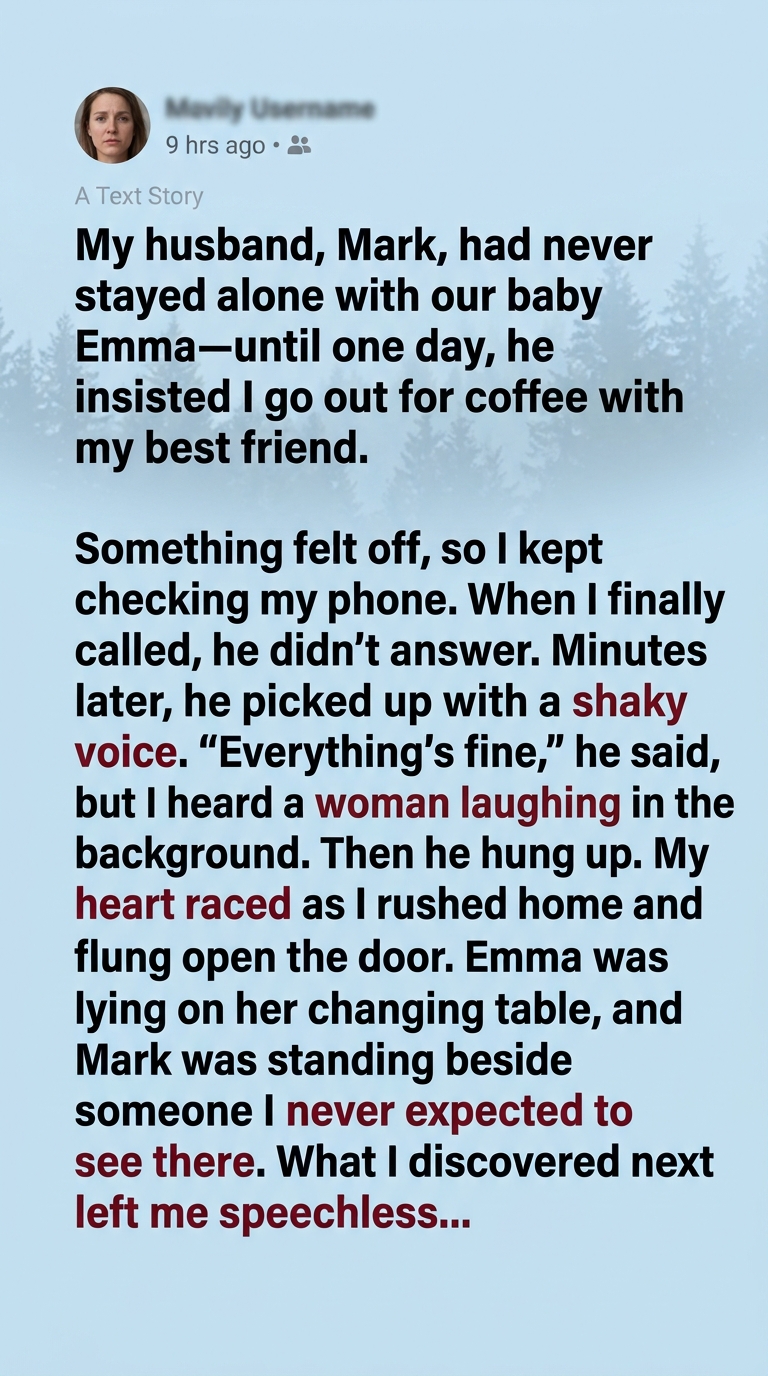
My husband, Mark, had never spent an entire afternoon alone with our six-month-old daughter, Emma.
He always had an excuse.
He was too tired. He had work to finish. He didn’t know how to soothe her when she cried. He insisted I was better at handling the little things, like changing diapers and preparing bottles.
So when he suddenly encouraged me to meet my best friend for coffee, I was surprised.
“Go on,” he said, smiling as he kissed my forehead. “You deserve a break. Emma and I will be fine.”
Something about his smile felt strange.
Still, I’d been exhausted for weeks. My best friend, Laura, had been begging me to leave the house for an hour, and I finally agreed.
I packed Emma’s diaper bag, wrote down her feeding schedule, and showed Mark where I’d left the clean bottles.
He laughed.
“Relax, honey. She’s my daughter too.”
I smiled, kissed Emma’s soft forehead, and left.
At the café, Laura noticed I kept glancing at my phone.
“You’re allowed to enjoy yourself,” she teased. “Mark can handle one afternoon.”
“I know,” I said.
But I didn’t know.
Twenty minutes later, I called home.
No answer.
I sent a text asking whether Emma had eaten.
Nothing.
I tried calling again.
This time, he picked up.
“Hey,” he said, his voice strangely shaky.
“Is everything okay?”
“Everything’s fine.”
Then I heard it.
A woman’s laugh.
Not a laugh from the television. Not a voice from a video playing in the background.
A woman was in my house.
“Mark? Who’s there?”
There was a brief silence.
Then he said, “I have to go.”
The call ended.
I stared at my phone, my heart pounding.
I called him back immediately, but he rejected the call.
Laura put down her coffee.
“What happened?”
“I don’t know,” I whispered. “But there’s someone at my house.”
I paid the bill, grabbed my purse, and rushed to my car.
The entire drive home, my mind raced through possibilities. Maybe it was a relative. Maybe a neighbor had stopped by. Maybe there was a perfectly innocent explanation.
But why had Mark sounded so frightened?
And why had he hung up?
When I reached our house, I barely remembered putting the car in park.
I hurried to the front door, turned the handle, and stepped inside.
“Mark?”
No answer.
Then I heard a soft voice from the nursery.
I walked down the hallway and pushed open the door.
Emma was lying on her changing table, kicking her tiny feet. Mark stood beside her, pale and rigid.
And next to him was a woman I never expected to see in my home.
My mother-in-law, Patricia.
She was holding a folded blanket and wearing the same pleasant smile she’d used at family gatherings for years.
“Well,” she said, looking me up and down, “you’re home early.”
I barely glanced at her.
“Why are you here?”
Mark opened his mouth, but no words came out.
Patricia answered for him.
“Your husband invited me. I thought I’d help him learn a few things about taking care of his own daughter.”
I looked at Mark.
“Is that true?”
He rubbed the back of his neck.
“Mom said she could help. I thought it might be easier if she showed me what to do.”
“Then why didn’t you tell me?”
Neither of them answered.
I went straight to Emma and lifted her from the changing table. She was warm, clean, and apparently unharmed, but I held her close while I checked her little face and hands.
Patricia gave an impatient sigh.
“Oh, don’t be so dramatic. She’s perfectly fine.”
I turned toward her.
“I asked why you were here without telling me.”
Her smile vanished.
“Because Mark is my son, and this is his home too. He doesn’t need your permission to invite his own mother over.”
That might have been true in an ordinary situation.
But this wasn’t an ordinary visit.
My husband had never asked for help with Emma before. He had encouraged me to leave, ignored my calls, and sounded terrified when I finally reached him.
Something was wrong.
I looked at Mark again.
“Please tell me what’s going on.”
He glanced at his mother.
That small movement told me more than any explanation could have.
“Mark,” I said quietly, “look at me.”
He did.
His eyes were red.
“I didn’t know how to tell you.”
My stomach dropped.
“Tell me what?”
He swallowed hard.
“Mom said she needed to talk to me about something. She asked me to make sure you were gone first.”
Patricia stepped forward.
“Mark, don’t start.”
He flinched.
And in that moment, I realized this wasn’t simply about a surprise visit.
My husband was afraid of disappointing his mother.
He had been afraid of her long before Emma was born.
“Mark,” I said, keeping my voice steady, “you can tell me the truth.”
He looked at Emma in my arms.
Then he whispered, “She told me I wasn’t Emma’s father.”
For a moment, I couldn’t understand the words.
“What?”
Patricia folded her arms.
“I said there are questions about the baby’s resemblance to our family. Someone had to raise the issue.”
I stared at her.
Emma had Mark’s dark hair, his deep-set eyes, and the same little dimple that appeared when he smiled. But even if she hadn’t resembled him at all, that would never have justified what Patricia was doing.
“Why would you say that?” I asked.
Patricia lifted her chin.
“Because I have a right to protect my son.”
Mark shook his head.
“Mom, you said you had proof.”
She went silent.
I looked between them.
“What proof?”
Mark finally explained.
A few days earlier, Patricia had called him and claimed she’d found a private message that suggested I had been unfaithful before Emma was born. She refused to send him the message, insisting she needed to explain it in person.
Then she told him that if he wanted to know the truth, he should arrange for me to leave the house for an hour.
He had agreed.
He hadn’t told me because he was afraid of what I might say if the accusation turned out to be true.
My heart hurt in a way I hadn’t expected.
“Mark, do you believe I cheated on you?”
He looked down.
“I didn’t know what to believe.”
Those words hurt more than Patricia’s accusation.
We had been married for three years. I had been beside him through his job changes, his father’s illness, and the months when we struggled to conceive. I had never imagined that he would allow his mother to plant this kind of suspicion between us without asking me about it.
But before I could answer, Patricia reached into her purse.
“I brought something,” she announced.
She pulled out a printed photograph and placed it on the dresser.
It showed me standing outside a restaurant beside a man I recognized immediately: Daniel, an old university friend.
We had met for lunch several months before Emma was born.
The photograph had been taken from across the street.
“Whoever took this,” Patricia said, “saw you meeting another man. Mark deserves to know what happened.”
I stared at the picture.
Then I looked at the date printed beneath it.
It was from a lunch I’d told Mark about at the time. Daniel had been visiting the city for work, and we’d met for an hour. I had even shown Mark a photograph from the restaurant afterward.
“That’s Daniel,” I said. “You know that.”
Patricia waved a hand.
“I know what you told us.”
I took a slow breath.
“Then let’s establish what actually happened. Mark, you can call Daniel if you need to. You can look at the messages from that day. But you don’t get to turn an ordinary lunch into proof of an affair just because your mother says so.”
Mark stared at the photograph.
His face had gone pale.
“Mom,” he said, “you told me this was something different.”
Patricia’s expression hardened.
“I told you what I believed.”
“No,” he replied. “You told me you had evidence.”
She snatched the photograph from the dresser.
“I don’t have to stand here and be interrogated in my own son’s house.”
She turned toward the door.
“Patricia,” I said, “you came into my home, made an accusation about my marriage, and involved our baby in a confrontation you deliberately arranged. You owe us an explanation.”
She stopped.
For the first time since I’d walked in, she looked uncertain.
Then she said something I would never forget.
“I was trying to protect Mark before he wasted his life on a woman who might leave him with nothing.”
I stared at her.
“By making him doubt his own wife?”
“By making him think.”
Mark stepped between us.
“Mom, stop.”
She turned toward him, stunned.
He had spent his entire life trying to avoid disappointing her. I knew that. I’d watched him apologize for harmless decisions, change plans because she disapproved, and spend hours defending himself whenever she decided he’d let her down.
But now, he looked at her with something I’d never seen before.
Disappointment.
“You told me you had proof,” he repeated. “You didn’t. You made me send my wife away so you could show me a photograph of her having lunch with a friend.”
“I was worried about you.”
“Then you should have talked to me honestly.”
Patricia’s lips tightened.
“You’ll regret speaking to me like this.”
Mark took a breath.
“Maybe. But I’m not going to let you use my fear against my family anymore.”
She looked at me as though she expected me to celebrate.
I didn’t.
My husband had just admitted that he had doubted me, and we still had a serious problem to address.
“Patricia,” I said, “I need you to leave for today.”
She grabbed her purse.
“Gladly.”
She swept past us and slammed the front door behind her.
For several seconds, the house was silent except for Emma’s soft babbling.
Mark sat on the edge of the nursery chair and covered his face with his hands.
“I’m sorry,” he whispered.
I remained standing, holding our daughter.
“I need you to understand something. Your mother didn’t force you to deceive me. You chose to go along with her plan.”
He nodded.
“I know.”
“I can understand being confused or frightened. But you could have asked me. You could have told me what she said. Instead, you made me leave my own home so you could investigate an accusation behind my back.”
He looked up, tears in his eyes.
“I was scared. I’ve spent my whole life trying to make her happy. When she said that, I couldn’t stop thinking about it. I knew I should have trusted you enough to talk to you, but I didn’t know how to face either of you.”
I sat across from him.
“That isn’t an excuse, Mark. But it’s something we need to talk about honestly.”
He nodded again.
“I want to fix this.”
“I want us to understand how it happened before we pretend everything is fine.”
We spent the rest of the afternoon talking. I showed him the messages from my lunch with Daniel, including the conversation where I’d told Mark about the meeting beforehand. Mark acknowledged that he had known about it and had no real reason to believe his mother’s claim.
But the photograph wasn’t the only problem.
The deeper problem was that Patricia had learned how to make him question himself, and he had never learned how to set boundaries with her.
For years, I’d assumed his reluctance to challenge her was simply a personality trait. Now I understood how deeply it affected our marriage.
That evening, Mark called his mother.
He told her that she couldn’t visit without arranging it with both of us, and that accusations about our relationship would not be tolerated. He also told her that he would not discuss our marriage with her as though I were an outsider.
Patricia cried. Then she became angry. Then she accused me of turning her son against her.
Mark listened without arguing.
“I’m responsible for my own decisions, Mom,” he said. “This one is mine.”
After he hung up, he looked at me.
“I should have said that years ago.”
I didn’t tell him everything was forgiven.
I wasn’t ready.
But I told him I appreciated that he’d finally said it.
Over the next few weeks, we worked through what had happened. Mark began speaking with a counselor about his relationship with his mother and the fear that made it difficult for him to challenge her. We also agreed to attend couples counseling so we could rebuild trust without pretending the incident had been harmless.
And Mark began taking a more active role in caring for Emma—not as a way to prove anything to me, but because he was her father.
He learned how to prepare bottles, soothe her when she cried, change her diapers, and recognize when she was tired. Some days were messy. Some evenings, he called me from the nursery because he couldn’t figure out why she wouldn’t settle.
But he stopped treating fatherhood as something he needed permission to learn.
One Saturday morning, several weeks later, Mark told me to meet Laura for coffee again.
I looked at him cautiously.
“Are you sure?”
He smiled, a little sheepishly.
“Yes. Emma and I have plans.”
“What kind of plans?”
He held up a tiny pink dress.
“Apparently, we’re going to try to get her dressed without putting it on backward.”
I laughed despite myself.
When I returned two hours later, I found Mark sitting on the living-room rug with Emma asleep against his chest. The bottle was washed, the diaper bag was packed, and the pink dress was indeed on backward.
He looked up and grinned.
“We survived.”
I sat beside him.
For a moment, I simply watched our daughter sleep.
Then Mark said, “I know I can’t ask you to forget what happened.”
“No,” I replied. “You can’t.”
“But I want to earn back your trust. And if Mom ever tries something like that again, I won’t hide it from you.”
I studied his face.
“That’s a promise you’ll have to keep through your actions.”
“I know.”
I rested my head against his shoulder, not because everything was suddenly perfect, but because I could see that he finally understood what had been at stake.
The woman I’d found beside my baby that afternoon had been my mother-in-law, not a secret lover or a stranger.
But the real betrayal wasn’t her presence in my nursery.
It was the fact that she had convinced my husband to treat me like an enemy—and that he had allowed her to do it.
I couldn’t control what Patricia believed or whether she ever apologized. I couldn’t erase the fear that had shaped Mark’s relationship with her.
But I could insist that our marriage belonged to us.
And Mark could choose to become the husband and father his family needed.
That day, I went out for coffee expecting an ordinary break from motherhood.
I came home to an accusation that could have destroyed my marriage.
What saved us wasn’t a dramatic confession or a perfect explanation.
It was the moment Mark finally stopped trying to earn his mother’s approval at the expense of his own family—and began taking responsibility for the choices he made.