The Letter Daniel Left Behind
The first sentence was addressed to me.
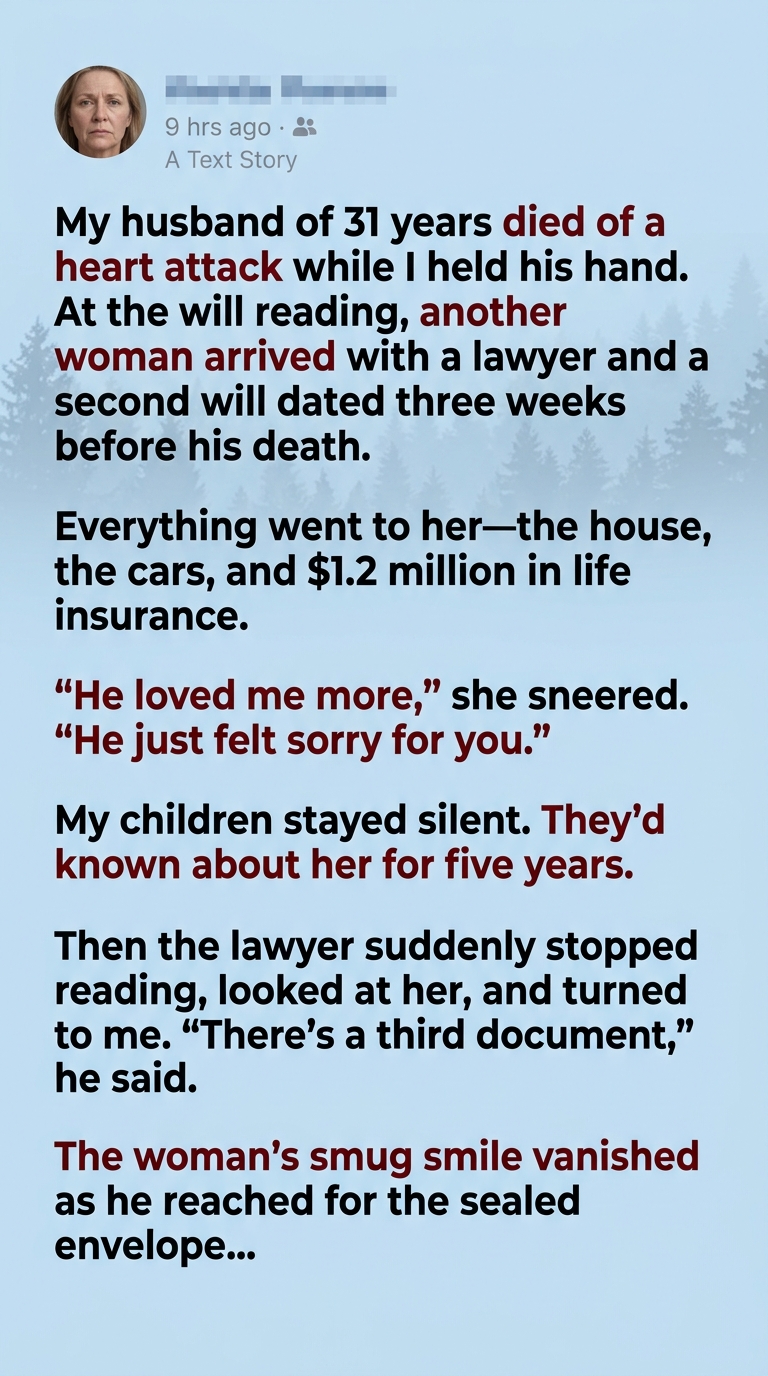
To my wife, Margaret Bennett, if you are reading this, something has happened that I hoped I would have time to explain to you myself.
I stopped breathing for a moment.
It was Daniel’s voice on the page. The careful handwriting, the way he always wrote my full name when something mattered.
Mr. Collins continued.
I have made mistakes that I am ashamed of. I have hurt people I love, and I know that an explanation cannot undo that hurt. But I need you to know that I have not forgotten thirty-one years of marriage, the home we built, or the life we shared.
Victoria shifted in her chair.
“This is ridiculous. He was trying to make himself feel better.”
Mr. Collins held up one hand.
“Please let me finish.”
The letter went on.
Daniel acknowledged that he had been involved with Victoria. He did not attempt to excuse the affair or blame me for it. He wrote that he had allowed a second life to grow around a relationship he should have ended honestly, and that he had become increasingly frightened of the consequences of telling the truth.
Then came the paragraph that made my hands tremble.
Victoria has told me that she intends to challenge the estate arrangements unless I leave her everything. She says she has records that will expose the relationship and that she will make sure Margaret receives nothing.
Victoria shot to her feet.
“That is a lie!”
Her lawyer caught her arm.
“Sit down, Victoria.”
She stared at him in disbelief before dropping back into her chair.
Mr. Collins continued reading.
I am writing this because I want my intentions documented independently of any conversation I have had with Victoria. I have not agreed that she should inherit our home or receive Margaret’s share of our assets. I want my estate handled according to the valid documents already held by my attorney unless a properly executed replacement is established.
The room was utterly silent.
Then Mr. Collins turned to the next page.
It contained a formal statement signed by Daniel and witnessed by two people who were not members of our family. The statement recorded that he had met with his attorney to discuss concerns about pressure being placed on him regarding his estate.
It also directed Mr. Collins to preserve the correspondence Daniel had provided and to seek independent legal review if anyone presented a later will that contradicted his documented wishes.
The letter did not magically settle the dispute. It did, however, give the attorney a clear reason to stop the reading and examine the competing documents.
Victoria’s attorney requested a copy of everything.
Mr. Collins agreed, with the understanding that the original documents would remain secured and that the relevant parties would obtain independent legal advice.
Victoria looked at me with open hatred.
“You think you’ve won something?”
I finally found my voice.
“No. I think my husband has just given us a reason to find out what actually happened.”
She laughed bitterly.
“He was going to leave me everything. He told me that.”
“Then you should have no problem with an independent review.”
For the first time, she had nothing to say.
What My Children Had Been Hiding
The meeting ended without an estate distribution.
Mr. Collins explained that he would need to verify the signatures, examine the original documents, review the life insurance beneficiary records, and determine which instruments were legally effective. He also warned us that a will and a life insurance policy were separate matters: changing one did not automatically change the other.
Victoria left with her attorney.
I remained seated long after the door closed.
Michael and Emily were still there.
I looked at them, my own children, the babies I had held against my chest, the children whose scraped knees I had kissed and whose school plays I had attended even when Daniel was away on business.
“Five years,” I whispered.
Emily covered her mouth.
“Mom, please.”
“Five years of knowing your father was seeing someone else. Five years of looking me in the face while I believed our marriage was what it appeared to be.”
Michael leaned forward.
“We didn’t know how to tell you.”
“You could have started by telling me the truth.”
He looked down.
The explanation came in fragments.
Michael had discovered the affair after seeing a message on Daniel’s phone. He confronted his father, who begged him not to tell me until he had decided what to do.
Emily found out several months later. Daniel told her he intended to end the relationship, then asked her to give him time.
That time became years.
Whenever the children considered telling me, Daniel promised that he would speak to me himself. He told them that exposing the affair would destroy the family and that he needed to resolve things without hurting me unnecessarily.
Eventually, they became trapped in the lie they had agreed to protect.
“Did you ever think about what it was doing to me?” I asked.
Emily was crying openly now.
“Yes. Every day.”
“But you still chose not to tell me.”
She nodded.
I wanted to comfort her. That instinct was so deeply ingrained that my hand almost moved toward hers.
Instead, I left it in my lap.
“I love you both,” I said. “But I don’t know how to trust you right now.”
Michael’s face crumpled.
“Are we going to lose you, too?”
That question hurt more than I expected.
“You haven’t lost me. But you cannot expect me to pretend this didn’t happen because we’re family. I need time, and I need you to understand that your choices had consequences.”
Neither argued.
I walked out of the office alone.
Outside, the afternoon sun was shining. Cars passed, people hurried along the pavement, and somewhere nearby a child laughed.
The world continued as if mine hadn’t just been turned upside down.
I sat in my car and cried for the first time since the funeral.
Not just because Daniel had betrayed me.
I cried because I had spent five years living inside a story everyone else knew was false. I cried because my children had watched me love their father without knowing the truth. And I cried because even in death, Daniel had left me with another problem to solve.
But when the tears finally stopped, I wiped my face, started the engine, and drove home.
I had no intention of letting someone else decide what happened next.
The Investigation
The following week, I hired my own attorney, a woman named Susan Miller who specialized in estate disputes.
She listened carefully while I explained everything, then reviewed the documents Mr. Collins had provided.
“We need to separate what we know from what we suspect,” she told me. “The letter is important evidence of your husband’s concerns and intentions. But it doesn’t automatically invalidate a later will. We need to establish whether that will was properly executed, whether Daniel had the required capacity, and whether there was any undue influence.”
She also asked me to obtain the life insurance policy records through the appropriate channels.
I had assumed that because the policy had been intended to protect me, the proceeds would automatically come to me. Susan explained that the actual beneficiary designation and any valid changes would matter. We would need to obtain the insurer’s records before drawing conclusions.
For the first time in weeks, I felt that someone was helping me distinguish fear from fact.
Mr. Collins cooperated with the review. He provided the original will he had held before Victoria appeared, the sealed letter, and records of Daniel’s earlier estate planning.
The new will raised several questions.
The witnesses were employees of a private care service Victoria had used for her own father. One recalled meeting Daniel briefly but couldn’t remember watching him sign the document. The other said she had signed papers at Victoria’s request but wasn’t certain what she had witnessed.
Neither statement proved fraud. But both were serious enough to require further examination.
Susan arranged for the signatures to be reviewed by a qualified document examiner and requested relevant records through formal legal channels. The lawyers also sought communications relating to the preparation and signing of the purported new will.
Several weeks later, a message surfaced in the records Victoria had voluntarily provided to her attorney.
It was a text from Daniel dated two days before the document was supposedly signed.
I am not agreeing to any changes until Collins reviews them. Please stop asking me to sign papers at your apartment.
There was no dramatic confession. No single message that answered every question.
But it contradicted Victoria’s claim that Daniel had freely and enthusiastically arranged to leave her everything.
Susan told me that the evidence could support a challenge, but we would still need the court to decide the disputed issues if the parties could not reach a resolution.
Meanwhile, the insurance company confirmed that it had records of an attempted beneficiary change. The company had flagged the submission for additional verification because the signature and supporting information required clarification.
The policy had not simply transferred to Victoria because she said it had.
That discovery gave me hope, but Susan cautioned me against celebrating too soon.
“We have evidence to investigate,” she said. “We do not yet have a final outcome.”
For the first time since Daniel’s death, I understood that I could fight for the truth without needing to know the ending in advance.
The Woman Who Thought She Had Won
Victoria’s attorney eventually contacted Susan to discuss a resolution.
By then, the document examiner had identified inconsistencies between the signature on the disputed will and several verified examples of Daniel’s handwriting. That finding did not establish who had produced the document or whether it was fraudulent, but it strengthened the need for a formal challenge.
Victoria’s position began to change.
She no longer insisted that the entire estate should be transferred immediately. Instead, her attorney proposed that the parties negotiate a settlement.
Susan advised me not to agree to anything without reviewing the complete evidence.
During a mediation session, Victoria sat across from me in a conference room, wearing another immaculate suit. She looked less confident than she had at the will reading.
“I loved Daniel,” she said.
I looked at her.
“You may have loved him. I can’t tell you what you felt.”
Her eyes narrowed.
“He told me he was going to leave you.”
“Then he should have told me himself.”
“He didn’t want to hurt you.”
I almost laughed.
“That’s an interesting way to describe what he did.”
For a moment, neither of us spoke.
Then Victoria said, “You had thirty-one years with him. I had five. I thought he was finally going to choose me.”
I studied her face.
There was anger there, and grief, and perhaps the dawning realization that Daniel had made promises he had never been prepared to keep.
But none of that made her entitled to my home or my financial security.
“I didn’t choose this situation,” I said. “And I won’t accept being punished for it.”
She looked away.
The mediation did not produce an immediate agreement. The estate remained subject to the legal process, and the disputed documents continued to be examined.
Eventually, after further review, Victoria’s side agreed not to pursue the purported will as the basis for an immediate transfer. The parties reached a court-approved resolution of the estate dispute based on the verified earlier will and the applicable beneficiary records.
The house remained mine under the valid estate arrangements and the property records. The insurance proceeds were distributed according to the insurer’s confirmed beneficiary designation, not Victoria’s claims. The remaining estate was handled according to the final resolution and applicable law.
There was no instant fortune, no dramatic courtroom speech, and no public confession that erased the past.
There were months of paperwork, difficult conversations, legal bills, and mornings when I woke up exhausted before the day had even begun.
But I kept my home.
And I kept my right to decide what came next.
The Last Letter
Several months after the dispute was resolved, Mr. Collins contacted me about a final item he had found among Daniel’s stored papers.
It was a handwritten letter addressed to me, separate from the sealed document.
I took it home and opened it at the kitchen table where Daniel and I had eaten breakfast for three decades.
Margaret,
If you are reading this, I have left you with a mess I should have had the courage to face while I was alive.
I cannot ask you to forgive me. I cannot ask you to remember only the good years or pretend that my choices did not change them.
I loved you, but I did not always act like a man who understood what love required. I allowed fear and selfishness to become excuses. I let other people carry the consequences of decisions I should have owned myself.
Whatever happens with the estate, I hope you will build a life that belongs to you. Don’t spend the rest of your years trying to understand every lie I told. Some of them have no answer that will make the pain worthwhile.
You deserved the truth when I was alive. I am sorry I did not give it to you.
Daniel.
I read the letter twice.
Then I folded it carefully and placed it in the drawer beside our old photographs.
I didn’t destroy his things. I didn’t erase thirty-one years of memories because the final years had contained a betrayal. Our marriage had been real to me, even if Daniel had kept parts of his life hidden.
I could remember the morning he carried our daughter into the house for the first time. I could remember our son’s graduation, the holidays, the terrible family road trips, and the quiet evenings when we sat together without needing to speak.
Those memories belonged to me, too.
But they no longer required me to deny what he had done.
My children and I began rebuilding our relationship slowly. I told them I wanted them in my life, but I would not be their father’s keeper of secrets anymore. They had to accept that trust would return through honesty and consistency, not through a single apology.
They did.
It took time.
Some conversations were painful. Some ended with all of us crying. But we learned to speak openly about Daniel without pretending that he had been either a perfect husband or a completely bad man.
Victoria eventually disappeared from our lives.
I heard through the lawyers that she had moved to another city. I never contacted her again.
A year after Daniel’s death, I returned to the ocean town we had once planned to visit for our thirty-second anniversary.
I went alone.
I walked along the beach, watched the waves break against the shore, and sat on a bench until the sun began to set.
For a long time, I had thought that surviving betrayal meant proving I was stronger than the person who hurt me.
I finally understood that it meant something quieter.
It meant refusing to let someone else’s lies dictate the rest of my life.
Daniel’s final letter had not repaired our marriage. The third document had not erased the affair. And winning the estate dispute had not brought back the husband I thought I had.
But the truth had given me something I had nearly lost.
My ability to choose my own future.
When I returned home, I took the old photograph of Daniel and me from the mantelpiece. I didn’t throw it away. I placed it in an album alongside photographs of our children, our house, and the life we had built.
Then I closed the album.
I was still grieving. I was still angry. And I was still learning how to live without the person I had expected to grow old beside.
But for the first time in a long time, I wasn’t waiting for Daniel to explain himself.
I was moving forward.
He had spent five years hiding the truth from me. His final documents couldn’t undo that betrayal—but they ensured that the last lie he left behind would not decide the rest of my life.