The Photograph They Never Expected to See
The photograph was ten years old.
It showed me standing outside a small brick building in the rain, holding a set of keys in one hand and a folder of documents in the other. Beside me stood my grandmother, Evelyn, smiling proudly.
Behind us was a sign that read:
SOLD — EVELYN’S FAMILY HOME
But that wasn’t the part that made my relatives go silent.
The photograph had been taken on the afternoon I bought the house my grandmother had lived in for forty-two years.
And according to the story my parents had told everyone, I had never been able to afford it.
For most of my childhood, my family treated my sister Vanessa as the daughter who would make them proud and me as the daughter who would always need fixing.
Vanessa was charming, outgoing, and skilled at making people feel important. She knew how to compliment my mother, laugh at my father’s jokes, and turn every family gathering into an opportunity to remind everyone how well she was doing.
I was different.
I liked numbers, quiet mornings, and solving problems without announcing every achievement. I worked part-time through college, saved what I could, and rarely asked my parents for money.
That didn’t fit their preferred version of me.
My mother called me unambitious. My father said I lacked confidence. Vanessa joked that I would probably still be renting a tiny apartment when I was forty.
Whenever I accomplished something, my parents found a reason to diminish it.
When I graduated with honors, my mother asked why I hadn’t graduated a semester earlier.
When I got my first promotion, my father asked how much Vanessa’s husband earned.
When I paid off my student loans, Vanessa laughed and said I should have bought a better car instead.
I learned not to share much.
Then, ten years ago, my grandmother changed everything.
Evelyn had always been the one person in the family who saw me clearly. She never compared me with Vanessa. She asked about my work, remembered the little things I told her, and encouraged me to build a life that didn’t depend on anyone else’s approval.
She also owned a modest house that had belonged to her and my grandfather.
After my grandfather died, the house became increasingly expensive for her to maintain. She wanted to move into a smaller apartment near her friends, but she worried that selling the property would mean losing the place where she had raised her children.
I offered to buy it.
I had saved for years, and I was working in financial operations for a growing company. My income wasn’t glamorous, but I had learned to budget carefully, invest consistently, and live below my means.
We hired independent professionals to assess the property’s value, reviewed the paperwork, and completed the sale through the ordinary legal process.
I paid a fair market price.
My grandmother received the money she needed for her next chapter, and I bought a home I could afford.
It was one of the proudest days of my life.
My parents, however, saw it differently.
When I told them about the purchase, my mother accused me of manipulating my grandmother.
My father demanded to know where I’d gotten the money.
When I explained that I had saved it, he laughed.
“You’re telling me you’ve suddenly become some kind of financial genius?”
I showed him the documents.
He barely looked at them.
Vanessa called the purchase a lucky break and told everyone that Grandma had practically given me the house.
That was the beginning of the story they repeated for years: I was irresponsible, I couldn’t manage money, and whatever I had achieved was the result of someone rescuing me.
The truth was much less dramatic.
I had worked hard, saved carefully, and made a sensible purchase.
But the truth didn’t flatter my parents, so they ignored it.
Then came the incident that changed my relationship with them forever.
The Money They Said I Owed
A few months after I bought the house, my father called me in a panic.
He had invested in a small business venture with an acquaintance. The venture failed, and he was facing a substantial financial loss.
He told me he had made a mistake and needed help.
I offered to review the records with him.
What I found was worse than he had described. He had mixed personal and business expenses, borrowed against money he couldn’t easily replace, and relied on projections that had never been properly verified.
I wasn’t qualified to rescue his investment, and I couldn’t afford to absorb his losses.
But I could help him understand his options.
I spent several weekends organizing his paperwork, separating documented expenses from estimates, and helping him prepare questions for an accountant and attorney.
My mother was furious that I wouldn’t simply hand over my savings.
“After everything we’ve done for you,” she said, “you can’t help your own father?”
I reminded her that I had already offered hours of help and had even covered several immediate household expenses while they sorted out their finances.
She dismissed that.
“You owe us more than that.”
I should have recognized the warning in those words.
Instead, I kept trying to prove that I was a good daughter.
Over the following months, I paid for my father’s car repair, covered an overdue utility bill, and helped my parents reorganize their budget. Every time I helped, the request became a little larger.
And every time I said no, my mother reminded me how much my childhood had cost.
Eventually, I asked her to stop.
“I love you,” I told her. “But I’m not an unlimited source of money. I need to build my own future, too.”
She hung up on me.
A week later, my parents told relatives that I had refused to help them because I was selfish and ungrateful.
They didn’t mention the bills I’d paid or the weekends I’d spent sorting through my father’s records.
When my grandmother confronted them, they accused her of taking sides because I had bought her house.
Grandma was devastated.
She called me that night and apologized for the tension.
“You shouldn’t have to keep proving that you’re a good person,” she said. “Especially to people who have already decided what they want to believe.”
Those words stayed with me.
I stopped paying my parents’ expenses unless I freely chose to help with a specific need. I stopped defending myself against every accusation. I stopped trying to win arguments that changed shape every time I answered them.
And I began keeping records.
I saved receipts, bank statements, messages, and copies of the documents relating to the house purchase. I also kept the messages in which my parents had asked for money and acknowledged that it was help I was giving voluntarily.
I never planned to publish any of it.
I simply wanted a reliable record in case someone eventually tried to turn their version of events into an official claim against me.
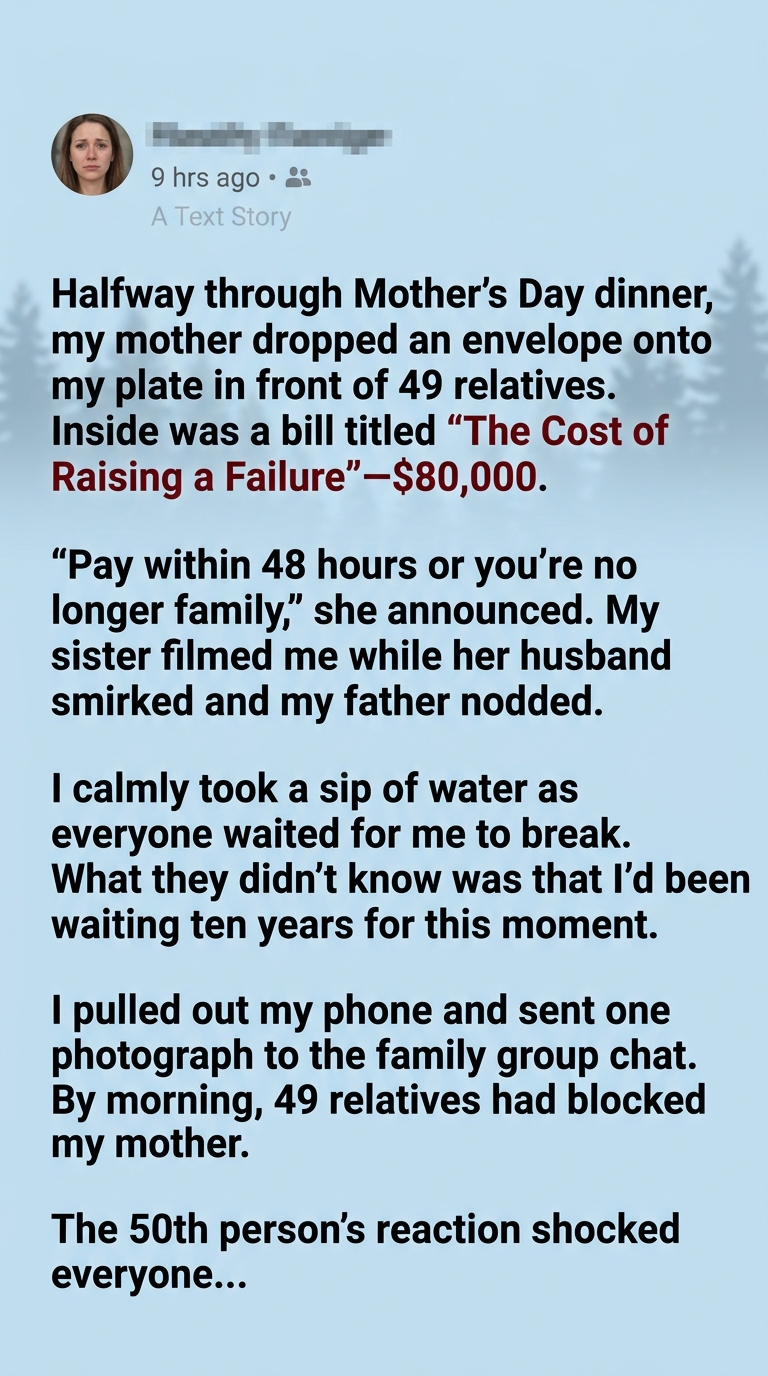
Ten years later, my mother handed me that absurd invoice.
And suddenly, I understood why I had kept everything.
The Family Group Chat Explodes
At the dinner table, my uncle Peter was the first to speak.
“Richard,” he said slowly, looking at my father, “is this the house you told us she got for practically nothing?”
My father shifted in his chair.
“That’s not what the picture proves.”
My uncle turned his phone toward him.
“The photograph shows the sale sign. The message attached to it says she bought it at the assessed market price. There’s a copy of the closing statement, too.”
My mother grabbed her phone so quickly she nearly knocked over her wineglass.
“Why do you have all this?”
“Because I kept the documents from a major financial transaction,” I replied. “The same way any responsible person would.”
My aunt leaned across the table.
“Wait. Diane, you told us she had borrowed money from Evelyn and never paid it back.”
“I never said that,” my mother snapped.
“You absolutely did,” my aunt replied. “You said Evelyn had practically given her the house and that she was taking advantage of an elderly woman.”
Another relative opened the photograph and zoomed in on the attached documents.
Someone else scrolled back through the group chat.
Then my cousin spoke.
“There’s another message here.”
I knew exactly which one he meant.
Along with the photograph, I had attached a screenshot of a message my mother had sent me ten years earlier, shortly after the sale.
It read:
You should be grateful Grandma gave you this opportunity. Don’t go around acting like you accomplished something on your own.
Below it was my response:
I paid the agreed price. I worked for the money, and Grandma received what the house was worth. Please stop telling people otherwise.
And below that, my mother’s reply:
No one will believe you over your own mother.
The table went completely silent.
My mother stared at the screen as though she could somehow force the message to disappear.
My father reached for his phone.
“Everyone is taking this out of context,” he announced. “This is a private family matter.”
My uncle Peter shook his head.
“No. You made it public when you handed her a bill in front of fifty people.”
“Forty-nine,” Vanessa muttered automatically.
Nobody laughed.
I looked at my mother.
“You invited everyone here to watch me be humiliated. You gave me forty-eight hours to pay a debt I never agreed to owe. You called me a failure in front of the entire family.”
She lifted her chin.
“Parents sacrifice everything for their children.”
“Yes,” I replied. “And children can be grateful for that without owing their parents the rest of their lives.”
For once, she had no immediate response.
Then Vanessa stood up.
“This is ridiculous. She planned this! She knew Mom was going to confront her, and she brought a picture to make everyone feel sorry for her.”
I looked at my sister’s phone, still recording.
“Did you know about the invoice before tonight?”
She hesitated.
“Of course I knew Mom wanted to talk to you.”
“Did you know she planned to demand eighty thousand dollars?”
Vanessa looked at our mother.
That was answer enough.
I felt a strange sadness, but no surprise.
My sister had spent years benefiting from the family story. She had never needed to challenge it because the story placed her on top.
She wasn’t about to surrender that position easily.
“You’re all acting like I’m the villain here,” she said.
“No one has to decide who the villain is,” I replied. “You can look at the documents and decide what happened for yourselves.”
Then I stood, picked up my handbag, and looked around the table.
“I’m not paying that invoice. If my parents believe they have a legitimate legal claim, they can have it reviewed by an attorney. But I will not sit here while I’m threatened and insulted.”
I turned to my mother.
“And I’m not going to pretend this is normal just because we’re related.”
I left before dessert.
For the first time in my life, I didn’t stay behind to soothe everyone else’s feelings after someone had hurt mine.
The Forty-Nine Blocks
By the following morning, my phone was filled with notifications.
My uncle Peter had sent a message to the family group chat saying he would no longer participate in conversations that demeaned me.
My aunt apologized for repeating things she’d heard without checking them.
Two cousins admitted they had believed the story about Grandma giving me the house because my parents had repeated it for years.
Then the messages began arriving from relatives who had been at the dinner.
One by one, people told me they were stepping away from my mother.
Some blocked her number. Others muted the family chat or asked her not to contact them for a while. A few told her directly that they wouldn’t attend future gatherings if she continued using them as an audience for humiliating someone.
By noon, forty-nine relatives had blocked her or otherwise cut off direct contact.
I knew because several of them told me. I didn’t ask anyone to do it, and I didn’t celebrate it.
The point had never been to organize a family-wide punishment.
I had wanted the truth to be seen.
My mother had spent years telling everyone that I was irresponsible, ungrateful, and incapable of building a life without her. She had assumed that if she repeated the story often enough, nobody would ever question it.
But people had finally seen evidence that contradicted her claims.
And many of them were no longer willing to play along.
Vanessa called me that afternoon.
“You’ve destroyed Mom,” she said without greeting me.
“No. I sent a photograph and the records that went with it.”
“Everyone is blocking her!”
“That’s their decision.”
“You could tell them to stop.”
I closed my eyes.
“Vanessa, I can’t control what other adults decide to do. And I won’t lie to make this easier for Mom.”
She accused me of being vindictive.
I reminded her that I hadn’t created the invoice, chosen the public setting, or issued the forty-eight-hour ultimatum.
She hung up.
I thought that was the end of it.
Then, at 6:17 p.m., I received a message from the one person whose reaction I had never anticipated.
My grandmother.
She was the fiftieth person.
And she wasn’t angry.
She was heartbroken.
The Fiftieth Person
Grandma called that evening.
I answered immediately.
“Grandma?”
“Oh, sweetheart,” she whispered.
Her voice sounded smaller than I had ever heard it.
“I saw the messages.”
I sat down on the edge of my bed.
“I’m sorry you had to see all of that.”
“Don’t apologize for telling the truth.”
She paused.
“I need to ask you something. Did your mother really give you an invoice for eighty thousand dollars?”
“She did.”
“And she gave it to you in front of everyone?”
“Yes.”
I heard her take a shaky breath.
“I always knew Diane could be cruel when she felt she was losing control. But I never imagined she would do something like this.”
I didn’t know what to say.
Grandma had spent years trying to keep the family together. She often encouraged me to be patient with my parents, not because she believed their behavior was acceptable, but because she hoped they would eventually learn to treat me differently.
Now she sounded exhausted.
“I want you to know something,” she said. “I remember the house sale. I remember the documents. I remember how carefully you planned everything because you wanted to make sure I was treated fairly.”
“I know.”
“And I remember what your mother told me afterward.”
My stomach tightened.
“What did she tell you?”
Grandma was silent for a moment.
“She told me you had asked me for the house as a gift. She said you had manipulated me into selling it below market value, and that you were trying to make yourself look successful at my expense.”
I closed my eyes.
Even after all these years, hearing the accusation repeated still hurt.
“I tried to explain what had actually happened,” I said. “But she wouldn’t listen.”
“I know, sweetheart. I know.”
Then Grandma told me something I hadn’t expected.
She had kept her own copies of the sale documents, including the independent valuation, the purchase agreement, and the records showing that she had received the agreed payment.
She had also saved a letter she wrote shortly after the sale, explaining that the transaction was voluntary and that she was satisfied with the terms.
She had never needed to use those records.
Until now.
“I want the family to see my statement,” she said. “Not because I want to punish your mother, but because I refuse to let her rewrite what happened between us.”
My eyes filled with tears.
“You don’t have to get involved.”
“I’m already involved,” she replied gently. “Your mother brought my name into this when she claimed you owed her money for raising you. She used our relationship to make you look dishonest. I have a right to tell the truth about my own decisions.”
The next morning, Grandma sent a short statement to the family group chat, along with copies of the relevant documents.
She confirmed that I had purchased her house through a voluntary, properly documented sale. She stated that she had received the agreed price and had never asked me to repay her for the transaction.
She also made one thing clear:
“I did not give my granddaughter a house. She bought it. I was proud of her for being able to do so.”
Then she addressed the invoice.
“I raised my children because I chose to become a parent. I never expected them to repay me for their childhood. Diane’s demand is not something I support, and I will not remain silent while one grandchild is humiliated for refusing to pay a debt that was never agreed upon.”
Grandma didn’t block my mother that day.
She did something much harder.
She told her that she needed distance and would no longer participate in family gatherings where people were pressured, shamed, or threatened.
She also asked my mother not to contact her until she was ready to have an honest conversation without blaming other people.
That was the reaction that shocked everyone.
My grandmother had always been the peacemaker.
Now she was choosing the truth over keeping the peace.
The Forty-Eight-Hour Deadline
The forty-eight hours passed without a payment.
Nothing happened.
No legal papers arrived. No official notice appeared. No authority contacted me about the invoice.
My mother had never produced a contract showing that I had agreed to repay her for raising me. The document she had presented was simply a list of numbers she had assembled herself.
I still sought independent legal advice, because I wanted to understand my position rather than rely on assumptions. The attorney reviewed the invoice and the available records, explained the distinction between a demand and an enforceable obligation, and advised me to keep all communications in case the dispute escalated.
I followed that advice.
I didn’t send my mother an angry message. I didn’t publish her private information online. I didn’t try to embarrass her at another gathering.
I simply declined to pay and kept my records.
Three weeks later, my father contacted me.
His message was short.
Your mother is upset. I think you should call her and try to resolve this.
I read it several times.
He didn’t apologize for nodding while she humiliated me. He didn’t acknowledge the invoice or ask why she had thought it was acceptable.
He simply wanted me to restore the family’s comfort.
I replied:
I’m willing to have a conversation when we can discuss what happened honestly. I’m not willing to pretend it didn’t happen just to make everyone comfortable again.
He didn’t answer.
Vanessa was the first to reach out with anything resembling an apology.
She admitted that she had known our mother planned to confront me, although she claimed she hadn’t realized how extreme the demand would be. She also acknowledged that recording me had been cruel.
I appreciated the apology, but I didn’t immediately return to our old relationship.
“I need time,” I told her. “And I need to know that you’ll speak up if this happens again.”
She said she understood.
Whether she truly did would become clear over time.
My mother sent a message too, but it wasn’t an apology.
I can’t believe you would do this to your own family.
I didn’t respond.
For years, I’d believed that if I explained myself clearly enough, my mother would finally understand me. I thought that if I showed her my receipts, my achievements, and my sacrifices, she would acknowledge that I was not the failure she claimed I was.
But I had finally learned that I didn’t need her agreement to know the truth about my life.
I had built a career. I had purchased a home through years of careful saving. I had helped my parents when I could. I had loved my family even when loving them was painful.
None of those things required an eighty-thousand-dollar invoice to become real.
What I Learned After That Dinner
Six months later, my relationship with my family looked very different.
Some relatives resumed speaking to my mother after she acknowledged that the invoice had been inappropriate. Others maintained their distance. A few chose to stay out of the conflict altogether.
I didn’t tell anyone what they should do.
My relationship with Vanessa improved slowly. We began with occasional messages and short visits, without pretending that everything was fixed. She eventually admitted that she’d spent years enjoying the approval she received by comparison with me, and that confronting our mother’s behavior would have meant risking her own place in the family.
It wasn’t an excuse, but it was the first honest conversation we’d had in years.
My father remained distant for a while. Eventually, he admitted that he had gone along with the dinner because he believed I would pay some amount to make the embarrassment stop.
He said he hadn’t expected me to challenge the demand.
I told him that was precisely the problem.
He had assumed I would rather surrender money than risk being rejected by my own family.
He was right about one thing: for a long time, that was exactly what I would have done.
But not anymore.
My grandmother and I grew closer. We spent Sunday afternoons together, drinking tea and talking about ordinary things. She never asked me to forgive my mother, and I never asked her to choose sides.
She simply reminded me that I was allowed to have a life of my own.
And that was enough.
As for the invoice, I kept it in a folder with the records from that night. Not because I wanted to stare at it or nurse my anger, but because it reminded me of the moment I finally stopped trying to earn a place in a family I had belonged to all along.
My mother had intended that dinner to be a public verdict on my worth.
Instead, it became the night everyone finally saw how much of the family’s story had depended on me staying quiet.
I had waited ten years for the truth to be visible.
I didn’t need to destroy anyone to make that happen.
I only needed to stop hiding the evidence.
The most powerful thing I did that night wasn’t sending the photograph. It was refusing to pay for the privilege of being called family.