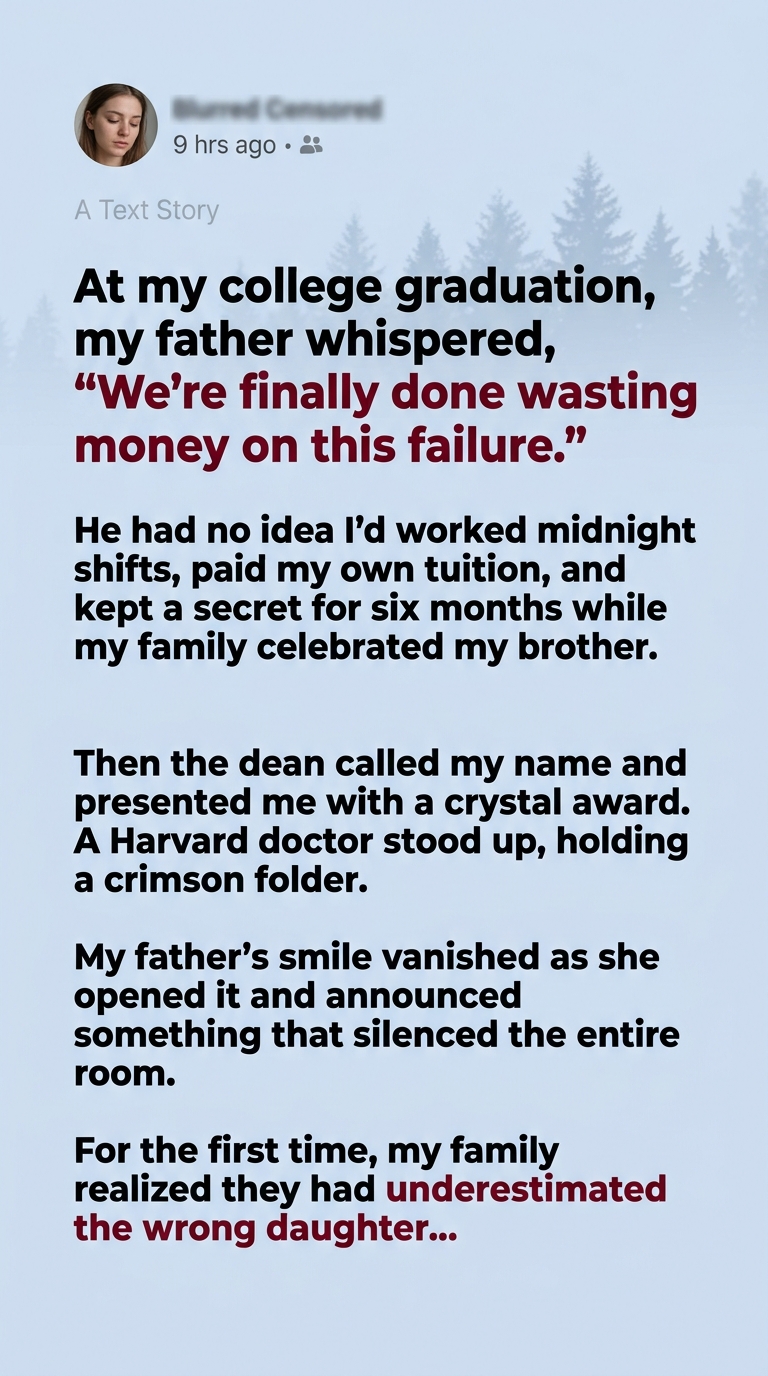
At my college graduation, my father leaned toward me and whispered, “We’re finally done wasting money on this failure.”
He said it while hundreds of people around us applauded the graduating class.
My mother pretended not to hear him. My older brother, Ethan, checked his phone, looking bored. And I sat there in my black graduation gown, gripping the program so tightly that the paper began to wrinkle.
What my father didn’t know was that I had paid my own tuition, worked midnight shifts at a hospital laundry facility, and survived six months of rejection, exhaustion, and fear while keeping a secret my family would never have believed.
He also didn’t know that, in a few minutes, a doctor from Harvard would walk onto that stage carrying a crimson folder.
And when she opened it, the smile would disappear from his face.
My name is Emily Carter, and for most of my life, my family treated me like the child who would never quite measure up.
My brother Ethan was the golden one.
He was three years older than me, charming, confident, and exceptionally good at making my parents believe he was destined for greatness. When he announced he wanted to study business, my father bought him a new laptop. When he landed an internship, my mother hosted a dinner party. When he graduated, my parents rented a ballroom and invited nearly a hundred people.
I still remembered the photographs from that evening.
My father stood beside Ethan with one hand on his shoulder, beaming as if his son had just won a Nobel Prize.
Two years later, Ethan was still searching for a job that matched his expectations, but my parents continued introducing him as a future executive.
I never begrudged my brother his opportunities.
What hurt was how differently my parents treated my ambitions.
When I told them I wanted to study biomedical science, my father barely looked up from his newspaper.
“That’s an expensive degree for someone who isn’t naturally exceptional.”
My mother suggested nursing instead, as though she were offering me a consolation prize.
When I explained that I wanted to study the science behind disease and help develop better treatments, my father laughed.
“Everyone wants to save the world until the bills arrive.”
I applied anyway.
When my acceptance letter arrived, I held it against my chest and cried in my bedroom.
I thought perhaps my parents would finally be proud.
My father read the letter, nodded once, and asked how much tuition would cost.
When I told him, he placed it on the kitchen counter.
“We’ll help you for the first year,” he said. “After that, you’ll need to prove this is worth the money.”
I thanked him.
I didn’t know then that the promised help would become another weapon he could use whenever I disappointed him.
By the end of my first year, my grades were excellent, but my family had begun questioning every expense. Ethan needed money for an apartment deposit. His car needed repairs. He had found a business opportunity that required an investment.
Every time I asked about tuition, my father told me to be patient.
Every time Ethan asked for help, money appeared.
So I found work.
At first, I worked evenings at a grocery store. Then I took midnight shifts at a hospital laundry facility, sorting sheets and gowns while the rest of the city slept. The work was exhausting, but the hospital offered steady hours, and I could study during breaks when the workload allowed.
I learned to sleep in short stretches.
I learned to carry flashcards in my coat pocket.
I learned how to calculate whether I could afford groceries, textbooks, and the next tuition payment without overdrawing my account.
I stopped asking my parents for money.
They barely noticed.
When family friends asked about my studies, my mother said I was “still figuring things out.” My father called my degree an expensive experiment.
Meanwhile, Ethan moved back into my parents’ house after his business plans failed. They called it a temporary setback and told everyone he was regrouping.
I kept my head down.
I wasn’t trying to prove that my brother was less successful than me. I wanted to build a life where my worth wasn’t determined by whether my father approved of my choices.
Then, during my final year, something happened that changed everything.
One of my professors, Dr. Alvarez, recommended me for a competitive research placement connected to a medical research team in Boston.
The program focused on an area I had studied for years: how certain cellular mechanisms contributed to disease progression and how those pathways might eventually be targeted by new treatments.
The application process was demanding. I submitted my academic record, research work, recommendations, and a detailed proposal. I interviewed remotely with members of the team and answered questions about my methods, limitations, and plans for further study.
I didn’t tell my family.
I had learned that sharing my hopes with them often meant spending the next several weeks defending why I deserved to have them.
Six weeks later, an email arrived.
I read it standing beside the washing machines at work.
Then I read it again.
I had been selected.
The placement included a funded research position, a stipend, and an opportunity to present my work at a university research symposium. My results would be reviewed by senior researchers, and the team would decide whether the project justified further development.
I sat down on an overturned laundry basket and covered my mouth.
For the first time in years, I felt as though my work had opened a door I hadn’t needed my father to unlock.
But the secret grew more complicated.
My research mentor introduced me to a physician-scientist affiliated with Harvard Medical School, Dr. Victoria Bennett, who was collaborating with the research group.
She had spent years studying the disease pathway my project examined. She challenged my assumptions, asked me to defend my analysis, and encouraged me to distinguish what the data actually showed from what I hoped it would prove.
At first, I was intimidated by her.
Then I realized she was treating me the way I had always wanted to be treated: as someone whose ideas deserved serious consideration.
Under her guidance, I refined my methods, repeated several experiments, and revised my conclusions when the evidence didn’t support my initial interpretation.
My project did not produce a miracle cure.
It did something more realistic and valuable.
It identified a promising pattern that justified further investigation, and my work became part of a larger research effort. The team invited me to continue contributing after graduation, subject to the next phase of funding and review.
Dr. Bennett also nominated me for a university award recognizing outstanding undergraduate research.
I was told the decision would remain confidential until the graduation ceremony.
That was the secret I’d kept for six months.
Not because I wanted to surprise my family, but because I had learned to protect my happiness until it was real.
Graduation day arrived on a bright Saturday morning.
I woke before dawn, ironed my gown, and pinned my hair into place. I had barely slept the night before.
My parents arrived late.
My mother wore a cream dress and carried a handbag that cost more than a month of my living expenses. My father complained about parking. Ethan arrived in sunglasses, saying he had a lunch meeting afterward.
When we found our seats, my mother looked around the auditorium.
“It’s smaller than Ethan’s graduation,” she said.
I smiled politely.
My father glanced at the program.
“Let’s get through this quickly.”
I looked at the stage, where faculty members were taking their seats. My hands felt cold.
I’d imagined this day differently when I was younger. I’d imagined my father standing to applaud, my mother wiping away happy tears, and my brother finally telling me he was proud of me.
Instead, I had learned to lower my expectations.
The ceremony began with speeches, applause, and the long procession of graduates.
I listened as other students were recognized for their achievements. Some had overcome financial hardship. Others had conducted research, served their communities, or excelled in their fields.
Every story reminded me that a graduation gown could hide years of struggle.
Then my father leaned toward me.
“We’re finally done wasting money on this failure,” he whispered.
I felt the words settle somewhere deep inside me.
I could have reminded him that I had paid my own tuition.
I could have told him that I had worked nights while studying full-time.
I could have listed every bill I had covered without his help.
Instead, I looked straight ahead.
“Dad,” I said quietly, “you didn’t pay for my degree.”
He frowned.
Before he could respond, the dean stepped to the microphone.
“We now turn to a special recognition for exceptional undergraduate research.”
My heart began to race.
The dean spoke about the importance of persistence, intellectual honesty, and the courage to pursue questions whose answers were not yet known.
Then he announced my name.
“Emily Carter, please join us on stage.”
For a second, I didn’t move.
My mother turned toward me.
“Why are they calling you?”
I stood.
The auditorium filled with applause as I walked toward the stage. I could feel hundreds of eyes following me, but I kept my gaze on the dean.
He shook my hand and presented me with a crystal award.
“Your work reflects remarkable discipline and promise,” he said.
I thanked him, still trying to understand that this was really happening.
Then he stepped aside.
A woman in a dark crimson suit rose from the front row.
Dr. Victoria Bennett.
She carried a crimson folder.
My father leaned forward, squinting.
“Who is that?”
I heard him, but I didn’t answer.
Dr. Bennett walked to the microphone.
“Good afternoon,” she began. “I’m Dr. Victoria Bennett, a physician-scientist affiliated with Harvard Medical School and a collaborator on Emily Carter’s research project.”
The room grew quiet.
“I’m here because Emily’s work deserves recognition beyond today’s ceremony. Over the past six months, she has contributed to a research effort examining a promising biological pathway involved in disease progression. She approached the work with rigor, challenged her own assumptions, and revised her conclusions when the evidence demanded it.”
She opened the crimson folder.
“Research is not about claiming to have solved a problem before the evidence is ready. It’s about doing the difficult work that makes future discoveries possible.”
She paused and looked directly at me.
“Emily has earned a funded continuation position with our collaborating research team, subject to the project’s next review stage. She has also been selected to present her findings to a panel of researchers, with the possibility of contributing to a larger study.”
Applause began to ripple through the auditorium.
Then Dr. Bennett added something I hadn’t expected.
“Her selection was based on her work, not her circumstances. But I understand that she completed this project while supporting herself through school and working overnight shifts.”
She closed the folder halfway.
“That kind of perseverance deserves to be recognized. Emily, on behalf of the team, congratulations.”
The auditorium erupted in applause.
I stood frozen, holding the crystal award against my chest.
For the first time in my life, people were applauding something I had accomplished without my family’s approval.
I looked toward my parents.
My mother’s mouth hung open.
Ethan had taken off his sunglasses.
And my father’s face had gone completely blank.
He stared at Dr. Bennett, then at the award in my hands, as if someone had suddenly changed the language in which the world operated.
The dean invited me to say a few words.
I approached the microphone, my knees trembling.
“I’d like to thank my professors, my research mentors, and everyone who helped me reach this point,” I began.
My voice caught.
“I also want to thank the people who taught me that progress doesn’t always look impressive from the outside. Sometimes it’s a night shift, a difficult exam, a failed experiment, or the decision to keep going when nobody is watching.”
I paused.
“I used to think success meant convincing people I was worth believing in. Now I understand that the work matters even when no one believes in you yet.”
I looked out at the audience.
“And I hope I never become so certain of someone else’s limitations that I stop them from discovering what they’re capable of.”
I stepped away from the microphone.
The applause rose again.
I didn’t look at my father as I left the stage.
I didn’t need to.
After the ceremony, my parents waited near the auditorium entrance.
My mother reached me first.
“Emily! Why didn’t you tell us?”
I adjusted the ribbon attached to my award.
“Tell you what?”
“That you were doing research with Harvard. That you were getting a position. That you were being honored!”
“I didn’t know the final decision until recently.”
My father stepped forward.
“You should have told us. We’re your family.”
I stared at him.
“You told me I was wasting money on a degree I paid for myself.”
His face tightened.
“That isn’t what I meant.”
“It was exactly what you meant.”
He glanced around, noticing that several people nearby were looking in our direction.
“Don’t turn this into an argument. Today should be about your achievement.”
I almost laughed.
For years, he had dismissed my work because it didn’t fit the future he’d imagined for me. Now that someone with an impressive title had praised it, he wanted to claim a place beside me.
I wasn’t ready to give him one.
Dr. Bennett approached us, carrying the crimson folder.
“Emily,” she said, “I wanted to give you the formal details of the appointment and discuss the next steps.”
She handed me a sealed document.
My father immediately straightened.
“That’s wonderful. We’re very proud of her.”
Dr. Bennett looked at him politely.
“I’m glad to hear that.”
Then she turned back to me.
“Your work speaks for itself. Remember that research is a long process. There will be setbacks, and you’ll need to keep asking difficult questions. That’s part of the job.”
I nodded.
“Thank you, Dr. Bennett.”
She shook my hand and moved on to greet another faculty member.
My father watched her leave.
Then he turned to me.
“So, Harvard. This could be very good for the family.”
I felt something inside me finally settle.
“It’s good for me,” I said.
He blinked.
“What?”
“My work. My future. My achievement. It’s mine, Dad.”
His face reddened.
“I’ve always wanted what’s best for you.”
“Then why did you call me a failure before you knew what I’d accomplished?”
He opened his mouth, then closed it.
For once, he had no immediate answer.
My mother began to cry softly.
“Emily, please. We didn’t know you were struggling so much.”
I looked at her.
“I told you I was working nights. I told you I was paying my own tuition. You knew. You just didn’t think it mattered.”
She wiped her eyes.
“We thought you were making things harder than they needed to be.”
“I was working hard because I had to. I wasn’t asking you to fix everything. I wanted you to believe I was capable of building a life for myself.”
My father shifted his weight.
“Fine. We made mistakes. But you can’t hold this over us forever.”
“I’m not holding anything over you,” I said. “I’m telling you what happened.”
He looked away.
Ethan, who had remained silent throughout the exchange, finally spoke.
“Dad, she did all of this herself. Maybe just tell her congratulations.”
My father turned toward him sharply.
But Ethan didn’t back down.
For the first time, my brother looked uncomfortable with the role our family had assigned him. He had been the favored child for so long that I wondered whether he had ever understood what it felt like to be constantly measured against someone else’s expectations.
He looked at me.
“Congratulations, Emily. Seriously. You earned it.”
I thanked him.
It wasn’t a perfect reconciliation, but it was sincere.
My father eventually muttered, “Congratulations.”
The words were stiff, almost resentful.
I accepted them without pretending they repaired everything.
That evening, I went home to my small apartment, placed the crystal award on my desk, and opened the crimson folder.
Inside were the details of my funded position, the research team’s expectations, and the next steps for my work.
There was no guarantee that I would become a leading scientist. No promise that my research would change medicine. No magical future in which every struggle disappeared.
There was simply an opportunity I had earned.
And that was enough.
Over the following months, I continued working with the research team while planning the next stage of my education. I still worked hard. I still made mistakes. Some experiments failed, and some promising ideas turned out to be dead ends.
But I no longer treated every setback as evidence that my father might have been right.
I learned to evaluate myself by the quality of my work, the honesty of my conclusions, and the way I treated people—not by the approval of someone who had never taken the time to understand me.
My relationship with my parents changed slowly.
My mother began asking about my research, though at first she seemed more interested in the prestigious names attached to it than in the work itself. I answered her questions honestly, even when the answers were complicated.
My father took longer.
He occasionally mentioned my award to friends, but I noticed he rarely mentioned the years I’d worked to earn it. He preferred the story in which I had surprised everyone with a sudden success.
I stopped correcting him every time.
I didn’t need to win an argument about my past to build my future.
Eventually, he asked whether he could visit my workplace.
I told him I’d think about it.
I wanted any future relationship to be built on genuine interest and respect, not on the sudden realization that my achievements could make him look good.
Months after graduation, I received a message from Dr. Bennett inviting me to present an update on my research.
I read it at my kitchen table, smiling to myself.
Then I looked at the crystal award on my desk.
It reminded me of the moment my father had whispered that I was a failure.
For a long time, I had believed that the greatest satisfaction would be watching his expression change when he discovered what I’d accomplished.
And yes, seeing his confidence collapse had been unforgettable.
But the real victory had come later, when I realized I no longer needed that expression to define my worth.
My father had underestimated me.
My family had mistaken quiet determination for weakness.
They had assumed that because I didn’t boast about my struggles, I wasn’t achieving anything worth noticing.
They were wrong.
But I hadn’t earned my degree to humiliate them. I hadn’t worked midnight shifts to make my brother look unsuccessful. And I hadn’t pursued research just to prove that my father had made a mistake.
I had done it because I loved the questions, because the work mattered to me, and because I wanted to build a life that belonged to me.
The crimson folder didn’t make me valuable.
The crystal award didn’t make me intelligent.
And a doctor’s introduction at graduation didn’t suddenly turn a failure into a success.
I had been working toward my future long before anyone called my name.
My family simply hadn’t been paying attention.
And the day I finally understood that, I stopped waiting for them to recognize the daughter I had already become.