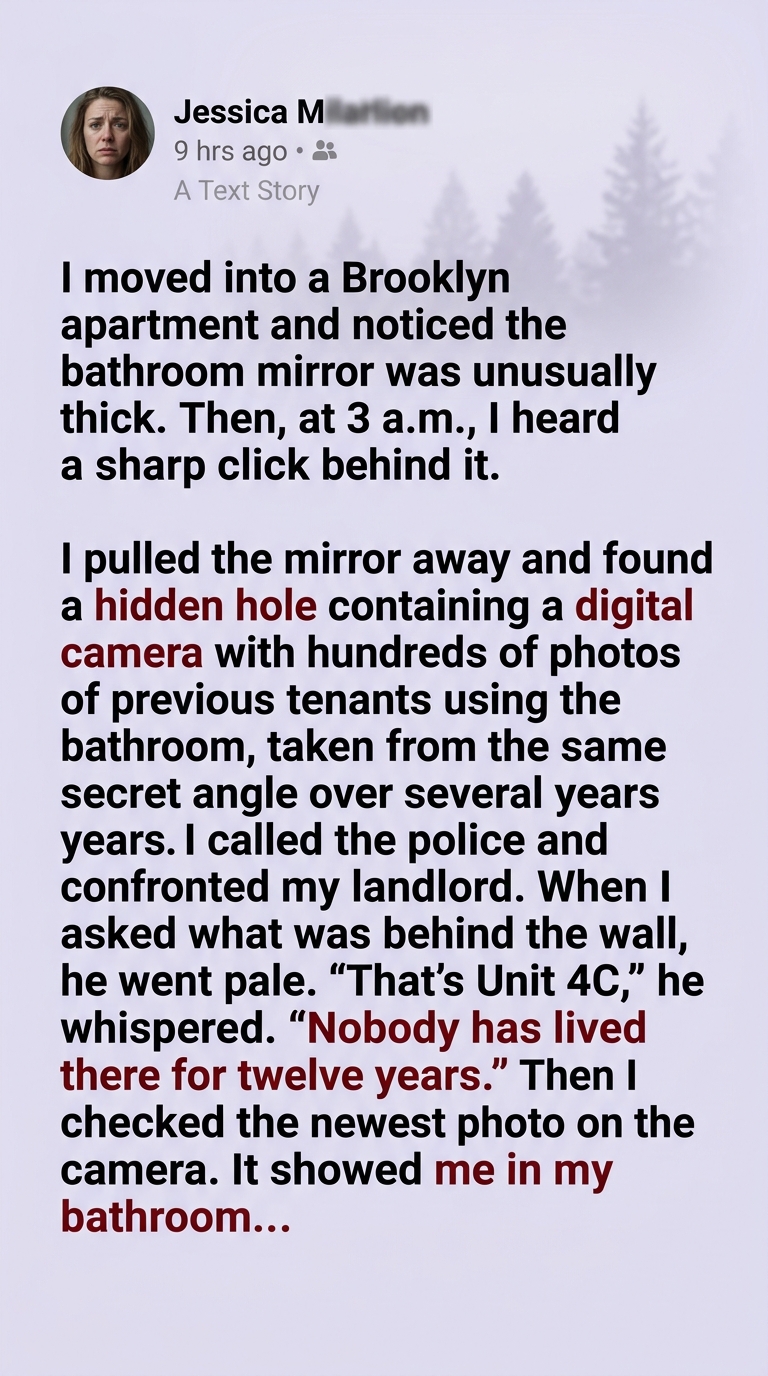
I moved into a Brooklyn apartment and noticed the bathroom mirror was unusually thick.
At first, I assumed it was just an expensive mirror. The apartment had been renovated recently, and my landlord, Mr. Harlan, had proudly told me that everything was “brand-new and completely secure.”
But the mirror bothered me.
It stood several inches away from the wall, surrounded by a frame that seemed unnecessarily deep. When I tapped the glass, it made a hollow sound. I mentioned it to Harlan during the first week, and he laughed.
“Old Brooklyn buildings have strange walls,” he said. “Don’t worry about it.”
I might have forgotten the conversation if I hadn’t heard the clicking.
It happened at 3:07 a.m. on a Thursday.
Click.
I sat upright in bed, staring at the bathroom door.
A few seconds passed.
Click.
The sound was sharp and mechanical, like a camera shutter or a small switch being activated.
I got out of bed and walked down the hallway. The bathroom light was off, but a thin strip of streetlight slipped through the blinds, illuminating the mirror.
Nothing moved.
I checked the window, the ventilation fan, and the cabinet beneath the sink. Everything appeared normal.
Then I heard it again.
Click.
This time, I was standing directly in front of the mirror.
I placed my hand against the frame. The mirror shifted slightly beneath my palm.
My stomach tightened.
I pulled at one side, expecting it to be securely attached to the wall. Instead, the entire mirror moved forward a fraction of an inch.
Behind it, something metallic scraped against the plaster.
I stepped back, grabbed my phone, and turned on its flashlight.
The mirror wasn’t mounted directly to the wall.
It was covering a shallow recess.
My first thought was that I’d discovered a storage compartment. Maybe the previous owner had hidden an electrical panel or an old medicine cabinet behind it.
Then I pulled the mirror farther away.
There was a small opening in the wall, barely large enough for a hand. Inside sat a black digital camera, a power adapter, and several neatly bundled cables.
The camera was pointed directly at the toilet and shower.
I froze.
For several seconds, I couldn’t move. I could only stare at the lens, which seemed to stare back at me.
Then I noticed the memory card.
It was still inserted.
My hands shook as I disconnected the power cable. I didn’t want the camera recording another second, but I also didn’t want to destroy anything that might prove what I had found.
I placed the device on the counter and took photographs of the opening, the wiring, and the camera’s position. Then I called the police.
The dispatcher asked whether I was alone.
“Yes,” I whispered.
“Are you safe where you are?”
“I think so. But someone has been recording my bathroom.”
She told me to leave the device untouched, avoid searching through it further, and wait somewhere secure for officers to arrive.
I threw on a coat, left the apartment, and waited in the lobby.
When two officers arrived, I led them upstairs. They examined the opening and took possession of the camera as evidence. One officer photographed the installation while the other asked me when I had moved in and whether anyone else had access to the apartment.
I gave them my lease, my landlord’s contact information, and the messages in which I’d asked about the mirror.
Then one of them asked a question that made my skin crawl.
“Has your landlord ever entered the apartment while you were away?”
“He came by once to check a leaking pipe,” I said. “He gave me notice beforehand.”
“Anyone else?”
“No.”
The officer nodded, but his expression remained serious.
They told me not to return until they had assessed whether the apartment was safe. I spent the rest of the night at a friend’s place, sitting on her couch with a blanket around my shoulders, trying to understand how long the camera might have been there.
By morning, I had received a message from my landlord.
The police called me. What exactly did you find?
I stared at the screen.
He hadn’t asked whether I was safe.
He hadn’t apologized.
He wanted to know what I’d found.
I replied that the police had removed the device and that he could speak with them directly.
His answer came almost immediately.
Please don’t make assumptions. There may be a reasonable explanation.
I didn’t respond.
That afternoon, the police told me they had found hundreds of image files on the camera’s storage media. Some appeared to show previous occupants using the bathroom. The images had been taken from the same concealed angle over a period of years.
The officers were careful not to tell me more than they could confirm at that stage, but one detail made my stomach turn.
The files weren’t simply old photographs left behind on an abandoned device.
Some were recent.
Some appeared to have been captured automatically.
And the camera’s internal clock had recorded activity after the date I had moved in.
I asked whether the newest photograph showed me.
The officer paused.
“We’re examining the files. We need to preserve the evidence and establish exactly when and how the device was operated.”
I understood why he couldn’t tell me everything.
I also understood that someone had placed a camera inside a bathroom and hidden it where an ordinary tenant would never think to look.
That evening, I returned to the building with an officer so I could collect a few essentials. Harlan was waiting near the entrance.
He looked as though he hadn’t slept.
“Can we talk?” he asked.
“I think you should talk to the police.”
“I know how this looks.”
“Then explain it.”
He glanced toward the stairwell.
“Not here.”
I felt a cold wave of anger.
“You installed a camera in my bathroom?”
“No,” he said quickly. “No, I didn’t install it.”
“Then who did?”
He opened his mouth, but no answer came.
I took a step closer.
“What is behind that wall?”
His face changed.
It wasn’t ordinary surprise. His eyes moved toward the ceiling, then toward the hallway, as if he had heard someone approaching.
“What did you say?” he whispered.
“The hole behind my mirror. What’s on the other side?”
Harlan went pale.
“That’s Unit 4C,” he said. “Nobody has lived there for twelve years.”
For a moment, I thought I had misunderstood him.
I lived in apartment 4B.
If the opening behind my bathroom mirror connected to the neighboring unit, then someone could have accessed the camera without entering my apartment.
But why would a vacant apartment have cables running into my wall?
And why did Harlan look as though I’d just uncovered something far more dangerous than an illegal recording device?
“Show me,” I said.
He shook his head.
“You don’t understand.”
“Then help me understand.”
He looked toward the stairwell again.
“Unit 4C was sealed after the last tenant disappeared.”
The words landed like a stone in my stomach.
“Disappeared?”
“That’s what the records say.”
“What records?”
He swallowed.
“Please. Let the police handle this.”
Then he turned and walked away.
I stood in the lobby, watching him leave, with a dozen new questions racing through my mind.
Why hadn’t he told the police about the empty apartment?
How could a unit remain vacant for twelve years in a building where every square foot was worth a fortune?
And what did he mean when he said the last tenant had disappeared?
I immediately passed Harlan’s statement to the officers. They told me they would investigate the adjoining unit and verify the property’s records. I was not permitted to enter it myself, and I didn’t try.
For the next two days, I stayed with my friend.
I slept badly. Every time I closed my eyes, I imagined the camera’s tiny lens hidden behind the mirror. I kept thinking about the previous tenants whose images had been captured without their knowledge.
I wondered whether someone had watched them.
Whether someone had saved their photographs.
Whether the camera had been connected to a device in the neighboring apartment.
On Saturday afternoon, an investigator called.
“We’ve made progress,” she said. “We need you to come in and review something, but I want to be clear that we haven’t established who operated the camera.”
I agreed to meet her at the precinct.
She explained that the camera’s memory card contained a large collection of files, including images recorded at different times. Investigators were examining the metadata and trying to determine whether the device had been controlled remotely.
They had also obtained access to Unit 4C through the appropriate property and investigative procedures.
The apartment wasn’t entirely empty.
It contained old furniture, electrical equipment, and a desk covered in dust. Behind a false panel, investigators found wiring that appeared to connect to the concealed camera in my bathroom.
But the discovery that changed everything was a box of maintenance records.
Several entries referred to work performed inside Unit 4C long after it was supposedly sealed. The entries were signed with initials that matched Harlan’s.
That didn’t prove he had operated the camera, the investigator emphasized. But it contradicted his claim that nobody had entered the apartment for twelve years.
Then she turned her monitor toward me.
“We’ve recovered the newest image file. I want you to tell me whether you recognize the date and circumstances.”
The image was displayed on the screen.
It showed my bathroom.
My shower curtain was half open. A blue towel hung from the rack. My toothbrush stood beside the sink.
And there I was, standing in front of the mirror in the pajamas I’d worn on my second night in the apartment.
I felt sick.
The timestamp was 3:07 a.m.
The exact time I’d heard the clicking.
But that wasn’t the part that made my blood run cold.
In the corner of the photograph, reflected faintly in the mirror, was something I hadn’t noticed when I took the device out of the wall.
A shadow.
Someone was standing behind the opening.
Not in my bathroom.
On the other side of the wall.
I leaned closer to the screen.
“Can you enlarge that?”
The investigator adjusted the image.
The shadow remained indistinct, but there was a clear outline of a hand resting against the edge of the opening.
Someone had been close enough to the camera to reach through the concealed space.
Someone might have been watching when I discovered it.
I gripped the edge of the desk.
“Was someone in Unit 4C that night?”
“We’re investigating that possibility,” she said. “The image alone can’t establish who was there.”
Then she showed me a second photograph.
It had been taken six minutes after the first.
The bathroom was empty.
The mirror was back in place.
And the camera’s angle had changed slightly.
Someone had moved it.
I remembered how the mirror had shifted when I touched it. I remembered the metallic scrape behind the plaster. I had assumed the sound came from the camera’s mounting bracket.
But what if someone had been on the other side, adjusting it?
I asked the investigator whether the building had other cameras.
They had already begun reviewing the available security footage. A hallway camera showed Harlan entering the building shortly before midnight on the night I heard the clicking.
He left less than twenty minutes later.
He had told the police he hadn’t visited the building that night.
The investigator explained that the footage didn’t prove he had entered Unit 4C or operated the device. They were still checking access records, maintenance logs, and other evidence.
But his statement was now a serious concern.
I left the precinct feeling as though the ground beneath my life had shifted.
The camera was real. The photographs were real. The hidden connection to the neighboring apartment was real.
And my landlord had lied about being there.
The next morning, I received a call from an unfamiliar number.
A woman introduced herself as Claire. She said she had lived in Unit 4B years earlier, before moving out suddenly.
“I saw the news about the camera,” she said. “I think I know why the apartment next door was sealed.”
My heart began racing.
“What happened?”
She took a shaky breath.
“Twelve years ago, I rented 4B. The tenant in 4C was a man named Peter. He was quiet, and I barely spoke to him. But I remember hearing strange noises through the bathroom wall.”
“What kind of noises?”
“Clicking. Sometimes drilling. Sometimes what sounded like someone moving furniture in the middle of the night.”
I sat down.
“Did you ever report it?”
“Yes. I told the landlord. He said Peter was doing repairs and that I shouldn’t worry.”
“What happened to Peter?”
“He disappeared. One day his apartment was locked, and a few weeks later Harlan told everyone Peter had moved away. But his belongings were still there. I saw them through the door when a maintenance worker opened it.”
I felt my throat tighten.
“Did you know him well?”
“No. But there was one thing I never understood. A few days before he vanished, he came to my door and asked whether I’d noticed anyone entering my apartment while I was away.”
I closed my eyes.
“What did you tell him?”
“I said no. He looked relieved, then frightened. He told me to check my mirrors.”
My fingers went numb.
“Your mirrors?”
“Yes. He said someone had been watching people in the building. I thought he was having some kind of breakdown. Two days later, he was gone.”
I thanked Claire and gave her contact information to the investigator. I didn’t try to connect the story to a specific person or assume Peter had been responsible for the camera. The police needed to establish what had happened, and Claire’s account was another piece of evidence to examine.
Later that day, the investigator called me again.
They had located Peter through records associated with a former address. He was alive, living in another state, and had agreed to speak with investigators.
His account was disturbing.
He said he had discovered unauthorized wiring in Unit 4C years earlier and had reported it. He claimed Harlan had dismissed his concerns and later accused him of damaging the property. After a dispute over the apartment, Peter moved away and lost contact with the building.
He denied installing the camera.
Investigators were still working to corroborate his account.
The more they learned, the less the story resembled a simple case of a landlord hiding a camera. Someone had used a vacant apartment to create concealed access into neighboring bathrooms. The device had captured private images for years, and the person responsible had apparently returned to maintain it.
But there was still no confirmed answer about who had operated it.
Harlan’s attorney contacted me through the investigator and asked me not to discuss the case publicly while the investigation continued. I agreed not to share evidence or identifying details that could interfere with the investigation, but I also sought independent legal advice about my tenancy and privacy rights.
I was not going to move back into that apartment.
The landlord eventually agreed in writing to release me from the remaining lease obligations while the matter was investigated. I collected my belongings with assistance and found another place to live.
The police continued examining the camera, the wiring, the property records, and the images. I was told that the evidence could support further action, but I did not receive a dramatic confession or an instant explanation for every unanswered question.
Some things take time to prove.
What I did learn was that the camera had been connected to equipment in Unit 4C, and that records showed repeated access to the supposedly vacant apartment. Investigators were examining whether Harlan had knowingly enabled the installation or concealed evidence of it.
I never learned the full answer to every question.
I did, however, learn that the newest photograph was not the only image taken at 3:07 a.m. There were several files from that same night, each recorded from a slightly different angle.
Someone had been adjusting the camera while I was in the bathroom.
And someone had been close enough to hear me pulling the mirror away.
For months afterward, I found myself checking the mirrors in every new place I visited. I knew that fear wasn’t proof of danger, but I also knew I wasn’t imagining what had happened.
The camera had been hidden.
The photographs had been taken.
And someone had counted on every tenant assuming the mirror was just a mirror.
I eventually returned to a normal routine, though I never forgot the feeling of standing in my bathroom at three in the morning, realizing that a stranger might have been watching me for weeks.
Sometimes people ask me what was most frightening about that discovery.
It wasn’t the camera itself.
It wasn’t even the fact that the apartment next door had supposedly been empty for twelve years.
It was the realization that I had noticed something strange, asked my landlord about it, and accepted his reassurance because I wanted to believe my home was safe.
The most dangerous secret in that building hadn’t been hidden behind the mirror.
It had been hidden behind a confident explanation.
And the newest photograph proved that someone had been counting on me never to look behind it.