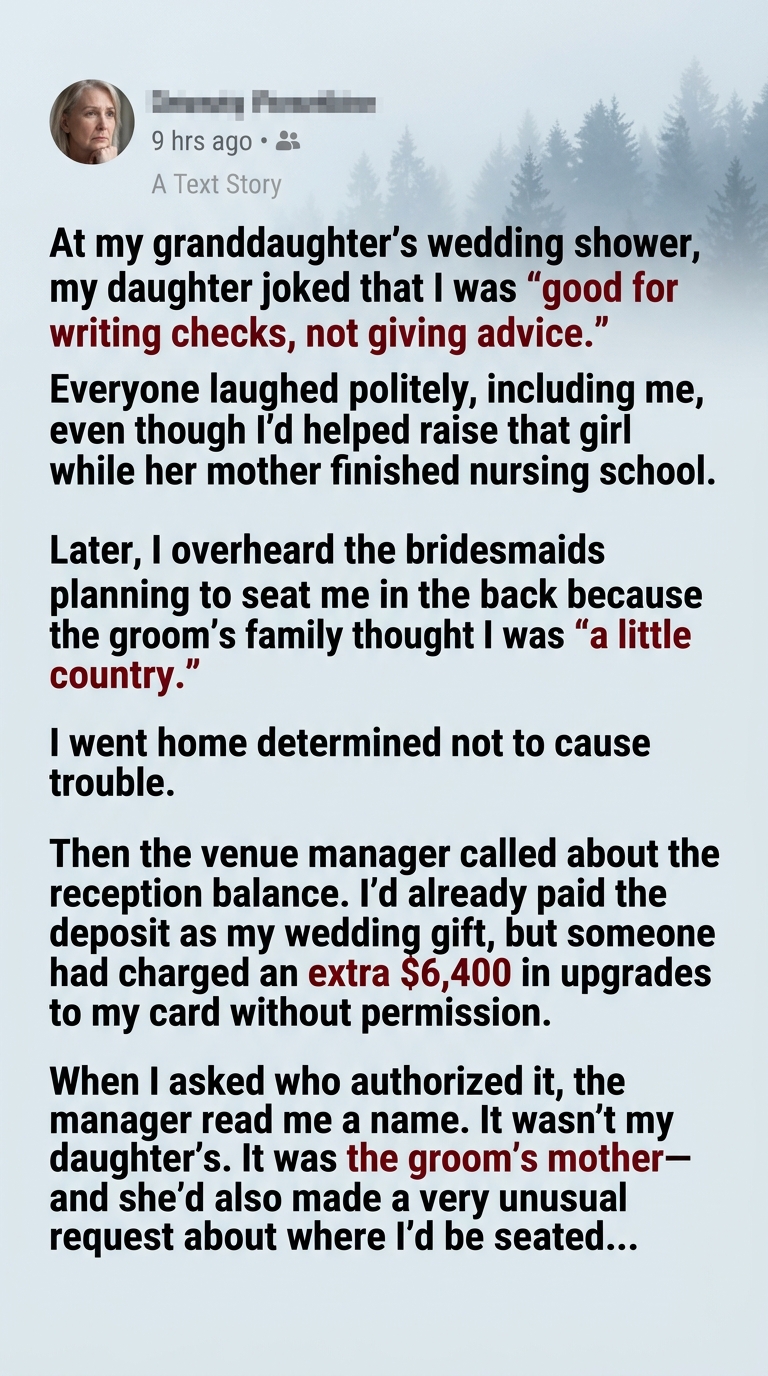
At my granddaughter’s wedding shower, my daughter stood up with a champagne glass in her hand and joked, “Mom is good for writing checks, not giving advice.”
Everyone laughed politely.
Including me.
I even smiled, because I had spent most of my life making sure my family never had to worry about money, food, or a place to sleep.
What my daughter didn’t mention was that I had helped raise her little girl while she finished nursing school. I had packed lunches, paid school fees, attended parent-teacher meetings, and sat beside that child through fevers and nightmares.
Now that little girl was twenty-four and preparing to marry a man from a wealthy family.
And suddenly, I was the embarrassing country grandmother who was useful only when someone needed a check.
Later that afternoon, I went looking for the restroom and overheard the bridesmaids talking near the hallway.
“We need to move Grandma to the back tables,” one whispered.
“Why?” another asked.
“The groom’s family thinks she’s a little country. His mother said the front tables should look elegant in the photographs.”
I stopped behind the half-open door.
Someone giggled.
“It’s not like she’ll notice. She’ll be happy just to be invited.”
I stood there for several seconds, my hand resting against the wall.
Then I quietly walked back into the party, hugged my granddaughter goodbye, and drove home.
I had no intention of causing trouble.
I had already paid the deposit for the wedding reception as my gift. I didn’t want a fight, and I certainly didn’t want to embarrass my granddaughter on the happiest day of her life.
But that evening, my phone rang.
It was the venue manager.
“Mrs. Whitaker, I’m calling about the outstanding reception balance. We need to verify an additional charge of $6,400 that was placed on your card.”
I sat up straight.
“An additional charge?”
“Yes, ma’am. The upgrades include premium floral arrangements, a champagne service, an upgraded head table, and a special seating arrangement requested by the family.”
“I didn’t authorize any upgrades.”
There was a pause.
“That’s what I wanted to clarify. The request came from Mrs. Bennett, the groom’s mother. She supplied your card details and told us you had approved the changes.”
My stomach tightened.
“I never gave her permission to use my card.”
“I understand. We have placed the disputed amount under review and will not process any further charges without your authorization.”
Then the manager hesitated.
“There’s one other thing you should know. Mrs. Bennett specifically requested that your name be placed at the very last table near the service entrance. She said it was important that you remain away from the main family photographs.”
I stared at the wall.
The last table.
Near the service entrance.
Paid for by the woman whose granddaughter I had helped raise.
For a moment, I considered calling my daughter and demanding an explanation. I imagined her becoming defensive, accusing me of making everything about myself, and reminding me that the wedding wasn’t mine.
Instead, I thanked the manager and asked for the paperwork documenting the charges and seating request.
Then I opened my banking app and froze the card.
I wasn’t going to shout.
I wasn’t going to threaten anyone.
But I was no longer going to pay for people to humiliate me.
The following morning, I called my granddaughter, Emma.
“Sweetheart, I need to ask you something about the wedding.”
“Sure, Grandma. Is everything okay?”
I told her about the additional $6,400 charge and the venue manager’s explanation.
She went silent.
“Wait,” she finally said. “What upgrades?”
I explained what the manager had told me.
“Grandma, I didn’t ask for any of that. I thought the reception deposit was your gift, and Mom said everything else was already covered.”
“Did you know they planned to seat me at the back?”
Her voice became small.
“No.”
I believed her.
But I also knew that believing her didn’t make the problem disappear.
“Emma, I love you. I’m not going to make you choose between me and the man you’re marrying. But I won’t let anyone use my money without permission, and I won’t pretend that being treated like an embarrassment is acceptable.”
She began to cry.
“I’m so sorry.”
“I know you didn’t make that phone call. But I need you to understand that this isn’t just about a chair.”
We talked for nearly an hour. She told me that the groom’s mother, Linda Bennett, had been making decisions about the wedding for months. She had insisted on the flowers, the champagne, the photographs, and even the wording on the invitations.
Emma had tried to push back on some things, but her fiancé, Christopher, kept telling her that his mother was only trying to help.
“Did Christopher know about the seating arrangement?” I asked.
“I don’t know,” Emma admitted. “I’ll ask him.”
That afternoon, the venue manager emailed me copies of the relevant paperwork. There was a written request for the upgrades, a seating chart, and a note stating that the additional expenses would be charged to my card.
The authorization section contained my name.
But the signature wasn’t mine.
I forwarded the documents to my bank and explained that I had not approved the transaction or permitted anyone to sign on my behalf. The bank opened a dispute and advised me to preserve all communications while it investigated.
I also asked the venue to remove my payment information from the event file and confirm in writing that no additional charges would be made against my account.
Then I contacted my attorney to understand my options if the unauthorized use of my card and signature was confirmed.
I wasn’t interested in revenge.
I wanted my money protected, my name cleared, and the truth established before anyone tried to turn this into a story about a difficult grandmother.
Two days later, Christopher called me.
“Mrs. Whitaker, Emma told me about the payment problem.”
“It’s more than a payment problem,” I replied.
“I know. Mom says there was a misunderstanding.”
“Did your mother ask the venue to seat me near the service entrance?”
He hesitated.
“I heard something about the seating chart, but I didn’t know she’d made it sound like you agreed.”
“Did you know she was using my card?”
“No. I thought your contribution was the deposit.”
I believed that he might be telling the truth. But I wasn’t going to let his uncertainty become an excuse for inaction.
“Then I suggest you ask your mother to explain it directly to you.”
He sighed.
“She says she wanted the reception to look a certain way.”
“And she thought my money was part of that plan?”
He had no answer.
I ended the call politely.
That evening, Linda Bennett called me herself.
“Mrs. Whitaker, I understand you’ve been making inquiries about the wedding.”
“I’m trying to resolve an unauthorized charge.”
Her voice sharpened.
“The upgrades were necessary. We are hosting a very important event, and your granddaughter deserves a beautiful wedding.”
“I agree that she deserves a beautiful wedding. That doesn’t give you permission to charge $6,400 to my card.”
“I assumed you would be happy to contribute. You’ve been so generous.”
“Generosity is something I choose, Linda. It isn’t permission you can give yourself.”
She made a small, impatient sound.
“You must understand that we have a certain standard to maintain. The seating arrangements were made to ensure the photographs look balanced.”
“And where, exactly, did you think I belonged?”
There was a pause.
“Near the back. It’s not personal.”
“Then why did you tell the venue manager to put me near the service entrance and keep me out of the family photographs?”
Linda didn’t answer immediately.
Finally, she said, “I thought you would prefer not to be in the way.”
I closed my eyes.
For years, I had worked hard to avoid being in anyone’s way. I had kept my opinions to myself, offered help before anyone asked, and paid bills without reminding my family what I had done.
Somehow, my silence had convinced people that I had no feelings worth considering.
“Linda,” I said, “you don’t get to decide where I belong after using my money without permission.”
She accused me of overreacting.
I told her the payment dispute would proceed through the bank and that any further communication about the charge should be in writing.
Then I hung up.
The next morning, Emma arrived at my house.
She was wearing jeans and an old sweatshirt, her eyes swollen from crying.
“I talked to Christopher,” she said. “He confronted his mother. She admitted she requested the upgrades and gave the venue your card details. She said she planned to pay you back after the wedding.”
“Did she admit she had no permission?”
Emma looked down.
“Yes.”
I let out a slow breath.
“Did Christopher know about the seating request?”
“He says he saw the chart but didn’t realize what it meant. He thought you were at a family table. When he learned it was the last table, he asked his mother to change it. She told him it was already settled.”
“And what did he do?”
“He didn’t push her.”
That answer hurt Emma more than it hurt me.
She sat down at the kitchen table, the same place where I’d helped her with homework when she was little.
“Grandma, I don’t know what to do. I love him, but I can’t believe his mother did this. And I can’t believe he let her.”
I reached across the table and held her hand.
“You don’t have to decide everything today. But you need to ask yourself whether the person you’re marrying can stand beside you when someone he loves behaves badly.”
She cried quietly.
I didn’t tell her to cancel the wedding. I didn’t tell her to go through with it. That choice belonged to her.
I told her only that marriage was not about finding a family without problems. It was about finding someone willing to face those problems honestly.
Over the next week, Christopher and Emma met with a counselor. He acknowledged that he had avoided confronting his mother because he feared upsetting her. He also admitted that he’d allowed Emma to believe the wedding arrangements were settled without checking what she actually wanted.
Emma decided to postpone the wedding.
It wasn’t a punishment. She told me she needed time to make sure she was marrying Christopher because she trusted him, not because she had spent months planning a ceremony she couldn’t bear to lose.
Christopher agreed to the postponement and began setting clearer boundaries with his mother.
Linda sent me a short message saying she regretted the “confusion” around the charges. I replied that I would wait for the bank’s decision and that any reimbursement should be documented.
The venue cooperated with the investigation. The bank reviewed the evidence, including the disputed authorization, and eventually removed the unauthorized charge from my account. The venue and Linda handled the remaining payment issue through their own process.
I never received a grand public apology.
There was no dramatic confrontation in a ballroom, no microphone passed around, and no moment when forty guests stood up to declare that I had been right.
Real life rarely works that way.
Instead, I received something quieter.
A few weeks later, Emma came over for dinner. She brought a photograph of herself as a little girl, sitting on my lap in the garden. Her front teeth were missing, her hair was tangled, and she was laughing so hard her eyes were nearly closed.
“I found this in Mom’s old album,” she said. “I want it at the wedding when we eventually have it.”
I smiled.
“You can put it wherever you want.”
She took my hand.
“Grandma, I should have stood up for you at the shower. When Mom made that joke, I laughed because I didn’t know what to do. I was embarrassed, and I didn’t want to make a scene.”
I squeezed her fingers.
“I’m glad you’re telling me now.”
“I don’t want to become someone who lets people treat the people she loves like that.”
“Then remember this moment,” I said. “You don’t have to be cruel to be firm, and you don’t have to stay silent to keep the peace.”
She leaned against my shoulder, just as she used to when she was a child.
When Emma eventually married Christopher, the celebration was smaller and more personal. They chose the venue together, agreed on the budget, and paid for their own upgrades. Linda attended, but she no longer controlled every detail.
I paid for the deposit I had originally offered as my wedding gift. I did it because I wanted to, not because anyone expected it.
And when the seating chart arrived, my name was at the family table beside Emma.
Not near the service entrance.
Not hidden from the photographs.
Right where I belonged—not because I had paid for a seat, but because I was family.
I never forgot what happened at that shower. I didn’t need to.
It taught me that helping people is meaningful only when it comes from the heart. The moment someone treats your generosity as an entitlement, you are allowed to draw a line.
I had spent years proving my love by writing checks, showing up, and quietly carrying burdens no one else wanted to carry.
That day, I learned I could love my granddaughter just as deeply without paying for anyone else’s disrespect.
And that was the most valuable gift I gave her.