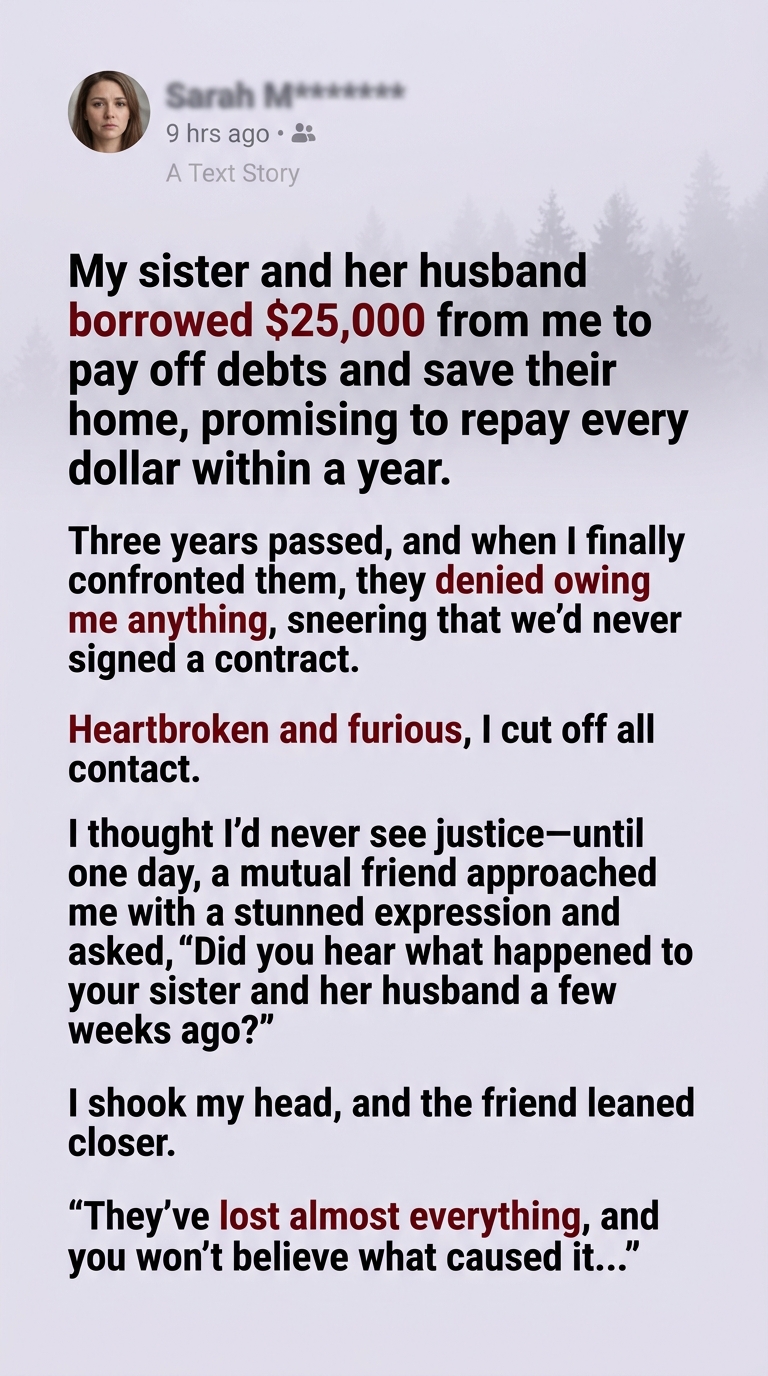
I lent my sister and her husband $25,000 to save their home.
Three years later, they looked me in the eye and claimed I had never given them a dime.
“We never signed anything,” my brother-in-law, Mark, sneered. “You can’t prove it was a loan.”
My sister, Rachel, sat beside him, staring at her coffee as if the conversation had nothing to do with her.
I walked out of their house that afternoon with a broken heart and a promise to myself: they would never get another dollar from me.
I never imagined that a few months later, a mutual friend would approach me with a stunned expression and reveal that my sister and her husband had lost almost everything.
And the reason had started with the very money they claimed never existed.
It began three years earlier, when Rachel called me crying.
She and Mark had fallen behind on their mortgage payments. Mark’s small contracting business had lost two major clients, their credit cards were nearly maxed out, and the bank had warned them that they needed to address their arrears or risk losing the house.
Their two children, Sophie and Ethan, were eight and six at the time.
Rachel kept repeating the same words.
“I don’t know what we’re going to do. The kids will lose their home.”
I had savings from years of working, living modestly, and avoiding unnecessary debt. I wasn’t wealthy, but I had enough to help.
When I visited them that weekend, I found unopened bills stacked on the kitchen counter. Rachel looked exhausted, and Mark barely spoke.
“We need twenty-five thousand dollars,” Rachel finally admitted. “If we can clear the overdue payments and settle the debts that are putting pressure on us, we can get back on our feet.”
I hesitated.
Twenty-five thousand dollars was a huge amount of money to me. It represented years of careful saving, emergency funds, and the security I’d worked hard to build.
But Rachel was my sister.
I remembered sharing a bedroom with her as children, staying up late whispering about our futures, and promising each other that we’d always be there when life got difficult.
I didn’t want her children to suffer because their parents had made financial mistakes.
So I agreed.
I transferred the money in several payments over the following days, using bank transfers rather than handing over cash. The transaction records clearly showed the amounts and dates.
Before I sent the final payment, I sat down with Rachel and Mark at their kitchen table.
“I need us to be clear about something,” I said. “This is a loan, not a gift. I need the money back within one year.”
Rachel reached across the table and squeezed my hand.
“Of course. We know that.”
Mark nodded.
“As soon as the business gets moving again, we’ll repay every dollar. You have our word.”
I believed them.
I didn’t insist on a formal written agreement. I trusted my sister, and I thought asking her to sign a document would make a painful situation feel like a business transaction.
That decision would haunt me later.
For the first few months, Rachel kept me updated. She told me Mark had secured a new contract and that they were finally catching up on their bills.
Then the updates became less frequent.
Whenever I asked about repayment, she said they needed a little more time.
At the one-year mark, I called her.
“Rachel, we agreed on a year. When can you start paying me back?”
She sighed.
“Mark’s business is still recovering. Could we have another six months?”
I wasn’t happy, but I agreed to wait.
Six months passed.
Then another year.
Every time I brought up the money, Rachel had a new explanation. Their car needed repairs. The children needed school expenses. Mark’s business had a slow month. An unexpected bill had arrived.
I tried to be patient. I knew life could be unpredictable, and I didn’t expect them to repay the entire amount overnight.
I would have accepted a reasonable payment plan.
What hurt was that they never offered one.
Meanwhile, I continued living carefully because I didn’t have the savings cushion I’d had before. I postponed replacing my aging car and put off repairs in my own home.
I wasn’t angry that my sister was struggling.
I was angry that she seemed to have forgotten what I had sacrificed to help her.
Three years after the original loan, I finally decided we needed to have an honest conversation.
I called Rachel and asked whether Mark and I could sit down with her.
She sounded irritated.
“Why does Mark need to be there?”
“Because the loan was to both of you.”
There was a pause.
Then she agreed.
I arrived at their house on a Saturday afternoon with a folder containing my bank statements and a handwritten timeline of the transfers.
I wanted to resolve the matter calmly. I had rehearsed what I planned to say, hoping that a clear conversation would finally move things forward.
Rachel and Mark were sitting in the living room when I arrived.
I placed the folder on the coffee table.
“It’s been three years,” I began. “I need us to agree on a repayment plan for the $25,000.”
Mark leaned back.
“What $25,000?”
I stared at him.
“The money I lent you to save the house.”
He laughed.
“You gave us money. We never signed anything saying it was a loan.”
My heart began pounding.
“Rachel, you told me you’d repay it within a year.”
She crossed her arms.
“I don’t remember agreeing to that.”
I looked at her, waiting for her to smile or admit that they were making a terrible joke.
She didn’t.
I opened the folder and showed them the bank transfers.
“These payments went directly to you. I have the dates, the amounts, and our messages from when we discussed the money.”
Mark barely glanced at the papers.
“Those transfers don’t prove you expected repayment.”
“They prove I gave you the money. Our messages explain why.”
He shrugged.
“Then take us to court if you think you have a case.”
Rachel finally looked at me.
“Honestly, I can’t believe you’re doing this to your own family. You helped us when we were struggling. Why are you trying to make us feel guilty now?”
I felt something inside me break.
I had spent three years worrying about their financial situation, giving them more time, and hoping that my patience would preserve our relationship.
Now they were treating my help as though it had been an unwanted gift I was selfish enough to regret.
“I wasn’t trying to make you feel guilty,” I said quietly. “I was asking you to keep your promise.”
Mark stood up.
“Well, we don’t owe you anything. There’s no contract.”
I gathered my folder.
I didn’t shout. I didn’t throw anything. I simply looked at my sister and waited for her to say something that would tell me she still cared about the truth.
She looked away.
That was the moment I understood that the money wasn’t the only thing I’d lost.
I had lost the relationship I’d believed we shared.
I left without another word.
For several days, I couldn’t sleep properly. I kept replaying the conversation, wondering whether I’d been foolish to trust them.
Then I made a decision.
I stopped calling.
I stopped answering messages that asked for favors.
I stopped attending family gatherings where Rachel and Mark would be present, at least until I could bear to see them without feeling the wound reopen.
I also sought independent legal advice. I learned that the absence of a signed contract did not automatically mean a loan could never be proven, but that the strength of a claim would depend on the evidence and the law that applied. The bank transfers and messages might matter, and a lawyer could assess whether pursuing repayment was worthwhile.
I organized everything I had: transfer records, text messages, emails, and notes from conversations.
I didn’t want revenge. I wanted the money back, or at the very least, an acknowledgment that what had happened was wrong.
But legal action would cost time and money, and I needed to understand the likely costs and risks before proceeding. I decided not to make an impulsive move simply because I was hurt.
Months passed.
I heard occasional updates about Rachel and Mark through relatives, but I didn’t ask questions. I was trying to rebuild my savings and move on with my life.
Then, one afternoon, I ran into our mutual friend, Daniel, at a grocery store.
He looked at me with an expression I couldn’t quite read.
“Have you heard what happened to Rachel and Mark a few weeks ago?”
I shook my head.
“We haven’t spoken in a long time.”
Daniel glanced around, then lowered his voice.
“They’ve lost almost everything.”
I felt a strange mixture of concern and disbelief.
“What do you mean?”
“The house is gone. Mark’s business has collapsed, and they’re staying with relatives while they figure out what to do next.”
I stood still, holding my shopping basket.
“Why?”
Daniel hesitated.
“It’s complicated. But the money they borrowed from you is part of the story.”
My stomach tightened.
He explained that after I cut contact, Rachel and Mark had continued running into financial problems. Their contracting business had struggled to recover, and they had taken on additional debt to cover operating costs and household expenses.
They had also borrowed money from other people, including a former business partner and a relative who had believed Mark’s claims that several large contracts were about to pay out.
Those contracts never materialized as expected.
The business began missing payments to suppliers. Creditors demanded repayment, and the couple struggled to keep up with their mortgage and other obligations.
Eventually, they sold some equipment and tried to negotiate with creditors, but the money wasn’t enough to stabilize the situation.
Their home was sold after they failed to resolve the mortgage arrears. The exact process involved their lender and the terms of their loan, but by the time Daniel spoke to me, they had already moved out.
I listened in silence.
“Did they lose the house because of my money?” I asked.
Daniel shook his head.
“Not exactly. They had problems long before that. But the money you gave them was supposed to get them back on their feet. They treated it like free money, and they never built a realistic plan to recover.”
He paused.
“There’s something else.”
I looked at him.
“After their business started collapsing, Mark told people that you had given them the $25,000 as a gift. He said you’d changed your mind and started demanding it back when you got angry.”
My face grew hot.
“He told people that?”
“That’s what he said. But a few weeks ago, one of the people they owed money to saw a message from Rachel that contradicted his story.”
Daniel explained that the former business partner had been reviewing records connected to money Mark owed him. In the process, he had come across a message Rachel had sent to a relative several months earlier.
In it, Rachel had referred to the $25,000 as a loan and said they were supposed to repay me once the business recovered.
The message didn’t magically resolve every legal question, but it directly contradicted the claim that they had never agreed to repay me.
The business partner confronted Mark about the inconsistency.
According to Daniel, Mark became furious and accused Rachel of exposing private family matters. Rachel, in turn, admitted to the relative that she had known all along that the money was a loan.
I felt sick.
For three years, I had questioned my own memory. I had wondered whether I’d been naive, whether I’d misunderstood their promises, whether I was somehow being unreasonable by expecting repayment.
Now I knew that at least one of them had acknowledged the truth in writing.
“What happened after that?” I asked.
“They had a huge argument. Rachel finally admitted to a few people that they owed you the money. She said she had been afraid that if she admitted it to you, you’d demand repayment immediately and they’d lose the house.”
I stared at him.
“So they denied the debt because they were afraid of losing the house?”
“That’s what Rachel told someone. I don’t know everything she was thinking.”
I let out a slow breath.
“They were already in danger of losing it.”
“I know.”
For a moment, I felt no satisfaction at all.
I imagined Rachel packing her children’s belongings, trying to explain why they couldn’t return to the home they’d known. I imagined Mark confronting the reality that his business might not recover.
Their choices had consequences, but their children had not made those choices.
I didn’t want Sophie and Ethan to suffer.
Still, I couldn’t pretend that the truth didn’t matter.
“What are they going to do now?” I asked.
“I’m not sure. They’re staying with Mark’s cousin for the moment. Rachel has started looking for work, and Mark is trying to settle what he can with his creditors.”
Daniel looked at me carefully.
“Rachel asked whether you’ve said anything about them.”
I almost laughed.
“Why would she care what I’ve said?”
“Because she’s embarrassed. And because she knows what she did to you.”
I looked down at my basket.
“Does she want to apologize?”
Daniel hesitated.
“She hasn’t said those exact words to me.”
That answer told me more than a long explanation could have.
I thanked him for telling me and finished my shopping.
But the conversation stayed with me all evening.
I had imagined that learning Rachel and Mark were facing consequences would make me feel vindicated. Instead, I felt sad, angry, and strangely relieved.
Sad because my sister’s family was struggling.
Angry because she’d denied the truth when I had given her every opportunity to be honest.
Relieved because I could finally stop wondering whether I had imagined the promise she’d made.
A week later, Rachel called me.
I nearly let it go to voicemail.
Then I answered.
“Hello?”
For several seconds, neither of us spoke.
Finally, she said, “Daniel told me you know what happened.”
“I do.”
She began crying.
“I’m sorry.”
I closed my eyes.
I had imagined hearing those words many times. In my imagination, I would feel immediate relief, perhaps even triumph.
Instead, I felt the exhaustion of three years of disappointment.
“What are you sorry for, Rachel?”
She sniffed.
“For everything. For the money. For lying about it. For acting like you were the one who had done something wrong.”
I waited.
She admitted that when their finances deteriorated, she had become terrified of losing the house. Mark had convinced her that if they acknowledged the loan, I might take legal action and make their situation worse.
She had gone along with him because denial felt easier than facing the debt.
Then, when the business continued to struggle, admitting the truth became even harder.
“I knew it was a loan,” she whispered. “I knew what we promised you.”
“Then why did you look me in the face and deny it?”
“I was ashamed.”
I felt tears gather in my eyes, but I kept my voice steady.
“I was ashamed, too. I felt foolish for trusting you. But I didn’t lie about what happened.”
“I know.”
“No, Rachel. You don’t understand. I wasn’t expecting you to repay all $25,000 immediately after your business struggled. I was expecting you to tell the truth and work with me on a plan. You could have paid me a little every month. You could have explained what was happening. Instead, you made me feel like I was inventing the whole thing.”
She cried harder.
“I know. I can’t undo it.”
“No, you can’t.”
She asked whether we could meet.
I told her I wasn’t ready.
Before ending the call, I made one thing clear.
“If you want to discuss repayment, put your proposal in writing. I’ll review it, and I’ll speak with my lawyer if necessary. But I can’t go back to pretending we’re okay just because you’re sorry now.”
She agreed.
A few weeks later, a letter arrived with a proposed repayment plan. Rachel acknowledged the original $25,000 loan and suggested monthly payments based on what she could reasonably afford while rebuilding her finances.
I forwarded the letter to my lawyer.
We reviewed the proposal and discussed how any agreement should be documented, including what would happen if payments were missed. I didn’t rush to accept it, and I didn’t demand an amount that would be impossible for her to pay.
Eventually, we reached a written agreement.
The first payment was small.
It wasn’t enough to repair my savings overnight, but it was a start—and, more importantly, it was an acknowledgment of the truth.
I haven’t fully reconciled with my sister.
We exchange occasional messages, mostly about practical matters. I still care about her, and I hope her children find stability. But I no longer confuse caring about someone with trusting them automatically.
Trust has to be rebuilt through actions.
Rachel has continued making payments, though the process will take time. I keep records and communicate about the loan in writing, just as my lawyer advised.
I don’t know whether our relationship will ever return to what it was.
Perhaps it shouldn’t.
I used to believe that family meant forgiving almost anything. Now I believe family should mean being able to tell the truth, especially when telling the truth is difficult.
I lent my sister $25,000 because I loved her and wanted to help her protect her children’s home.
I never expected that the money would cost us three years of trust.
And when I finally learned that she had lost the house, I realized something I hadn’t understood before: the loss itself wasn’t the justice I had been waiting for.
The real turning point was the moment she stopped denying what she owed.
I couldn’t undo the damage she’d caused, and I couldn’t make her choices for her.
But I could stop carrying the burden of her denial.
I could protect my finances, maintain my boundaries, and decide for myself whether reconciliation was possible.
Sometimes justice doesn’t arrive as a dramatic victory.
Sometimes it begins with a truth that can no longer be denied—and the courage to refuse to pretend otherwise.