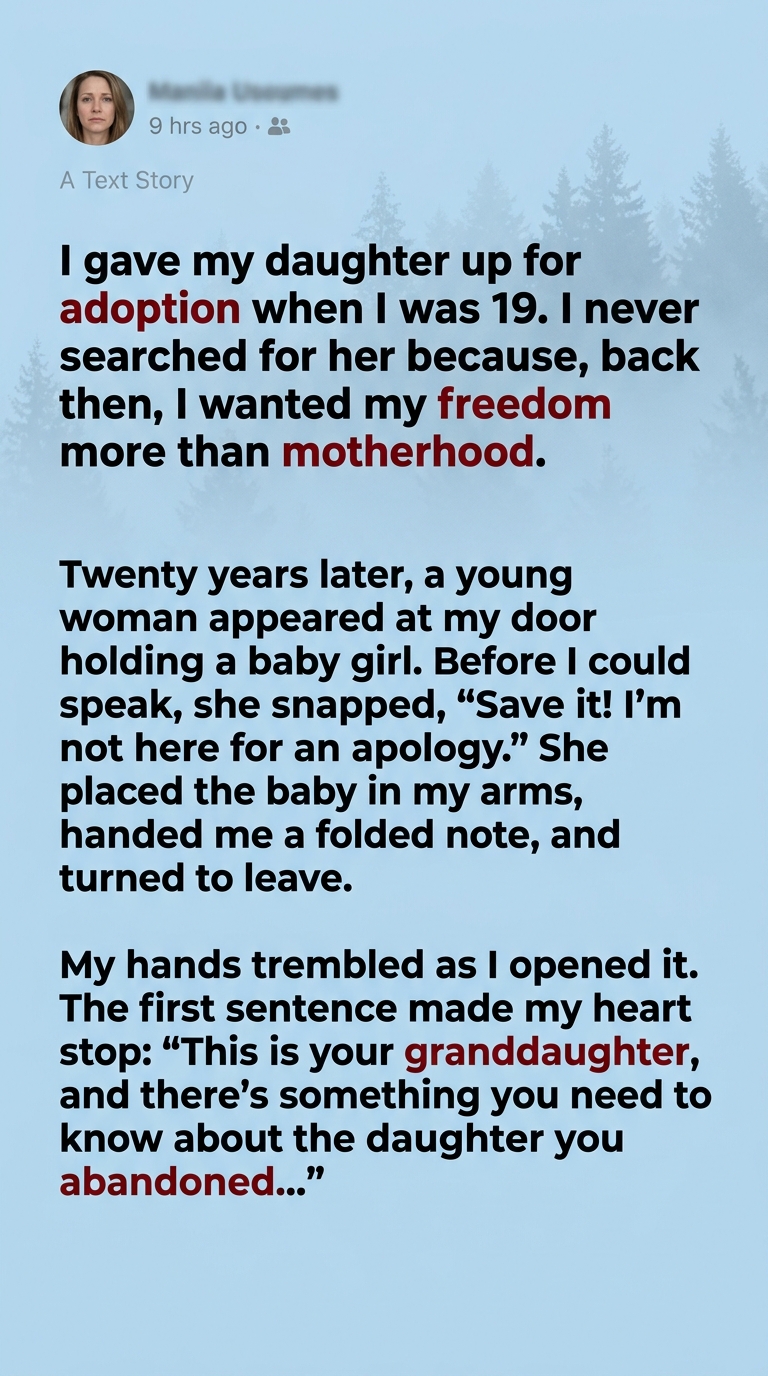
I gave my daughter up for adoption when I was nineteen.
For twenty years, I told myself it had been the right decision. I was young, broke, and terrified of becoming a mother. I wanted to travel, build a career, fall in love without responsibility, and live a life that belonged entirely to me.
So I signed the papers, watched another family carry my baby away, and promised myself I would never look back.
I kept that promise for two decades.
I never searched for her. I never sent a letter through the adoption agency. I never wondered aloud whether she had my eyes or whether she had grown up happy.
At least, that was what I told people.
The truth was that I thought about her every year on her birthday. I wondered whether she liked music, whether she laughed loudly like my father, and whether she had ever looked at her reflection and wondered where she came from.
But whenever those thoughts appeared, I pushed them away.
I convinced myself that searching for her would be selfish. She had a family. She had a life. I had no right to disturb it simply because I was finally curious about the child I had chosen not to raise.
Then, one rainy Thursday morning, someone knocked on my door.
I was forty when I opened it.
A young woman stood on my porch, holding a baby girl against her chest. She looked exhausted, with dark circles beneath her eyes and rain caught in her hair. The baby was wrapped in a pale yellow blanket, sleeping peacefully.
I almost asked whether she needed help.
Then I noticed the way she was staring at me.
Her eyes were the same hazel-green as mine.
“Are you Margaret Collins?” she asked.
“Yes.”
Her jaw tightened.
“I’m Emily.”
The name meant nothing to me at first.
Then she said, “You gave me up for adoption twenty years ago.”
My hand flew to my mouth.
For a moment, neither of us moved.
I had imagined meeting my daughter thousands of times. In some versions, she hugged me. In others, she screamed at me. Sometimes I pictured her arriving with questions I couldn’t answer, and sometimes I imagined her telling me she had never wanted to know who I was.
I had never imagined her standing on my doorstep with a baby in her arms.
“Emily,” I whispered.
“Save it!” she snapped. “I’m not here for an apology.”
She stepped forward and placed the baby in my arms before I could respond.
Instinctively, I held the little girl close. She stirred, made a tiny sound, and settled against my shoulder.
I could smell baby shampoo and warm cotton.
Emily pulled a folded note from her coat and pressed it into my free hand.
“Read that before you ask me anything.”
“Wait,” I said. “Please. I don’t understand what’s happening.”
“You will.”
She turned toward the steps.
“Emily, don’t go!”
She stopped but didn’t turn around.
“You had twenty years to look for me,” she said quietly. “You didn’t. So don’t expect me to stand here and make this easy for you.”
Then she walked away.
I stood in my doorway holding a stranger’s baby, watching my daughter disappear into the rain.
My hands trembled as I unfolded the note.
The first sentence made my heart stop.
This is your granddaughter, and there’s something you need to know about the daughter you abandoned.
I read it again, barely breathing.
The note was written in Emily’s handwriting.
Her name is Lily. She’s six months old.
I’m sorry I’m bringing her to you like this. I know I have no right to ask you for anything, and I know you might think I’m doing this to punish you.
I’m not.
I need you to understand that I didn’t come here because I want money or because I want you to pretend we were ever a family.
I came because I found something in my adoption records that nobody ever told me.
The woman who raised me was not the only person who knew about my adoption. Someone from your family knew where I was all along.
I stopped reading.
Someone from my family?
I looked down at the baby. Lily had opened her eyes, and she was staring up at me with an expression of complete trust.
I had spent twenty years avoiding the past.
Now the past was lying in my arms.
I carried Lily inside, made sure she was comfortable, and called the number Emily had written at the bottom of the note. It went straight to voicemail.
I tried again.
Nothing.
I called the adoption agency, but they couldn’t discuss Emily’s records without her consent. They explained that adoption files were confidential and that any additional information would need to be requested through the appropriate process.
I understood.
Emily had come to me on her own terms, and I couldn’t demand that everyone else reveal her history simply because I was suddenly desperate to know it.
I returned to the note.
When I was sixteen, I found a letter hidden inside a box of old documents. It was addressed to you, but it had never been mailed.
The letter was from my adoptive mother, Susan.
She wrote that she had tried to contact you after my adoption because she wanted to tell you I was healthy and happy. Someone responded on your behalf and told her you wanted no contact.
I believed that person was you.
I spent years thinking you had specifically asked not to hear about me.
But last month, when Susan became seriously ill, she told me something she had kept secret for years.
She said she never knew whether you had received her letter. She had been told that you didn’t want it.
She also told me that the person who handled the communication was your older sister, Diane.
My knees nearly buckled.
Diane.
My older sister had been twenty-four when I gave birth. She had been the person who drove me to the hospital, held my hand while I cried, and told me I was making the right decision by choosing adoption.
She had also been the person who told me afterward that the agency had asked us not to interfere with the adoptive family’s privacy.
I had never questioned her.
The note continued.
I don’t know why she did it. I don’t know whether she was trying to protect you, protect me, or protect herself from something.
But Susan said she never received an answer from you. She was told to stop trying.
I spent my entire life believing you knew about me and wanted nothing to do with me.
Then I learned that you might never have known I was waiting.
I sank onto the couch.
For twenty years, I had told myself that my daughter was living happily with a family who loved her. I had assumed that the adoption process had gone exactly as it was supposed to.
I had never known that a letter might have been written.
I had never known that someone might have stood between us.
But the note wasn’t finished.
The final paragraph was shorter.
There’s one more thing.
My adoptive mother kept a second envelope. She told me not to open it until I was old enough to understand why she had hidden it.
Inside was a copy of a letter from my biological grandmother.
She wanted to meet me.
She died before she could.
I stared at the page.
My mother had died when I was twenty-seven. She had been a quiet woman who rarely challenged Diane, even when they disagreed. I remembered her asking about the adoption during the first few months, then gradually stopping.
I had thought she was respecting my decision.
Now I wondered whether she’d been told there was nothing left to ask.
I looked at Lily again.
She had begun to fuss, so I checked her diaper and warmed a bottle. My hands shook so badly that I had to set the bottle down and take a breath before trying again.
I didn’t know whether Emily wanted me to keep Lily for the day or simply hold her while she gathered herself. I didn’t know whether she would return.
I called the number on the note once more and left a message.
“Emily, it’s Margaret. I’m sorry I didn’t look for you. I don’t know what happened with the letters, and I won’t pretend that changes the choices I made when I was nineteen. I don’t expect you to forgive me. But Lily is safe with me right now, and I want to understand what you need. Please call me when you’re ready.”
Then I waited.
Emily returned three hours later.
She stood at the door with her arms folded, her expression guarded.
“Is she okay?” she asked.
“Yes. She’s been sleeping.”
I stepped aside to let her enter.
She came straight to Lily and lifted her into her arms. The baby immediately reached for her mother’s necklace.
Emily kissed her forehead, and I saw her shoulders relax.
“Thank you for watching her,” she said.
It was the first gentle thing she’d said to me.
I didn’t mistake it for forgiveness.
“Can we talk?” I asked.
She hesitated, then sat at the kitchen table.
I placed the note between us.
“Did your adoptive mother explain why she never contacted me directly?”
Emily nodded.
“Susan said she sent the letter through the agency because she wanted to respect the adoption agreement. She didn’t want to show up at your house or force you to be involved. She just wanted you to know I was okay.”
“And Diane told her I didn’t want to hear from her?”
“That’s what the records Susan kept seem to suggest. But I don’t know exactly what happened. I only have the letter and what Susan told me before she died.”
I looked down at my hands.
“I never knew.”
Emily’s expression hardened.
“But you never looked.”
There it was.
The truth I couldn’t escape.
“No,” I said. “I didn’t.”
“Why?”
I could have told her I was young. I could have explained that I was frightened, that my parents had struggled financially, that I had been desperate to escape the small town where everyone knew my business.
All of that was true.
None of it changed what she’d experienced.
“I thought I was doing the right thing by leaving you with a family who wanted you,” I said. “Then I got used to not knowing. Every year, it became harder to admit that I was curious. I was afraid that if I searched for you, I’d discover you were unhappy because of me. Or that you’d hate me. So I told myself I was respecting your privacy.”
Emily looked at me for a long time.
“So you were protecting yourself.”
The words landed hard.
“Yes,” I whispered. “I think I was.”
She looked away.
“I used to imagine what you were like. Whether you had other children. Whether you ever thought about me. When I was little, I used to think you might be looking for me, too.”
My throat tightened.
“I’m sorry.”
“I told you I don’t want an apology.”
“I know. I’m not asking you to accept it.”
She took a breath.
“Susan was my mother. She loved me. She was there for every birthday, every school play, every awful teenage argument. She held me when I was sick and taught me how to drive. I don’t want you to think I’m here because I believe she wasn’t enough.”
“I don’t.”
“She was enough,” Emily said firmly. “I had a mother.”
I nodded.
“And then I became a mother myself,” she continued, looking down at Lily. “After she died, I started asking questions. I wanted to know where I came from. I wanted Lily to know her history, too. I wasn’t planning to meet you so soon, but I found that letter, and I couldn’t stop thinking about it.”
She explained that the discovery had changed the way she understood her childhood. She wasn’t suddenly convinced that everyone had lied to her, but she had questions she could no longer ignore.
She wanted to know whether I had ever received a letter from Susan. Whether I had known that my mother wanted to meet her. Whether Diane had acted on her own or believed she was doing what was best for everyone.
I didn’t have those answers.
But I knew someone who might.
Diane.
I called my sister that evening and asked her to come over.
She arrived the following afternoon. When she saw Emily sitting at my kitchen table with Lily in her arms, she stopped in the doorway.
“Oh,” she whispered.
Emily looked at her.
“You know who I am.”
Diane’s face went pale.
“Yes.”
I felt a cold weight settle in my stomach.
“You knew she was coming?”
“No.”
“Then why do you look like that?”
Diane sat down slowly.
For several minutes, she said nothing. Then she looked at Emily and began to cry.
“I need to explain something,” she said.
Emily didn’t move.
Diane admitted that she had received a letter from Susan shortly after the adoption. She had been terrified that I would change my mind about giving Emily up, so she had told Susan that I wanted no contact.
She said she had believed she was protecting me from reopening a wound I had worked hard to close.
“Did you ever give me the letter?” I asked.
“No.”
“Did you tell Mom that Emily’s adoptive family wanted to keep in touch?”
Diane shook her head.
“I told her the agency wanted everyone to move on.”
I felt sick.
“You made that decision for me.”
“I thought I was helping you.”
“You didn’t ask me.”
“I know.”
Diane wiped her face.
“I was twenty-four. I thought you were too young to understand what you would feel later. You seemed relieved after the adoption. You started working, you moved away, and you built a life. I thought bringing Emily back into it would destroy everything you were trying to do.”
“And the letter from Mom?” Emily asked.
Diane’s eyes filled again.
“That came years later. Mom wanted to meet you. She asked me to help her contact your adoptive family. I was afraid that if you found out, you would blame me for the first letter. So I told Mom that the family didn’t want contact.”
Emily stared at her.
“You let your own mother die without meeting me because you were afraid of getting caught?”
Diane began to sob.
“I was ashamed. Every year I waited made it harder to tell the truth. I kept thinking I’d find the right time, but I never did.”
No one spoke.
I wanted to shout. I wanted to ask how my sister could have carried such a secret for so long. I wanted to rewind twenty years and demand that she hand me the letter.
But I couldn’t change what she’d done.
And I couldn’t pretend her confession erased the years Emily and I had lost.
Emily stood, holding Lily close.
“I need some time,” she said.
Diane reached toward her, then stopped.
“I understand.”
“No,” Emily replied. “You understand that I found out. You don’t understand what it feels like to spend your whole life believing your biological family didn’t want you, then discover that someone made sure you never got the chance to ask.”
She walked to the door.
Before leaving, she turned to me.
“I’ll contact you when I’m ready.”
I nodded.
“I’ll be here.”
And I meant it.
Over the next several weeks, Emily and I exchanged occasional messages. At first, they were practical questions about family medical history and names in old photographs. She asked whether certain health conditions ran in our family. I answered what I knew and admitted when I didn’t know.
I didn’t bombard her with calls. I didn’t demand visits or ask her to call me Mom.
She had a mother, and I respected that.
Eventually, she invited me to meet her for coffee. Lily came with her, tucked into a stroller, and spent most of the visit trying to grab the sugar packets from the table.
Emily told me stories about Susan. I listened as she described their traditions, their holidays, and the small things her mother used to do when she was upset.
I asked questions, but I didn’t compare myself to the woman who had raised her.
At the end of our coffee, Emily said something I wasn’t expecting.
“I don’t know if I’ll ever forgive you for not looking for me.”
I swallowed.
“I understand.”
“But I don’t think I want to spend the rest of my life angry about it, either.”
She looked down at Lily.
“I want my daughter to know where she came from. That doesn’t mean I know what place you should have in our lives yet.”
“I’ll follow your lead.”
She nodded.
It wasn’t forgiveness.
It was a beginning.
Months later, Emily invited me to Lily’s first birthday party. Diane wasn’t invited, and I didn’t question that decision. Emily needed to decide for herself whether she wanted a relationship with her aunt.
I brought a small picture book and a handwritten card. I didn’t write about destiny or second chances. I simply told Lily that I hoped her life would be filled with people who listened to her, respected her choices, and loved her without asking her to earn it.
Emily read the card quietly.
Then she looked at me.
“Thank you for not making this about what you want.”
I felt tears gather in my eyes.
“I spent a long time making choices without considering what you might need,” I said. “I’m trying not to do that anymore.”
She didn’t hug me. She didn’t call me Mom.
But she invited me to sit beside her while Lily ate cake and smeared frosting across her cheeks.
For that afternoon, it was enough.
I still regret the years I lost with my daughter. I regret the letters I never knew existed and the questions I never asked. I regret that my fear made silence feel easier than facing the past.
But I have learned that the truth doesn’t always arrive in time to repair everything. Sometimes it arrives only to show us what was lost—and what might still be possible.
When Emily first appeared at my door, she told me she wasn’t there for an apology.
She was right.
An apology could never give her back the childhood she spent wondering why I hadn’t searched for her. It couldn’t give my mother the chance to meet her granddaughter. And it couldn’t erase the years my sister’s secret kept us apart.
All I could do was stop asking the past to excuse me.
I could listen. I could be honest. I could respect Emily’s boundaries and let her decide what kind of relationship, if any, she wanted with me.
I had given up my daughter when I was nineteen because I believed freedom meant walking away from a responsibility I wasn’t ready to carry.
Twenty years later, I finally understood that loving her now meant accepting that she owed me nothing.
Not forgiveness.
Not affection.
Not even another visit.
If she allowed me to remain in her life, it would have to be because I had earned her trust—not because we shared blood.
And that was the first promise I made to my daughter that didn’t ask anything of her in return.