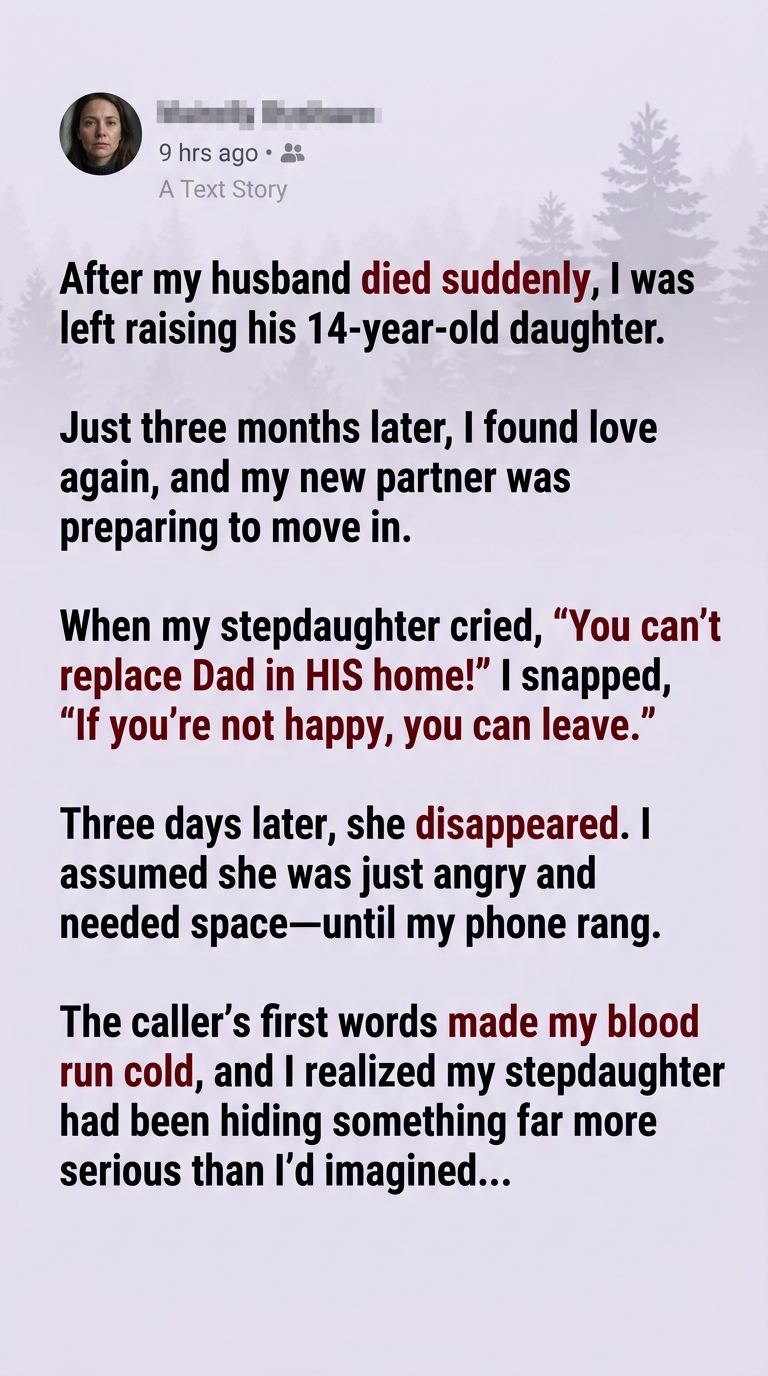
Three months after my husband died, I fell in love again.
I know how that sounds.
People might assume I never truly loved my husband, that I was eager to move on, or that I cared more about my own happiness than the daughter he left behind. But grief is complicated, and loneliness can make even the smallest kindness feel like a lifeline.
My husband, Daniel, died suddenly at forty-two. One moment, he was complaining about the coffee being too weak. The next, I was standing in a hospital corridor while a doctor explained that there was nothing more they could do.
His fourteen-year-old daughter, Lily, was at school when I received the call.
I had to be the one to tell her.
I’ll never forget the way she looked at me. She didn’t scream or cry at first. She simply stared, as though I had spoken a language she couldn’t understand. Then she asked the same question over and over.
“Are you sure? Are you sure, Claire?”
I held her while she sobbed into my shoulder, promising that we would get through it together.
Daniel had been a devoted father. Lily’s biological mother had left when Lily was little, and Daniel had raised her mostly on his own before we married. I had been in Lily’s life for six years, and although we weren’t always close, I loved her.
After the funeral, I tried to keep our lives stable. I packed her lunches, drove her to school, attended meetings with her teachers, and sat outside her bedroom when she couldn’t sleep.
But I was grieving, too.
Daniel had been my husband, my best friend, and the person I imagined growing old beside. Our home felt painfully empty without him. His shoes remained beside the door. His coffee mug sat in the cupboard. Sometimes, I caught myself turning to tell him something before remembering he was gone.
Then I met Mark.
He was a friend of a friend who helped me carry groceries one rainy afternoon. He didn’t push me to talk about Daniel or tell me everything happened for a reason. He simply listened.
Over the next several weeks, we began spending time together. He made me laugh when I thought I had forgotten how. He checked on me without demanding anything in return, and he never acted as though my grief was an inconvenience.
Eventually, I began to feel something I hadn’t expected to feel again.
Hope.
When Mark asked whether we could build a future together, I said yes.
Looking back, I can admit that I moved too quickly. I was desperate to believe that life could still hold happiness. I wanted our home to feel warm again, and I mistook my readiness for companionship as proof that everyone else was ready, too.
Lily wasn’t.
When I told her Mark would be moving in, she stared at me across the kitchen table.
“How long has this been going on?” she asked.
“Lily, we’ve been seeing each other for a little while.”
“A little while?” Her voice trembled. “Dad has been dead for three months.”
“I know this is difficult.”
“No, you don’t know!” she shouted. “You don’t know what it’s like to lose your dad and then watch someone else take his place!”
I tried to explain that Mark wasn’t replacing Daniel. But Lily wasn’t listening anymore.
“This is Dad’s house,” she said. “His things are still here. His clothes are still in his closet. And now you’re bringing another man into his home like he never existed!”
I was exhausted, grieving, and defensive. Instead of hearing the frightened child beneath her anger, I heard an accusation.
“Mark isn’t replacing your father,” I snapped. “And if you’re not happy, you can leave.”
The moment the words left my mouth, Lily went silent.
She looked at me as though I had slapped her.
Then she stood, walked upstairs, and shut her bedroom door.
I told myself she was being dramatic. Teenagers said hurtful things when they were upset. I had apologized to her countless times over the years, and she always came around eventually.
But that evening, she didn’t come down for dinner.
The next morning, she barely spoke to me.
I knocked on her door before leaving for work, but she told me she wanted to be alone. I left a plate of food outside her room and went about my day.
Three days later, Lily disappeared.
At first, I wasn’t worried.
Her bedroom door was closed, and I assumed she had gone for a walk or was avoiding me because she was still angry. I had a busy morning, and I thought giving her space was the mature thing to do.
By lunchtime, however, I realized I hadn’t heard her moving around upstairs.
I knocked.
No answer.
I opened the door.
Her bed was made. Her phone charger was still plugged into the wall, but her phone was gone. A few clothes were missing from her wardrobe, along with her backpack.
My stomach tightened.
I called her phone. It rang several times before going to voicemail.
I sent a message.
Lily, where are you? Please let me know you’re safe.
Nothing.
I called her best friend, Sophie, who said she hadn’t seen Lily since school. I contacted two other friends and received the same answer.
By late afternoon, panic had begun to replace my irritation.
I called the police to report her missing. They asked for a description, what she had been wearing, where she might go, and whether there had been any recent conflict at home.
When I mentioned our argument, the officer asked me to explain exactly what had happened.
I repeated my words, and hearing them aloud made me feel sick.
If you’re not happy, you can leave.
I had said that to a grieving fourteen-year-old who had already lost one parent.
I called Daniel’s sister, Rebecca, hoping Lily might have contacted her. Rebecca was furious when I explained what had happened, but she didn’t know where Lily was either.
“You need to find her,” she said. “She’s a child, Claire.”
“I know.”
“Then stop assuming she’s just being difficult.”
I spent that night calling everyone I could think of. I barely slept. Every passing car made me look toward the window, and every time my phone lit up, I grabbed it with shaking hands.
On the third day, it finally rang.
The number was unfamiliar.
I answered immediately.
“Hello?”
A woman spoke in a calm, professional voice.
“Am I speaking with Claire Morgan? I’m calling about Lily. She’s safe, but we need you to come to the hospital. And there’s something you need to understand before you arrive.”
My blood ran cold.
“Is she hurt?”
“She has been examined by our medical team. I can’t discuss every detail over the phone, but she asked us to contact you.”
I grabbed my keys.
“What happened to her?”
There was a pause.
Then the woman said, “Claire, Lily didn’t leave because she wanted to punish you. She left because she was afraid to come home. She has told us something serious, and we need to make sure she has the support she needs.”
I could barely breathe.
“What did she tell you?”
“I think it’s best that we speak in person. Please come as soon as you can.”
I drove to the hospital with my hands gripping the steering wheel so tightly my fingers hurt.
Every possible explanation raced through my mind. Had someone hurt her? Had she been staying with a stranger? Had my careless words pushed her into a dangerous situation?
When I arrived, a hospital social worker named Ms. Bennett met me in a small consultation room.
She explained that Lily had been found at a bus station after approaching a staff member and asking for help. She had been frightened, exhausted, and reluctant to give anyone my number.
A local outreach worker had helped her get to a safe place, and she had been brought to the hospital for assessment because she was distressed and had not been eating or sleeping properly.
“Where is she?” I asked.
“She is resting. Before you see her, I need you to understand that she has disclosed something concerning about a person she knows. We are taking it seriously, and we are following the appropriate safeguarding procedures.”
My mouth went dry.
“Who?”
Ms. Bennett didn’t immediately answer.
“Lily says that before Daniel died, she had been receiving messages from someone who made her uncomfortable. She says she tried to tell her father, but she isn’t sure he understood how serious it was. After his death, the messages continued.”
I felt the room tilt.
“Who was sending them?”
“Someone she knew through your family.”
My mind raced through relatives, neighbors, friends, and people who had visited our home.
Then Ms. Bennett gave me the name.
Mark.
For a moment, I couldn’t speak.
Mark had been kind to me. He had brought groceries, listened to my grief, and offered to help with Lily. He had spoken about wanting to be a steady adult in her life.
I remembered how he sometimes asked whether Lily was home. I remembered him offering to drive her to activities and telling me that teenagers needed firm boundaries.
I had interpreted all of it as thoughtfulness.
“What do you mean, messages?” I whispered.
Ms. Bennett explained that Lily had shown her a series of messages that made her uncomfortable. Some had arrived late at night. Others asked her to keep their conversations private. Lily said Mark had made comments about her appearance that she didn’t know how to respond to, then told her she was being immature when she tried to end the conversations.
The social worker was careful not to make conclusions before the information could be properly assessed. The messages had been preserved, and the appropriate authorities would review them.
But Lily had been frightened enough to leave home rather than risk living under the same roof as Mark.
I covered my mouth with my hand.
I had been so focused on my own loneliness that I hadn’t noticed how uncomfortable my stepdaughter had become.
And when she finally told me she felt someone was taking her father’s place, I had responded by telling her to leave.
“Can I see her?” I asked.
Ms. Bennett nodded, after explaining that Lily could decide how much contact she wanted.
I found her sitting on the bed in a quiet room, wrapped in a hospital blanket. Her hair was tangled, and her eyes were swollen from crying.
When she saw me, she immediately looked away.
I stopped near the doorway.
“Lily?”
She didn’t answer.
I sat in the chair beside her bed, leaving space between us.
“I’m so sorry,” I whispered.
Her face crumpled.
“You told me to leave.”
The words cut straight through me.
“I know. I was wrong.”
“You didn’t even care why I was upset. You just wanted him here.”
I had no defense.
She wiped her cheeks.
“I tried to tell Dad about the messages. I didn’t know how to explain it, and he was always tired after work. He told me Mark was probably just being friendly. Then Dad died, and you started bringing Mark around all the time.”
She took a shaky breath.
“When you said I could leave, I thought you had already chosen him. I thought nobody would believe me if I said anything bad about him.”
I moved as though to reach for her, then stopped.
“Can I sit closer?” I asked.
After a moment, she nodded.
I moved my chair beside the bed.
“You should never have had to feel that you had to leave your home to be safe,” I said. “And you should never have had to prove that your feelings mattered. I’m sorry I didn’t listen.”
She cried harder, and this time I waited for her to decide whether she wanted a hug.
Eventually, she leaned against me.
I held her gently, feeling both relief that she was safe and a terrible shame that she had believed she couldn’t come to me.
I wanted to promise that everything would be fine. But I didn’t know that yet.
What I could promise was that I would listen, that I would not pressure her to forgive anyone, and that her safety mattered more than my relationship with Mark.
The hospital social worker helped us understand the next steps. Lily would receive support from professionals trained to work with young people in distress. The messages would be reviewed, and the relevant authorities would determine what further action was appropriate.
I didn’t confront Mark alone or give him an opportunity to pressure Lily into changing her account. I contacted the appropriate authorities, preserved the information available to me, and made arrangements to ensure he could not access Lily while the concerns were being assessed.
When I eventually spoke with Mark, I kept the conversation brief and made it clear that he was not to contact Lily. He denied intending to frighten her, but his denial did not erase what she had experienced or the evidence that needed to be reviewed.
I ended the relationship.
It was painful to accept that the person who had helped me through grief was also someone my stepdaughter had been afraid of. But I understood that my loneliness could never be a reason to dismiss her concerns.
When Lily came home, I made sure she knew she wasn’t being sent away. We talked about boundaries, privacy, and who she could contact if she ever felt unsafe. I also arranged counseling for both of us so we could work through Daniel’s death and the damage our conflict had caused.
Healing wasn’t immediate.
For weeks, Lily watched me carefully, as though she expected me to change my mind and ask her to leave again. I didn’t demand affection or insist that we return to how things had been before.
I simply showed up.
I attended her school meetings. I listened when she wanted to talk about her father. I let her keep Daniel’s things exactly where she wanted them, and I asked before changing anything in the house.
One evening, several weeks later, I found her sitting beside Daniel’s old armchair.
“Do you think Dad would be angry with me?” she asked.
“For what?”
“For telling people about Mark.”
I sat beside her.
“No,” I said. “You did the right thing by asking for help.”
She stared at the empty chair.
“I miss him.”
“So do I.”
For the first time in months, we cried together without trying to make the other person feel better.
I still loved the man Daniel had been. I still missed the life we had planned. And I still wished I could go back and take back the cruel words I had spoken to Lily.
But grief had taught me something I should have understood sooner: loving a child means listening even when her feelings are inconvenient, even when they challenge the future you want, and even when you desperately wish the problem would disappear.
I had believed that falling in love again meant I was finally moving forward.
Instead, I had nearly lost the person who needed me most.
Lily didn’t need me to replace her father. She needed me to protect her place in the family he had left behind.
And I finally understood that a home isn’t simply a house someone owns, or a place where a new relationship begins.
It’s the place where a child should never have to choose between telling the truth and having somewhere to sleep.
I couldn’t undo the three days she had spent afraid and alone. I couldn’t erase the moment I told her to leave.
But I could make sure she never had to wonder whether she belonged again.
And this time, I intended to prove it through my actions—not just my words.