I Tracked My 16-Year-Old Daughter’s Car—and Found the Man Who Had Destroyed My Family
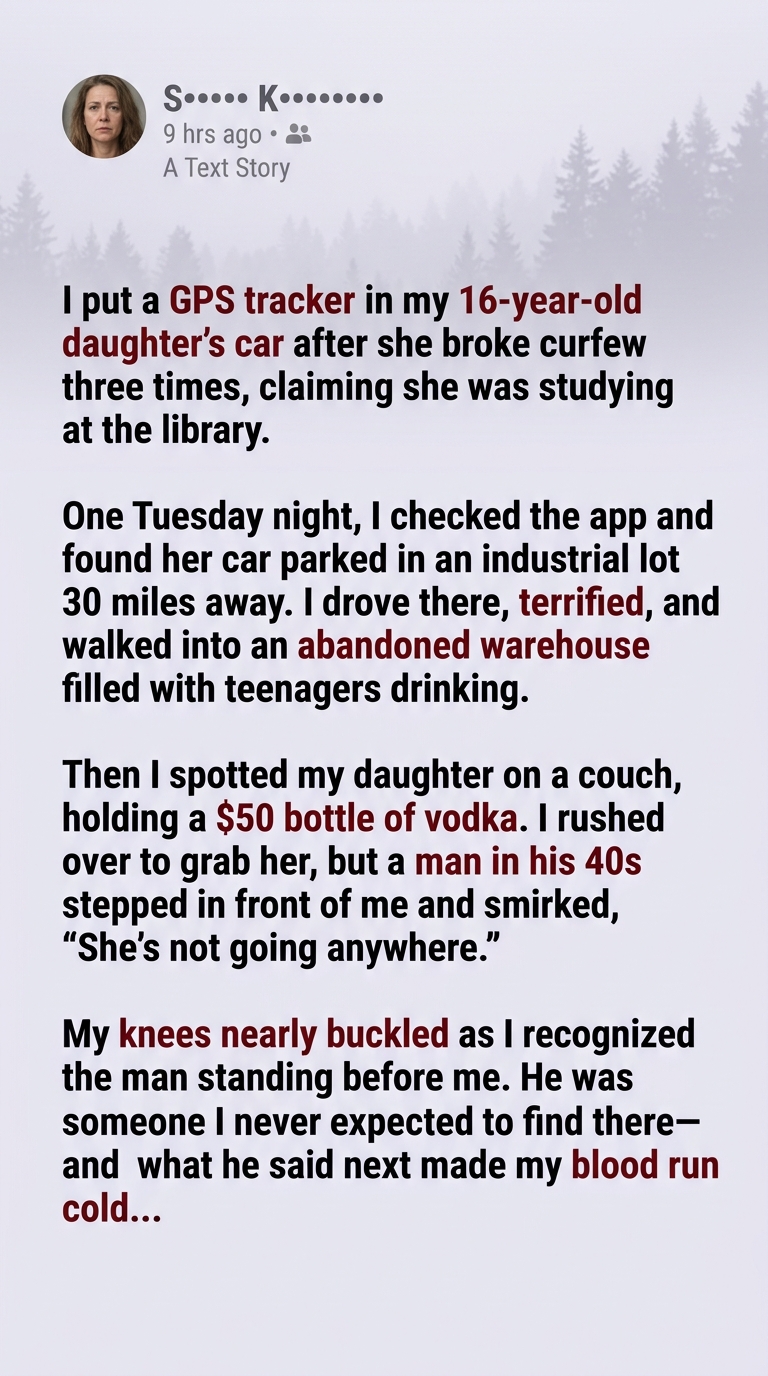
I put a GPS tracker in my 16-year-old daughter’s car after she broke curfew three times, claiming she was studying at the library. One Tuesday night, I checked the app and found her car parked in an industrial lot 30 miles away. I drove there, terrified, and walked into an abandoned warehouse filled with teenagers drinking. Then I spotted my daughter on a couch, holding a $50 bottle of vodka. I rushed over to grab her, but a man in his 40s stepped in front of me and smirked, “She’s not going anywhere.” My knees nearly buckled as I recognized the man standing before me. He was someone I never expected to find there—and what he said next made my blood run cold…
“Your daughter knows exactly who I am,” he said. “Ask her what she’s been doing here every Tuesday.”
I couldn’t breathe.
Standing in front of me was Mark Sullivan, my younger brother.
The same brother who had disappeared from our lives eleven years earlier after a bitter family dispute. The same man I had been told moved across the country and wanted nothing more to do with us.
And the same man who had once sworn he would never hurt my family.
“Mark?” I whispered.
He smiled without warmth.
“Hello, Rachel.”
Behind him, music thudded through the warehouse. Teenagers crowded around folding tables, drinking from plastic cups. Some looked barely fourteen. An open bottle lay on the floor beside a boy slumped against a wall.
My daughter, Emily, stared at me from the couch.
The vodka bottle trembled in her hand.
“Mom?”
I moved toward her.
“Put that down. We’re leaving.”
Mark stepped into my path.
“I told you,” he said. “She’s not going anywhere.”
“Get out of my way.”
He leaned closer.
“You don’t get to show up after all these years and start giving orders.”
I glanced toward the open doorway. I had driven thirty miles in a panic, expecting to find my daughter somewhere she shouldn’t be. I hadn’t expected to find my brother in a building full of intoxicated teenagers.
I didn’t know who else was there, whether anyone had weapons, or what Mark might do next.
But I knew one thing.
Emily was sixteen, and I needed to get her somewhere safe.
“Emily,” I said firmly, keeping my eyes on her. “Come stand beside me.”
She hesitated.
Mark laughed.
“Don’t bother. She’s been coming here for weeks. She likes it here.”
My stomach dropped.
“Is that true?” I asked her.
Emily lowered her eyes.
That was answer enough.
I wanted to demand an explanation. I wanted to ask how she could lie to me, how she could put herself in danger, and why she had never told me about Mark.
But none of those questions mattered more than getting her out.
I took out my phone and called emergency services, giving them the warehouse location and explaining that minors were drinking alcohol at a gathering with an adult who was preventing me from leaving with my daughter. I stayed on the line and followed the dispatcher’s instructions.
Mark’s expression changed when he realized what I was doing.
“You’re calling the police on your own brother?”
“I’m calling for help because there are children drinking in an abandoned warehouse, and you’re blocking me from taking my daughter home.”
He stared at me.
Then he said the words that made my blood run cold.
“You should be more worried about what your daughter came here to find.”
I looked at Emily.
Her face had gone completely white.
“Mom,” she whispered, “I need to tell you something.”
Before she could continue, Mark turned toward the teenagers.
“Everyone stay where you are. Nobody needs to make this worse.”
Several people began moving toward the back exit. Others suddenly became very interested in their phones. One girl started crying.
I moved beside Emily, putting myself between her and Mark.
“Tell me now,” I said quietly.
She swallowed hard.
“I didn’t come here just to drink.”
“Then why are you here?”
Her eyes filled with tears.
“Because he said he knew Dad.”
The warehouse seemed to fall silent around me.
My husband, David, had died six years earlier in what the police described as a late-night car accident. Emily had been ten. She remembered him, but as the years passed, her memories became fragments: his laugh, his old baseball cap, the way he carried her on his shoulders.
Mark had been part of the family back then. He and David had been close once, until a dispute over money tore them apart.
After David’s death, Mark and I had argued over something he claimed my husband had told him before the accident. I had accused Mark of lying, and he had stormed out of my house.
We hadn’t spoken since.
“What do you mean he knew Dad?” I asked.
Emily wiped her cheeks.
“He messaged me online. He said there were things about Dad you never told me. He said you were hiding the truth about the accident.”
I stared at my brother.
“You contacted my daughter behind my back?”
“I gave her answers,” Mark replied.
“You gave a sixteen-year-old access to an illegal drinking party in an abandoned building.”
“I didn’t force her to come.”
“No. You just used her grief to get her here.”
For the first time, his smirk disappeared.
He glanced at the other teenagers, then back at me.
“You always thought you were the only one who knew David.”
I felt a chill crawl down my spine.
“What are you talking about?”
Mark took a breath.
“Your husband didn’t die the way you think he did.”
My hands went numb.
For six years, I’d accepted the accident report, the funeral, and the explanation given to me by the authorities. There had been questions, of course, but nothing that suggested a different conclusion.
“What do you know about David’s death?” I demanded.
Mark looked at Emily.
“Tell her what you found.”
She reached into her pocket and pulled out a folded sheet of paper.
“I found it in Dad’s old toolbox in the garage,” she said. “I wasn’t looking for anything. I was trying to find a screwdriver for my school project.”
I took the paper.
It was a photocopy of an old handwritten note. The handwriting looked familiar, but I couldn’t immediately place it.
At the bottom was a date: three days before David’s accident.
The note read:
Mark, I can’t keep covering for you. You promised me this was over. If anything happens, Rachel needs to know the truth.
There was no signature.
But I recognized the handwriting.
It was David’s.
I read it again.
Then a third time.
“What did you do?” I asked Mark.
He looked away.
For a moment, I thought he might deny everything. Instead, he rubbed his face and spoke in a voice that sounded suddenly older.
“David found out I was in trouble. I’d borrowed money from people I shouldn’t have, and I kept telling him I could handle it. He helped me pay some of it back. He was trying to get me out.”
“And the note?”
“He wanted me to stop lying to him.”
“Why would Emily believe you knew something about the accident?”
Mark looked at her again.
“Because I told her I was the last person to speak to him before he drove that night.”
I felt sick.
“Were you?”
He hesitated.
“Yes.”
Emily made a small sound beside me.
I turned toward her.
“He told me Dad called him from the car,” she whispered. “He said Dad was scared. He said you never knew because Mark promised him he wouldn’t tell you.”
Mark shook his head.
“I never said David was scared.”
“You said you had a recording,” Emily replied, her voice shaking. “You said if I came here, you’d let me hear it.”
I looked at my brother.
“Is there a recording?”
His silence was answer enough.
Then a siren sounded outside.
Mark’s eyes darted toward the loading doors.
“Listen, Rachel,” he said quickly. “This isn’t what you think.”
“I don’t know what to think anymore.”
He stepped closer, lowering his voice.
“David called me because he knew someone was following him. He told me he needed help. I was supposed to meet him that night, but I didn’t go.”
My heart hammered against my ribs.
“Why not?”
“Because I was afraid. The people I owed money to had threatened me. I thought if I stayed away, they’d leave me alone.”
“Are you saying those people caused the accident?”
“I don’t know,” he said. “I swear I don’t know. But I should have told the police about the call. I should have told you.”
He looked at the floor.
“I was ashamed. After the funeral, I couldn’t face you. So I left.”
I wanted to scream at him. I wanted to demand why he had waited eleven years to return and why he’d chosen my daughter as the person to whom he would reveal this.
But before I could speak, two officers entered the warehouse.
They separated the adults from the teenagers and began checking on anyone who appeared intoxicated. An officer spoke with Emily and me while another kept Mark nearby.
I told them what I’d witnessed and showed them the note. I explained that Emily had been contacted by an adult family member who had invited her to the gathering under the promise of revealing information about her deceased father.
The officers took the document for review and asked Emily what had happened. They arranged for her to be assessed because she had been drinking, and I stayed close enough to reassure her while allowing the professionals to do their work.
Mark was questioned separately.
I didn’t know whether he had committed a crime beyond what I had witnessed. I didn’t know whether his story about David was true, or whether he was inventing details to protect himself.
I only knew that the note deserved to be examined and that David’s death might not be as simple as I had believed.
That night, after Emily had been checked by medical staff and was safely home, she sat beside me on the couch.
She looked smaller than I had ever seen her.
“Are you going to hate me?” she asked.
I turned toward her.
“No.”
“I lied to you. I kept going there. I knew you wouldn’t let me come if I told you.”
I took her hand.
“We are going to talk about the lying, and we’re going to talk about the drinking. There will be consequences. But I’m not going to stop loving you because you made a dangerous decision.”
She began to cry.
“I just wanted to know more about Dad. You never talk about him anymore.”
The words hurt because there was truth in them.
After David died, I’d spent years trying to keep our lives steady. I’d worked, raised Emily, paid the bills, and avoided talking about the accident because every conversation reopened a wound I didn’t know how to close.
I had thought silence would protect her.
Instead, it had left room for someone else to fill the silence with promises.
“I should have talked to you more about him,” I said. “I’m sorry.”
She leaned against me.
We stayed that way for a long time.
The following morning, I contacted an attorney and asked how to preserve the note and any other evidence without interfering with the investigation. I also contacted the appropriate authorities to ask whether David’s old accident records could be reviewed in light of the new information.
I did not confront Mark again on my own.
Over the next several weeks, investigators reviewed the available records and interviewed people who had known David. They could not immediately confirm that the accident had been anything other than what the original report described. Mark’s account was inconsistent in places, and his claim about a possible threat needed independent corroboration.
But they did find evidence that David had called Mark shortly before the crash. That alone did not prove foul play, yet it was enough for investigators to ask additional questions and examine the timeline more carefully.
Mark eventually admitted that he had withheld the call from the original investigators because he feared his own financial troubles would be exposed. He said he had contacted Emily because he wanted someone in the family to hear his side before he was forced to explain it publicly.
That did not excuse his decision to invite a minor to a drinking party or pressure her into keeping secrets from me.
I made that clear to him through the appropriate channels.
Emily and I began family counseling. We set clear rules about curfew, driving, alcohol, and online contact with adults. I explained why I’d installed the tracker, acknowledged that trust had broken down on both sides, and agreed that we needed to discuss safety and privacy rather than rely on surveillance alone.
She wasn’t instantly transformed into a perfect teenager. She was still sixteen—sometimes impulsive, sometimes angry, and still grieving the father she’d lost.
But she started telling me more.
She told me when she was curious about David’s past. She told me when friends pressured her to break rules. And when she felt the urge to hide something, we worked on finding a way to talk about it before it became a crisis.
As for Mark, I didn’t rush to forgive him.
I had no idea whether the full truth about David’s final night would ever emerge. I had no reason to accept every claim my brother made simply because he was family.
The next time he contacted me, I told him that any information he had about David needed to go to the investigators, not through my daughter. If he genuinely wanted to make things right, he could start by telling the truth and accepting responsibility for what he had done.
He agreed.
Whether he would follow through remained to be seen.
Months later, Emily and I visited David’s grave together. She brought a small bunch of sunflowers and placed them beside his headstone.
“I wish I’d known him better,” she whispered.
I put my arm around her.
“Me too.”
We stood there quietly, remembering the man we loved and acknowledging how many questions remained unanswered.
I had driven to that warehouse expecting to find a reckless teenager and bring her home.
Instead, I discovered that my brother had been using her grief to draw her into a dangerous situation—and that the story of my husband’s final night might still hold unanswered questions.
I couldn’t undo the years of silence. I couldn’t guarantee what the investigation would uncover. And I couldn’t protect Emily by making every decision for her.
But I could do three things.
I could keep her safe.
I could insist on the truth.
And I could make sure she never again felt she had to risk her safety just to learn about the father she missed.
That night in the warehouse changed our family forever.
Not because my brother’s claims suddenly explained everything, but because I finally understood how dangerous secrets become when people use them to control the ones who are still searching for answers.
And I promised myself that whatever the truth about David’s death turned out to be, my daughter would never have to go looking for it alone again.