My Brother Arrived 40 Minutes Late to Mom’s Funeral and Took Credit for Caring for Her. Then Her Lawyer Played One Recording…
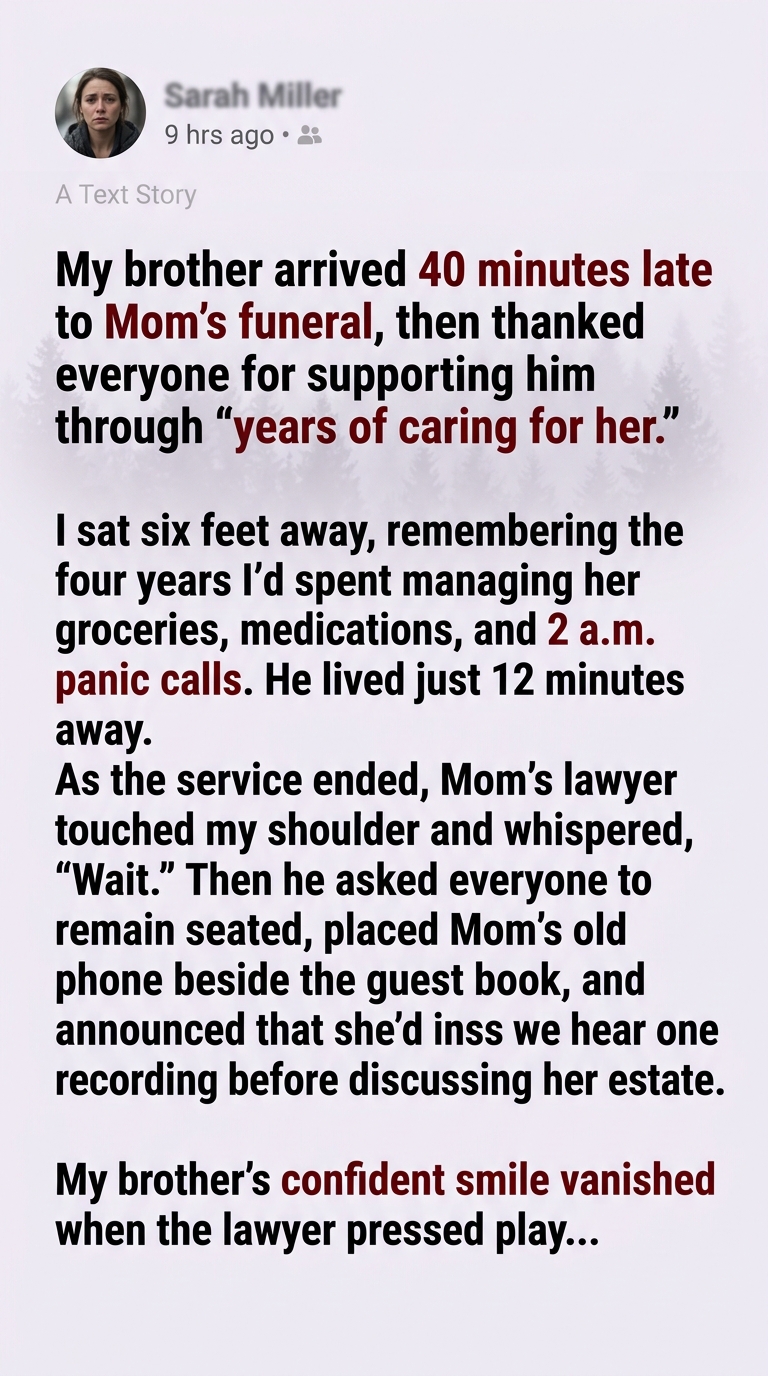
My brother, Andrew, arrived forty minutes late to our mother’s funeral.
He walked into the chapel wearing an expensive navy suit, carrying a bouquet of white roses, and wearing the solemn expression of a man who had spent the morning doing something important.
Everyone turned to look at him.
He shook hands with our relatives, hugged two of Mom’s oldest friends, and apologized loudly for being late.
“Traffic was terrible,” he explained. “I’ve barely had a moment to breathe these past few weeks.”
I sat six feet away, staring at the framed photograph of our mother beside the altar.
For four years, I had been the person who barely had a moment to breathe.
I was the one who drove twelve minutes across town to stock her refrigerator, sorted her medications into weekly containers, scheduled her appointments, and answered the phone when she called at two in the morning because she was frightened by a noise outside her bedroom.
Andrew lived twelve minutes away, too.
He had a comfortable house, a successful career, and a wife who loved planning weekend trips. He always seemed to have a reason he couldn’t visit Mom.
A business meeting.
A school event for his children.
A headache.
A promise he’d made to someone else.
Whenever I asked him to take Mom to an appointment, he’d say, “I’ll try, Claire. You know how busy things are right now.”
And because I couldn’t bear the thought of Mom sitting alone in a waiting room, I did it myself.
When she began forgetting small things, I made lists and put reminders on her refrigerator. When she stopped cooking regularly, I brought meals. When she called me after midnight, convinced she had forgotten to lock the back door, I drove over in my pajamas and checked every lock.
I never kept a tally.
She was my mother.
I loved her.
But I would be lying if I said I wasn’t exhausted.
Andrew finally took his seat beside his wife, Lauren, and leaned toward the relatives sitting behind him.
“I just want to thank everyone for supporting me through these last few years,” he said, his voice thick with emotion. “Caring for Mom has been the hardest thing I’ve ever done.”
I turned my head.
He continued.
“Watching someone you love slowly decline changes you. There were so many sleepless nights, so many difficult decisions. I did everything I could to make sure she was comfortable.”
I felt my fingers tighten around the funeral program.
Four years of sleepless nights?
He hadn’t answered one of Mom’s midnight calls.
Not one.
When she was frightened after a storm knocked out the electricity, I sat beside her until morning. When she slipped in the bathroom, I called the ambulance and waited at the hospital. When she cried because she thought she’d become a burden, I held her hand and promised she would never be alone.
Andrew had sent flowers twice.
He had visited on Mother’s Day and once the Christmas before she died.
Now he was accepting condolences for sacrifices he had never made.
I wanted to stand up and tell everyone the truth.
But I looked at Mom’s photograph and swallowed the words.
I wasn’t going to turn her funeral into a fight.
The service began, and I listened to the minister speak about Mom’s kindness, her stubbornness, and the way she always remembered the birthdays of people she hadn’t seen in years.
I thought about her little kitchen, the faded curtains she refused to replace, and the way she always offered me tea even when I had just arrived carrying three bags of groceries.
I remembered her last clear conversation with me.
“Claire,” she’d whispered, squeezing my hand, “you’ve done more than you know.”
I had told her not to talk that way.
She’d smiled.
“Promise me you’ll keep living your own life, too.”
I promised.
Then she closed her eyes and rested.
She died three days later.
As the minister finished, people began standing and gathering their coats. Andrew moved through the chapel, accepting hugs and telling everyone how grateful he was that they had supported him through such a difficult journey.
I remained seated.
My legs felt heavy, and I couldn’t imagine going home to an empty house without my mother calling to ask whether I had eaten.
Then someone touched my shoulder.
It was Mr. Bennett, Mom’s longtime lawyer.
“Claire,” he whispered, “please wait a moment.”
I looked up.
“Is something wrong?”
“Not exactly. Your mother left specific instructions.”
He walked to the front of the chapel and asked everyone to remain seated.
Andrew frowned.
“What’s going on?”
Mr. Bennett didn’t answer him.
Instead, he picked up a small black object from his briefcase and placed it beside the guest book.
Mom’s old phone.
The same phone I’d helped her use for years, with its scratched screen and a piece of tape covering a crack near the charging port.
Mr. Bennett cleared his throat.
“Your mother requested that, before we discuss the administration of her estate, everyone present hear a recording she made shortly before her death.”
Andrew’s expression changed.
“Why would she do that?”
Mr. Bennett looked directly at him.
“Because she considered it important.”
He pressed play.
At first, there was only the soft rustle of fabric and the faint sound of a chair moving.
Then Mom’s voice filled the chapel.
“If you’re hearing this, I’ve passed away, and my children are together.”
I covered my mouth.
Her voice was weaker than I remembered, but unmistakably hers.
“I want to say something before my lawyer discusses my estate. I have spent too many years worrying about whether my children are getting along. I’ve tried to keep the peace, even when keeping the peace meant pretending I didn’t see what was happening.”
Andrew shifted in his seat.
Mom continued.
“Andrew, I know you’ve told people that you’ve been caring for me for years. I know you’ve told them how difficult it was and how much you sacrificed.”
My brother’s face went pale.
“Mom,” he muttered, though the recording continued.
“I need you to understand that I know the difference between someone who visits when it is convenient and someone who shows up when there is no audience.”
A silence settled over the chapel.
Then Mom said the words that made Andrew stop moving altogether.
“Claire, I know what you’ve done for me. And I know what your brother has been telling people.”
I began to cry.
“I have kept records—not because I wanted to punish anyone, but because I wanted the truth to be known after I was gone.”
There was a pause.
Then Mom’s voice grew firmer.
“Mr. Bennett has copies of my care calendar, the messages I sent asking for help, and the notes I made after our conversations. I asked him to preserve them because I don’t want either of my children to feel that they must argue over my memory.”
Andrew turned toward the lawyer.
“What is this?”
Mr. Bennett held up one hand, asking him to wait.
The recording continued.
“Andrew, you may have your reasons for not being there. I know work can be demanding. I know life is complicated. But you do not get to rewrite the past simply because I can no longer correct you.”
My brother stared at the floor.
“Claire never asked me to choose between you. She never asked me to praise her. She simply kept showing up.”
I pressed my hand against my chest.
Mom’s voice softened.
“She came when I was frightened. She came when I was ill. She came when I couldn’t remember whether I’d taken my medication. She came even when she was tired, even when she had her own problems, and even when I told her I was sorry for asking too much.”
My tears fell onto the funeral program.
“I don’t want Claire to spend the rest of her life believing that being dependable means she must always put herself last. And I don’t want Andrew to spend the rest of his life believing that a good speech can replace a good deed.”
Andrew’s wife lowered her eyes.
Then came the final sentence.
“Before you discuss my money or my belongings, I want you to remember this: I knew who was there for me. And I loved both of my children, even when I was disappointed by their choices.”
The recording ended.
For several seconds, no one moved.
The chapel was silent except for someone quietly crying in the back row.
Andrew stood abruptly.
“This is ridiculous. She was ill. She was confused sometimes. You can’t take one recording and make me look like a monster.”
Mr. Bennett remained calm.
“No one is asking you to accept a characterization. Your mother wanted this recording played, and I have followed her instructions.”
Andrew looked around the chapel, searching for someone who would agree with him.
No one spoke.
Then he turned toward me.
“Claire, why didn’t you tell me she was keeping records?”
I stared at him.
“Because I didn’t know she was.”
He looked as though he wanted to say something else, but the lawyer opened his briefcase and removed a thick folder.
“Your mother left additional instructions regarding her care and estate,” he said. “We should discuss those privately, after the funeral.”
Andrew sat down again.
His confident smile was gone.
And for the first time in four years, I didn’t feel compelled to rescue him from the consequences of his own choices.
Two days later, I met Mr. Bennett at his office.
Andrew arrived with Lauren, carrying a leather folder of his own. He looked tired and irritated, as though the funeral recording had inconvenienced him.
Mr. Bennett began by explaining that Mom’s will was validly executed and that he would be handling the estate according to its terms. He made it clear that the recording did not determine anyone’s legal rights; the will and the applicable documents would do that.
Then he placed three folders on the table.
The first contained Mom’s care calendar.
Every appointment. Every prescription refill. Every emergency call.
My name appeared beside most of the entries.
Andrew’s appeared beside a handful.
The second folder contained messages.
Some were from Mom asking Andrew to visit. Others were from him apologizing for being busy or promising to come the following weekend.
One message was dated the night Mom fell in the bathroom.
Andrew, please call me. I’m scared and I don’t know what to do.
His reply had arrived the next afternoon.
Sorry, Mom. I fell asleep early. Hope you’re feeling better.
I stared at the screen.
I remembered that night vividly. I’d driven through heavy rain, found Mom sitting on the bathroom floor, and called an ambulance because she couldn’t put weight on her leg.
Andrew had never asked what happened.
The third folder contained Mom’s financial records and estate documents.
Mr. Bennett explained that Mom had been careful with her money. She had paid for her care from her own accounts, and there was no evidence that either child had been required to contribute financially.
She had also left clear instructions for the distribution of her remaining assets.
The house and most of her savings were to be divided according to the will. Certain personal belongings were assigned to specific people, including the old sewing machine she had promised me years earlier.
There was no dramatic inheritance that erased everything Andrew had done.
There was no secret fortune.
There was simply a carefully prepared estate and a mother who had wanted her wishes respected.
Andrew looked through the documents, his jaw tightening.
“She made me look terrible,” he said.
Mr. Bennett folded his hands.
“Your mother made her own decisions about what she wanted preserved. She did not ask me to alter or embellish anything.”
Andrew turned to me.
“Are you happy now? Everyone thinks I’m a terrible son.”
I took a long breath.
“No, Andrew. I’m sad.”
He looked surprised.
“I’m sad that Mom felt she had to document the help she received. I’m sad that you thought you could take credit for my work. And I’m sad that even now, you’re more concerned about what people think of you than what Mom needed.”
His face reddened.
“You have no idea how much pressure I was under.”
“Then you should have told the truth about it. You could have asked me for help. You could have told Mom you couldn’t visit. I would have understood that you had limits.”
I paused.
“But you told everyone you were doing things you weren’t doing. That’s what hurt.”
Lauren put a hand on his arm.
“Andrew, she’s right.”
He turned toward his wife.
“Whose side are you on?”
“I’m not taking sides,” she replied quietly. “I’m asking you to be honest.”
Andrew pushed his chair back.
“I need some air.”
He walked out of the office.
Mr. Bennett gave us a few minutes before continuing with the estate paperwork. Everything was handled according to Mom’s documented wishes, with questions directed through the lawyer rather than argued over in the room.
I left that afternoon feeling no triumph.
The truth had been heard, but it couldn’t give Mom back to me.
It couldn’t restore the nights I’d spent worrying about her or erase the loneliness of knowing my brother had been so close and yet so absent.
It could only end the lie that I’d been carrying the burden alone while someone else received the praise.
A week later, Andrew called.
I almost let it go to voicemail.
But I answered.
“Claire,” he said, “can we talk?”
“About what?”
“About Mom. About the recording.”
I sat at my kitchen table.
“All right.”
He was quiet for a moment.
“I didn’t realize she was keeping track of everything.”
“She wasn’t keeping track to punish you. She wanted her wishes understood.”
“I know.”
He sounded different now. Less defensive, though still uncomfortable.
“I thought that if I told people I’d been caring for her, it would make me feel less guilty about not visiting more often.”
I closed my eyes.
“Andrew…”
“I know. It’s a terrible excuse.”
He exhaled.
“I kept telling myself I’d visit next week. Then next week became next month. I was embarrassed that you were doing so much more than I was, so I started talking as though I’d been there the whole time.”
I didn’t rush to comfort him.
For once, I let him sit with the truth.
“Why didn’t you just help?” I asked.
“Because I was afraid I’d have to face how much she’d changed. And because I knew you were handling everything, so I told myself she was fine.”
“She wasn’t always fine.”
“I know that now.”
I looked at the empty chair across from me.
“Mom didn’t need you to be perfect. She needed you to show up. Even if you could only stay for twenty minutes. Even if you couldn’t do everything I did.”
“I know.”
His voice cracked.
“I’m sorry, Claire.”
I believed he was sorry.
But I also knew that an apology was not a time machine.
“I accept that you’re sorry,” I said. “But I need you to understand that what happened wasn’t just about Mom’s funeral. I spent four years being the person everyone called when something went wrong. I did it because I loved her. I never needed a medal. I just didn’t want you to pretend you’d done the same things when you hadn’t.”
“I understand.”
“I hope you do.”
We spoke for another ten minutes. We didn’t resolve everything, but we ended the call without shouting.
That was something.
Over the following months, Andrew and I began speaking occasionally. Sometimes we talked about Mom. Sometimes we talked about ordinary things, like our children and the weather. He didn’t become a different person overnight, and I didn’t suddenly trust every word he said.
But he stopped claiming he’d been Mom’s primary caregiver.
When relatives asked about the funeral recording, he told them the truth: I’d been the one who handled most of Mom’s daily care, and he’d not been there as much as he should have been.
It was a small change, but it mattered.
I also began doing something Mom had asked me to do in her final weeks.
I started living my own life again.
I took a weekend trip with a friend. I signed up for a pottery class I’d postponed for years. I stopped answering every family call as though it were an emergency I alone could solve.
Sometimes, I still felt guilty.
Then I remembered Mom’s voice on that recording.
Being dependable means you must not always put yourself last.
She had understood something I’d been too busy to recognize: love is not measured by how much of yourself you can sacrifice without complaint.
It is shown by the care you give, the honesty you practice, and the respect you offer the people who depend on you.
At Mom’s funeral, Andrew had tried to make himself the hero of a story he hadn’t lived.
But Mom’s final recording wasn’t really about exposing him.
It was about making sure the truth survived her.
She wanted me to know that she had seen me. She wanted Andrew to face the choices he’d made. And she wanted both of us to remember that love without honesty can become another way of hiding.
I still miss her every day.
I miss her calls, her old-fashioned advice, and the way she could make a cup of tea feel like a solution to almost anything.
But I no longer wonder whether my years of caring for her mattered.
She knew.
And sometimes, knowing that is enough.