My Son Said I Could No Longer Walk After Hip Surgery—Then I Found the Physical Therapist’s Exercise Sheet
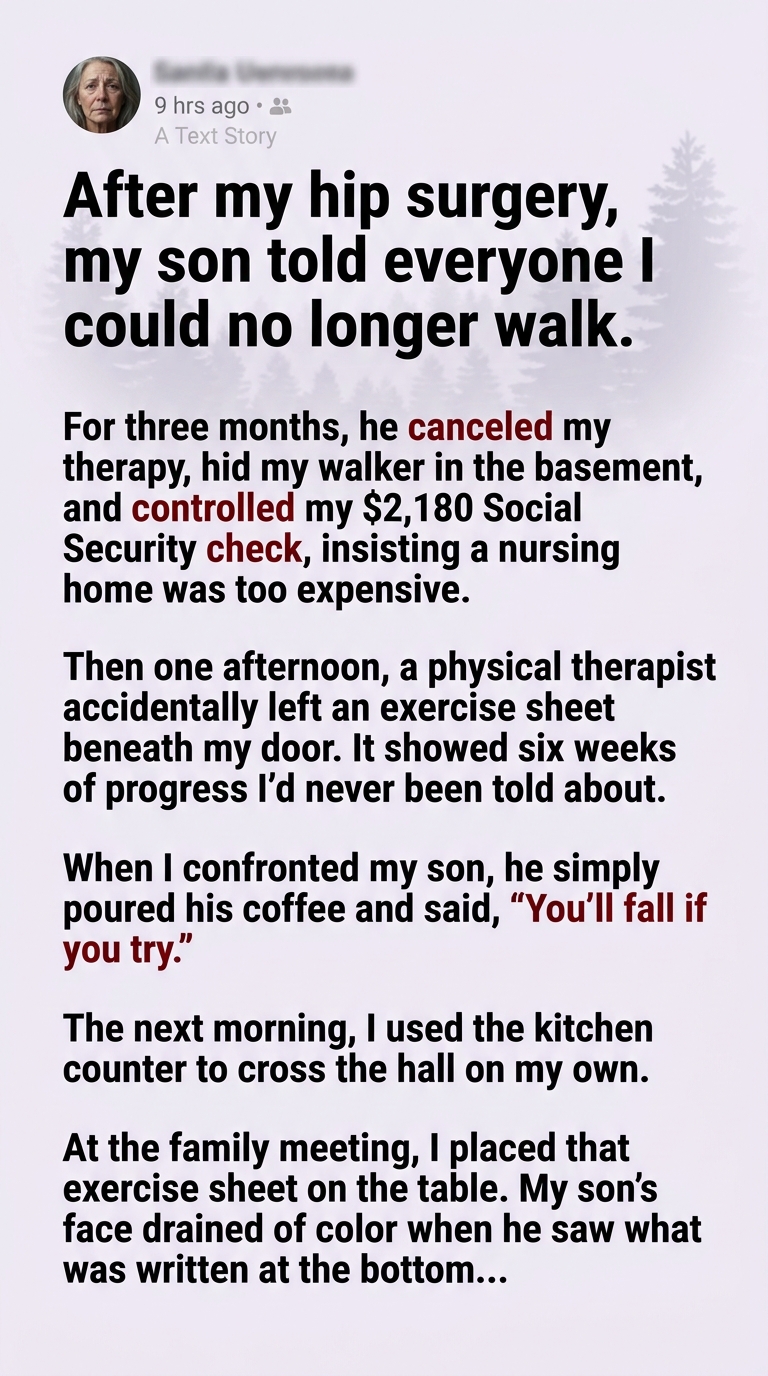
After my hip surgery, my son, Daniel, told everyone I could no longer walk.
At first, I believed him.
I was seventy-two years old, recovering from a major operation, and dependent on the people around me for things I’d done independently my entire life. Daniel moved into my house to help me recover. He told my relatives he would handle everything until I was strong enough to manage on my own.
I thought I was fortunate to have him.
I didn’t realize that, over the next three months, he would take control of nearly every part of my life.
My physical therapy appointments were canceled one by one. My walker disappeared into the basement. Whenever I asked about rescheduling therapy, Daniel sighed and reminded me how expensive everything was.
“You need to be realistic, Dad,” he would say. “Your body isn’t what it used to be.”
He began collecting my $2,180 monthly Social Security check, claiming he needed it to cover groceries, medication, and household expenses. When I asked to see the bills, he said I was worrying about things I couldn’t understand.
Then he started talking about nursing homes.
“I can’t keep doing this forever,” he told me one evening. “If you can’t take care of yourself, we’ll have to find somewhere that can.”
“But the doctor said rehabilitation was important.”
“The doctor doesn’t live here. I do.”
I stopped arguing.
I hated how quickly I had become afraid of upsetting my own son. I hated asking for help to get dressed, to reach the bathroom, or to retrieve a glass of water. Most of all, I hated the thought that Daniel might be right—that I was becoming a burden and had no choice but to accept whatever he decided for me.
Then, one afternoon, everything changed.
A physical therapist named Melissa had visited the house to drop off paperwork. As she left, a sheet of exercises slipped from her folder and landed beneath my bedroom door.
I picked it up.
At the top was my name.
Below it were six weeks of therapy notes, progress measurements, and exercises I’d supposedly been completing.
I read the page twice.
The notes said I had improved my standing balance, increased my supported walking distance, and demonstrated enough progress to begin practicing additional movements under professional supervision.
At the bottom, Melissa had written:
PATIENT HAS DEMONSTRATED CONSISTENT IMPROVEMENT. CONTINUED PHYSICAL THERAPY IS RECOMMENDED. PATIENT SHOULD BE ENCOURAGED TO PARTICIPATE IN DECISIONS ABOUT HIS RECOVERY.
I stared at those words until they blurred.
Six weeks of progress.
Six weeks in which I had been told my condition was hopeless.
I checked the dates. The sheet referred to sessions that had been scheduled, but I couldn’t remember attending them. Some entries appeared to describe assessments and exercises I had never performed.
I didn’t understand how the paperwork had been completed, but I knew I needed answers.
When Daniel came home that evening, I was sitting at the kitchen table with the sheet in front of me.
“What’s this?” I asked.
He glanced at it.
“Therapy paperwork.”
“Why does it say I’ve been improving?”
“Because they have to write something.”
“It says I was making progress.”
He poured himself a cup of coffee.
“You’re not strong enough to walk on your own, Dad. You’ll fall if you try.”
I watched him stir the coffee.
“Then why did you cancel my therapy?”
He didn’t answer immediately.
“Because it wasn’t helping.”
“How do you know? I haven’t been going.”
He set the spoon down.
“You’re making this difficult.”
That was when I understood something I should have recognized much earlier.
Daniel wasn’t simply worried about my recovery.
He was making decisions for me and expecting me never to question them.
The following morning, after he left to run errands, I opened the kitchen drawer where I’d kept my old walking aids and medical papers. My walker was still missing, but I found a sturdy cane I’d used before surgery.
I stood slowly, holding the counter.
My hip ached. My legs trembled. I was frightened.
I did not attempt to cross the hallway unsupported. I knew a fall could undo months of recovery, and I wasn’t going to risk my health to prove a point to my son.
Instead, I used the phone to contact my surgeon’s office and asked for an urgent review of my recovery plan. I also called Melissa, the physical therapist, and asked her to explain the paperwork.
Her answer shocked me.
She told me that she had repeatedly recommended continued therapy. She had also documented concerns about missed appointments and the lack of consistent access to my prescribed mobility equipment.
“Mr. Miller,” she said gently, “you should have been included in every decision about your treatment. If you want to continue rehabilitation, we can discuss the safest way to arrange it.”
I swallowed hard.
“Someone told me I couldn’t improve.”
“I’m sorry you’ve been made to feel that way. Your progress needs to be assessed by your medical team, not decided by a family member.”
For the first time in three months, I felt something I thought I’d lost.
Hope.
But I still needed to understand why my son had worked so hard to keep me dependent on him.
And I knew I couldn’t find that answer by confronting him alone.
Over the next several days, I spoke with my doctor, my physical therapist, and a social worker who helped older adults manage changes in independence and family support.
My doctor reviewed my recovery and confirmed that I needed a structured rehabilitation plan. I wasn’t ready to walk freely without assistance, but there were safe exercises and supervised activities appropriate to my condition.
The social worker also asked about my finances.
I told her Daniel had been collecting my Social Security checks.
“Do you know exactly where the money is going?” she asked.
I shook my head.
She helped me request my bank statements and review the arrangements for accessing my benefits. I learned that Daniel had been using my money for household expenses, but there were also withdrawals I couldn’t immediately explain.
Some receipts were missing. Some transfers had no clear description.
I didn’t accuse him of stealing everything. I didn’t know that yet.
But I knew I had the right to understand how my money was being used.
With help, I arranged to receive my benefit information directly, reviewed my account access, and sought advice about protecting my finances. I also asked that future medical decisions be discussed with me directly.
Then I invited Daniel to a family meeting.
I asked my daughter, Rebecca, to attend, along with my sister Helen and the social worker. Daniel agreed, apparently believing we would be discussing whether I needed a nursing home.
He arrived with a folder of papers and an expression of weary patience.
“I hope we’re finally going to make a realistic plan,” he said.
I placed the physical therapist’s exercise sheet on the table.
His face drained of color.
For a moment, he didn’t move.
Then he reached toward it.
“Where did you get this?”
“It fell beneath my door.”
He looked at the other people around the table.
“This is private medical information.”
“It’s my medical information,” I replied. “And I have a right to see it.”
Rebecca picked up the sheet and read the notes. Her expression tightened.
“Dad, why weren’t you getting therapy?”
Daniel leaned back in his chair.
“Because he wasn’t ready. I was the one here every day. I saw what he was like.”
“Did the therapist tell you to cancel the appointments?” Rebecca asked.
“No.”
“Did Dad ask you to hide his walker?”
Daniel’s silence answered her.
My sister Helen looked at him with disbelief.
“Daniel, he raised you. Why would you keep him from getting better?”
“I’m trying to keep him safe!” Daniel snapped. “You all show up for an hour and then leave. I’m the one who has to deal with everything.”
I took a slow breath.
“I know helping me has been difficult. I never asked you to do it alone. I asked you to help me recover.”
He shook his head.
“You don’t understand how much work this is.”
“Then you should have asked for more help. You should have told me you were overwhelmed. You had no right to make me believe I couldn’t improve.”
He stared at the table.
I slid another document toward him. It was a summary of the bank transactions I’d been able to review.
“I also want an explanation of my money.”
Daniel’s face tightened again.
“What is this supposed to mean?”
“It means I want to know where my $2,180 monthly check has been going.”
“I’ve been paying your bills!”
“Then show me the bills.”
He opened his mouth, then closed it.
Rebecca leaned forward.
“Daniel, Dad shouldn’t have to fight you to see his own finances.”
He rubbed his forehead.
“I didn’t steal from him.”
“Then help us understand the withdrawals,” I said.
The room fell silent.
Finally, Daniel admitted that he had used some of my money to cover his own expenses. He said he’d fallen behind on his mortgage and credit-card payments before moving into my house. He had convinced himself that he could borrow from my benefits temporarily and replace the money once his situation improved.
But he hadn’t told me.
And when I began recovering more slowly than he expected, he became afraid I’d insist on managing my own affairs again.
“If you could walk and handle your own money,” he said quietly, “you wouldn’t need me here.”
I felt a coldness spread through me.
“So you wanted me to need you?”
He looked up, panic in his eyes.
“No. That’s not what I meant.”
“Then what did you mean?”
He struggled to answer.
“I was drowning. I thought I could get everything under control before you noticed. Then you started asking questions, and I didn’t know how to fix it.”
His voice cracked.
“I thought if you moved into a nursing home, I could finally get my own life back.”
Nobody spoke.
I had spent three months believing I was failing my son because I couldn’t recover quickly enough.
Now I understood that he had been trying to manage his own crisis by taking control of mine.
I felt anger, but beneath it was a terrible sadness.
“Daniel,” I said, “you could have told me you were struggling. We could have discussed expenses. We could have brought in professional help. We could have made a plan.”
“I know.”
“Instead, you hid my walker. You canceled my therapy. You made me afraid to try.”
He covered his face.
“I know.”
For the first time, he looked less like a son who was in control and more like a frightened man who had made a series of terrible decisions.
But his fear did not erase the harm he had caused.
I looked at the social worker.
“What happens now?”
She explained that we could create a safe plan for my rehabilitation, arrange appropriate support at home, and continue reviewing my finances. If there was evidence of financial exploitation, I could seek further assistance and report it through the proper channels.
I decided that Daniel would no longer manage my money or make medical arrangements without my involvement and consent.
We would review every transaction, determine what needed to be repaid, and establish clear boundaries.
I also made it clear that he could not continue living in my home under the same arrangement. Any future help he provided would have to be agreed upon openly and would not give him control over my decisions.
Daniel nodded, though he looked devastated.
I didn’t ask him to leave that evening. We agreed on a short transition period while I arranged support and he found another place to stay.
For the first time since my surgery, the plan for my life was being made with me—not for me.
My recovery wasn’t a miracle.
The next morning, my physical therapist visited and helped me establish a safe routine. We began with supported standing, balance exercises, and short supervised movements appropriate to my condition. My walker was returned, and I learned how to use it properly again.
Some days were frustrating. Other days brought small victories.
The first time I walked the length of the hallway with my therapist beside me, I cried.
Not because the distance was impressive.
Because I had spent three months believing that my future had already been decided.
My daughter Rebecca helped me organize my bills. The social worker helped me understand my options for home assistance, and my medical team reviewed my progress regularly.
The financial review took longer. I didn’t assume every expense was improper, but I insisted that each transaction be explained. We documented the money Daniel had acknowledged using for his own bills and worked out a repayment arrangement with professional guidance.
Daniel moved out several weeks later.
Before he left, he stood in my doorway holding a box of his belongings.
“Dad,” he said, “I know saying I’m sorry doesn’t fix it.”
“No,” I replied. “It doesn’t.”
He looked down.
“I was scared. I thought everything was falling apart, and I made you responsible for fixing it.”
“You made me responsible for your problems while taking away my ability to manage my own.”
He nodded, tears gathering in his eyes.
“I know.”
I wanted to tell him everything was forgiven. He was my son, and I still loved him.
But I also knew that love could not mean pretending nothing had happened.
“I hope you’ll get help with what you’re going through,” I said. “And I hope you learn to ask for help before you hurt someone else.”
He wiped his eyes.
“I will.”
He left quietly.
I watched him walk down the driveway, then turned back toward my house.
The place felt different.
For months, I’d felt like a guest in my own home, waiting for someone else to decide what I was allowed to do. Now the kitchen counter was simply a kitchen counter. The hallway was a hallway. My bedroom was mine again.
I still needed help, and I still had a long way to go.
But I was no longer afraid to ask questions.
A few months later, I could walk short distances with my prescribed mobility aid and continue working toward my rehabilitation goals. I still had difficult days, but I had a care plan that respected both my safety and my independence.
I kept the exercise sheet in a folder beside my medical records.
Not as proof that I could do everything on my own.
As a reminder that my voice mattered, even when I was vulnerable.
My son had convinced himself that controlling my life was the same as helping me. I had almost believed him because I didn’t want to admit that someone I loved was hurting me.
I still love Daniel.
I hope one day we can rebuild our relationship. But that will require honesty, accountability, and respect—not simply an apology.
I have learned that needing help does not mean surrendering your dignity. Recovering slowly does not mean giving up. And being someone’s parent does not mean you must accept every decision they make on your behalf.
At seventy-two, I am learning to walk again.
But the most important step I took wasn’t across my hallway.
It was the moment I placed that exercise sheet on the table and said, “My life belongs to me, too.”