I Refused to Attend My Daughter’s Wedding Because She Married a Divorced Man With Two Children. Years Later, I Discovered What I Had Lost.
In 2015, I told my daughter she was throwing her life away.
Celia was twenty-six, intelligent, hardworking, and beautiful. She had just graduated from dental school, and I believed her future was bright enough to light the entire world.
Then she told me she was marrying a divorced man with two children.
His name was Michael. He was thirty-four, worked as a high school teacher, and had two children from his first marriage—a six-year-old boy named Ethan and a four-year-old girl named Sophie.
I met him twice before Celia announced their engagement.
Both times, I noticed how exhausted he looked. He carried a worn leather bag, drove an aging sedan, and spent much of our conversations checking his phone because his children needed him.
I didn’t see a devoted father.
I saw complications.
“You’re a dentist,” I reminded Celia one evening. “You’ve worked too hard to throw away your future on someone else’s responsibilities.”
She sat across from me at my dining table, her engagement ring catching the light.
“They aren’t someone else’s responsibilities, Mom. They’re his children.”
“And once you marry him, they’ll become yours, too.”
“I know.”
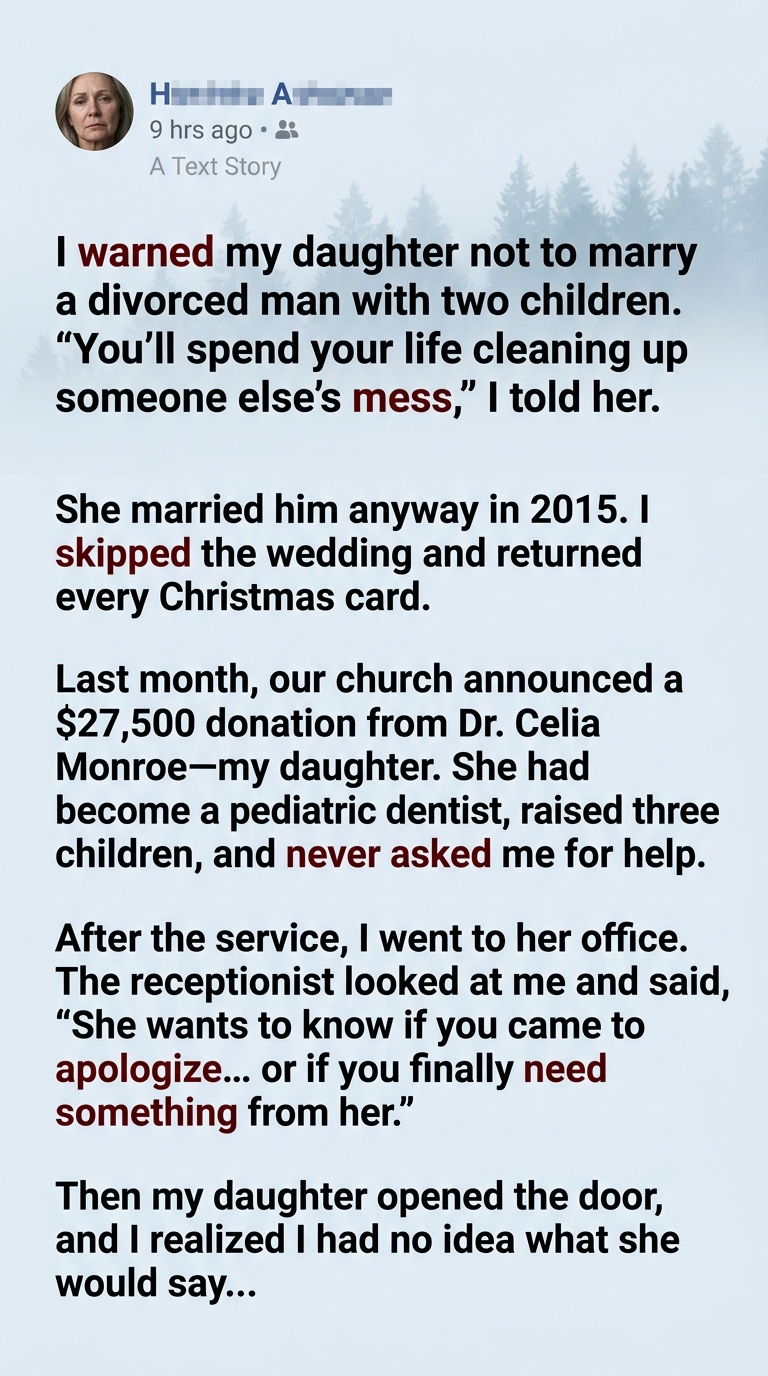
“You’ll spend your life cleaning up someone else’s mess. You’ll pay for another woman’s choices, raise children who may never love you, and put your own dreams aside for a man who already has a family.”
Celia’s expression changed.
“Michael isn’t asking me to give up my dreams.”
“Not yet.”
“Why can’t you just be happy for me?”
“Because I’m your mother. It’s my job to protect you from making mistakes.”
She looked at me for a long moment.
“I’m not asking you to agree with every decision I make. I’m asking you to trust that I know what love means.”
I couldn’t accept that answer.
I had raised Celia alone after her father died when she was sixteen. I worked two jobs for several years to pay our bills, made sure she had the best education I could afford, and sacrificed vacations, new clothes, and countless small comforts so she could pursue dentistry.
In my mind, her future was something I had helped build.
I believed I had earned the right to tell her when she was about to destroy it.
When she announced the wedding date, I gave her an ultimatum.
“Choose carefully, Celia. If you marry that man, don’t expect me to stand beside you and pretend it’s a good decision.”
She went quiet.
Then she said, “I hope one day you’ll understand why I’m choosing him.”
She married Michael in the spring of 2015.
I didn’t attend.
I told my friends the wedding was a mistake and that I refused to celebrate it. When Celia sent me a Christmas card that December, I returned it unopened.
The following year, another card arrived.
I returned that one, too.
Then came birthday cards, family photographs, and short letters in which she told me about her work and the children.
I sent every one back.
Eventually, the letters stopped.
I told myself she had made her choice and was living with the consequences.
For years, I heard occasional updates through relatives. Celia had joined a pediatric dental practice. Michael was still teaching. His children seemed to be doing well in school.
Then I heard that Celia and Michael had welcomed a daughter of their own.
Three children now.
Exactly the life I had warned her about.
I shook my head whenever someone mentioned it.
“She’s making everything harder than it needs to be,” I would say.
I didn’t ask whether she was happy.
I assumed she couldn’t be.
And because I had spent years telling myself that her marriage would eventually fail, I never considered the possibility that it might succeed.
Last month, our church announced a donation of $27,500 to expand its children’s dental outreach program.
The pastor stood at the front of the sanctuary and thanked the donor, a local pediatric dentist who had volunteered to help provide dental care for children whose families couldn’t afford regular appointments.
“Dr. Celia Monroe has made this contribution in honor of the people who taught her that every child deserves to feel safe, valued, and cared for.”
The congregation applauded.
I sat perfectly still.
Celia Monroe.
My daughter.
The pastor continued, explaining that Celia had become a respected pediatric dentist and had helped organize dental screenings for children from low-income families. Her donation would fund equipment, preventive-care supplies, and treatment for children who might otherwise go without it.
People around me whispered their admiration.
“Isn’t she your daughter?” a woman beside me asked.
I nodded, unable to speak.
“She must be doing wonderfully. You must be so proud.”
Proud.
The word lodged in my throat.
For years, I had imagined Celia struggling under the weight of her husband’s past. I had pictured her exhausted, resentful, and trapped in a marriage she would eventually regret.
Instead, she had built a career, raised three children, and found a way to give thousands of dollars to help families she had never met.
She had done it all without asking me for help.
After the service, I approached the pastor.
“Do you know where Celia’s office is?”
He gave me the address.
“She was here last week,” he said. “She spoke about her children and her husband. She seems very happy.”
I nodded, forcing a smile.
That night, I barely slept.
The next morning, I drove to Celia’s dental office.
I had rehearsed what I would say. I would tell her I had heard about the donation. I would congratulate her. I would explain that I had only wanted to protect her and that, as a mother, I had sometimes been too strict.
I would apologize, of course.
But I would also explain myself.
I wanted her to understand that I hadn’t stayed away because I stopped loving her. I had stayed away because I believed she would eventually realize I had been right.
The office was bright and welcoming, with colorful paintings of animals on the walls and a small play area filled with books and wooden toys.
A little boy sat beside his mother, holding a stuffed dinosaur while a receptionist helped them complete paperwork.
I approached the desk.
“I’m here to see Dr. Celia Monroe. I’m her mother.”
The receptionist looked at me carefully.
“May I tell her your name?”
I gave it.
She picked up the phone and spoke quietly. I couldn’t hear Celia’s response, but I saw the receptionist’s expression change.
She put the phone down.
“Dr. Monroe knows you’re here.”
I felt a wave of relief.
“Can I see her?”
The receptionist paused.
“She asked me to ask you one question first.”
My stomach tightened.
“What question?”
The receptionist met my eyes.
“She wants to know if you came to apologize… or if you finally need something from her.”
I felt as though someone had struck me.
“I don’t need anything.”
The receptionist nodded.
“That’s what I’ll tell her.”
A moment later, the office door opened.
Celia stepped into the hallway.
She wore a white coat over a pale blue blouse, and her hair was pulled back neatly. She looked older than the last time I had seen her, but there was something familiar in her expression—the same steady gaze she had given me when she was a teenager and knew I was being unfair.
For a moment, neither of us moved.
Then she said, “Hello, Mom.”
I had imagined this meeting a hundred times.
In some versions, she ran into my arms. In others, she cried and told me how much she had missed me. Sometimes she looked at me with anger, and I would explain everything until she understood.
But standing in front of her, I realized I had no idea what she would say.
“Hello, sweetheart,” I whispered.
She glanced toward the reception area.
“I have a patient in twenty minutes. We can talk in my office, but I need you to understand something first.”
I nodded.
“This isn’t going to be a conversation where you tell me why you did what you did and expect me to make you feel better about it.”
My mouth went dry.
“All right.”
She led me into her office and closed the door.
On one wall hung her dental qualifications. Another held photographs of children holding toothbrushes, smiling after community screenings.
On her desk was a framed photograph of Celia, Michael, and their three children.
Ethan was now a young man with his father’s dark hair. Sophie stood beside him, smiling at the camera. Their younger half-sister, Grace, sat on Michael’s shoulders.
They looked happy.
Not perfect. Not untouched by hardship.
Happy.
Celia noticed me looking at the picture.
“That’s our family,” she said quietly.
I sat down.
“I can see that.”
She took the chair opposite me.
“So. Why are you here?”
I had prepared a speech, but every sentence suddenly seemed inadequate.
“I heard about your donation at church. I wanted to tell you how proud I am of you.”
“Thank you.”
“And I wanted to see you.”
“Why now?”
I looked down at my hands.
“Because I realized I had been wrong.”
Celia remained silent.
I forced myself to continue.
“I thought your marriage would ruin your life. I thought you were giving up your future by marrying Michael. I told myself I was protecting you, but I never gave you a chance to show me that you knew what you were doing.”
She watched me without interrupting.
“I should have attended your wedding. I should have met your children properly. I should have opened your cards instead of sending them back.”
My voice trembled.
“I hurt you, Celia. I was so certain I knew what was best for you that I never stopped to consider what my rejection was doing to you.”
Her eyes glistened, but she didn’t look away.
“Do you know what hurt the most?” she asked.
I shook my head.
“It wasn’t that you disagreed with my choice. Parents and children disagree. It wasn’t even that you worried about me. I knew you were afraid I’d struggle.”
She paused.
“It was that you made me prove my love for Michael by losing you.”
I covered my mouth.
“When I married him, I knew it wouldn’t always be easy. I knew there would be school meetings, complicated schedules, difficult conversations with his ex-wife, and days when the children would need more from us than we had to give.”
She looked toward the family photograph.
“But I also knew what kind of man he was. He never asked me to replace their mother. He never expected me to abandon my career. He asked me to build a life with him, and he worked just as hard as I did to make that life possible.”
“I didn’t know,” I whispered.
“You didn’t want to know.”
The words landed between us.
She was right.
I had never asked about Michael’s children. I had never asked how Celia balanced work and family. I had never asked what their life was really like.
I had simply decided I knew the ending.
“You’re right,” I said. “I didn’t want to know.”
Celia looked surprised, as though she had expected me to defend myself.
I continued before fear could change my mind.
“I thought if I admitted I was wrong, it would mean all the sacrifices I made raising you had meant nothing. I confused protecting you with controlling you. I believed that because I had worked so hard to give you a good life, I had the right to decide what that life should look like.”
My eyes filled with tears.
“But it was your life. Your marriage. Your decision. And I punished you for not choosing what I wanted.”
Celia wiped one tear from her cheek.
“I missed you, Mom.”
The words broke me.
“I missed you, too.”
“I missed calling you when I had a hard day at work. I missed telling you when Ethan passed an important exam, when Sophie learned to ride a bicycle, when Grace was born. I wanted to share those things with you.”
She took a breath.
“But every time I thought about reaching out, I remembered the cards you sent back. I remembered standing at my wedding and looking at the empty seat where you should have been.”
I began to cry.
“I’m sorry.”
“I know you are now. But an apology doesn’t give me those years back.”
“No,” I whispered. “It doesn’t.”
She leaned back in her chair.
“I need you to understand that I’m not going to pretend everything is fine because you finally came here. I can’t go back to being the daughter who keeps reaching out and hoping you will change your mind.”
I nodded.
“I understand.”
“And if we try to rebuild this relationship, you need to respect my family. Michael is my husband. Ethan and Sophie are my children, just as much as Grace is. I won’t listen to you describe them as someone else’s mess again.”
“I won’t.”
“I mean it, Mom. I won’t let my children grow up believing they have to earn their grandmother’s love by fitting into your idea of a perfect family.”
I looked at the photograph on her desk.
“I would never want them to feel that way.”
“But that’s what you made me feel.”
I had no defense.
For years, I had told myself that my intentions mattered more than the pain I caused. I had believed that love gave me permission to be harsh, that my sacrifices excused my judgment, and that eventually Celia would understand.
Now I saw the truth.
Love without respect had become a reason to hurt her.
“I can’t change what I did,” I said. “But if you’ll allow me, I want to start doing better. I want to know your family. I want to learn who your children are. And I want to show you that I can respect the life you’ve built.”
Celia looked at the clock.
“My next patient will be here soon.”
I stood immediately.
“Of course. I won’t keep you.”
She walked me to the door.
Before I left, I turned toward her.
“Can I ask you something?”
She nodded.
“Did you ever regret marrying Michael?”
She considered the question carefully.
“There were difficult days. Of course there were. Raising children is hard. Marriage is hard. Blending a family takes patience, communication, and a lot of forgiveness.”
My heart sank.
Then she smiled faintly.
“But regret marrying him? No. He’s a good husband and a wonderful father. He helped me build the life I wanted. And his children taught me that family isn’t something you measure by who came first or whose name appears on a birth certificate.”
She opened the door.
“I hope one day you’ll get to know them yourself.”
I left the office with tears in my eyes.
I didn’t ask her to invite me to dinner. I didn’t ask to meet the children that afternoon. I didn’t ask her to forgive me.
For the first time, I understood that the next step belonged to her.
Three weeks later, Celia sent me a message.
Ethan has a school event on Saturday. If you’d like to come, you’re welcome to sit with us. Please don’t make promises to the children that you’re not ready to keep.
I read the message several times before answering.
I’d love to come. Thank you for giving me the opportunity.
On Saturday, I arrived early and waited outside the school auditorium. When Celia walked in with Michael and the children, I stood.
Michael greeted me politely. Ethan shook my hand. Sophie smiled shyly, and Grace hid behind her father’s leg until Celia introduced us.
I didn’t try to hug them. I didn’t tell them I was their grandmother and expect them to feel close to me.
I simply asked Ethan about school, listened to Sophie tell me about a project she’d been working on, and admired a drawing Grace proudly showed me.
When the event ended, Celia invited me to have lunch with them.
It wasn’t a dramatic reunion. Nobody made a speech. Nobody pretended the past had disappeared.
But when we sat around the table, Michael passed me the basket of bread without hesitation, and Celia asked whether I wanted more tea.
Small gestures.
Ordinary moments.
The beginning of something that might grow if I treated it carefully.
I still think about the $27,500 donation. Not because of the money, but because it forced me to see the woman my daughter had become when I wasn’t watching.
She had built a career helping children. She had raised three children with love and patience. She had created a home with a man I had refused to understand.
And she had done it without waiting for my approval.
For years, I thought I had lost my daughter because she chose the wrong man.
Now I understand that I nearly lost her because I believed my love entitled me to choose for her.
I can’t recover the wedding I missed or the Christmases I spent returning her cards. I can’t erase the years when she needed a mother and found only silence.
But I can stop asking her to prove that I deserve another chance.
I can listen. I can respect her husband and children. I can show up when invited, keep my promises, and accept that rebuilding trust will take longer than one apology.
When I left her office that first day, Celia had asked whether I came to apologize or because I finally needed something from her.
The honest answer was that I needed something.
I needed to become the kind of mother who could love her daughter without demanding that she live according to my fears.
And for the first time in years, I understood that the choice was mine.