The Woman in the Third Row
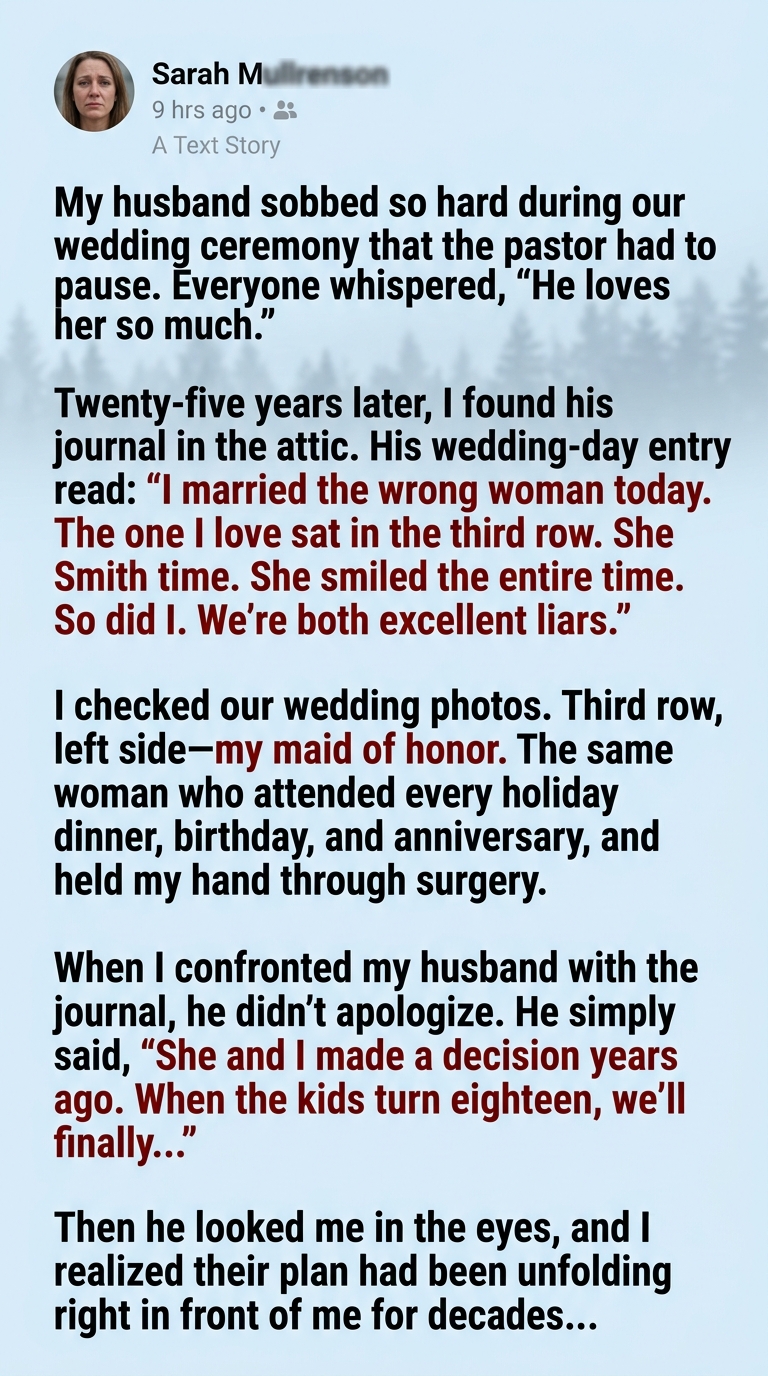
My husband sobbed so hard during our wedding ceremony that the pastor had to pause.
Guests whispered, “He loves her so much.”
I believed them.
I was twenty-six years old, standing in a white wedding dress, watching the man I loved struggle to say his vows through tears. Daniel held my hands so tightly that I could feel them trembling.
When the pastor asked whether he would love me for the rest of his life, Daniel broke down completely.
I cried, too.
I thought I was witnessing the happiest moment of his life.
Twenty-five years later, I found his journal in the attic.
I had been looking for our old tax documents when I discovered a dusty wooden box behind a stack of Christmas decorations. Inside were birthday cards, faded photographs, and three leather-bound journals.
I recognized Daniel’s handwriting on the first one.
Curiosity made me open it.
Most of the entries were ordinary observations about work, money, and our children. Then I found a page dated on our wedding day.
The first sentence made my stomach tighten.
“I married the wrong woman today.”
I read it again, hoping I had misunderstood.
Then I continued.
The woman I love sat in the third row. She smiled the entire time. So did I. We’re both excellent liars.
My fingers went numb.
I read the entry until the words blurred together.
Then I walked downstairs and found our wedding album.
I hadn’t opened it in years. The pages smelled faintly of old paper, and the photographs showed a younger version of myself smiling beside Daniel beneath an arch of white roses.
I turned to the group photographs.
Third row.
Left side.
There she was.
My maid of honor, Rebecca.
My best friend since college.
The woman who had stood beside me when I married Daniel. The woman who attended every holiday dinner, every birthday party, and every anniversary celebration. The woman who held my hand through emergency surgery when Daniel was traveling for work and stayed overnight at the hospital because I was afraid.
Rebecca, who had helped me raise my children.
Rebecca, who knew every secret I had ever told another human being.
I sat on the attic floor, staring at her smiling face.
Then I remembered Daniel’s tears at the altar.
Everyone had believed he was overwhelmed by love.
What if he had been grieving the life he thought he was losing?
I carried the journal downstairs and waited for Daniel to come home.
He arrived at six, loosened his tie, and asked what we should have for dinner.
I placed the open journal on the kitchen table.
“Who were you in love with when you married me?”
He looked at the page.
For several seconds, he didn’t move.
Then he sat down.
“Rebecca,” he said.
No denial.
No attempt to explain it away.
Just her name.
I felt something inside me collapse.
“How long?”
He stared at his hands.
“Since college.”
I gripped the edge of the table.
“Before our wedding?”
“Yes.”
“Did she love you, too?”
He nodded.
I waited for him to tell me it had ended. That they had chosen friendship. That whatever they felt for each other had become a memory before he walked down the aisle.
Instead, he said, “We made a decision.”
“What decision?”
Daniel finally looked at me.
“When the kids turn eighteen, we’ll finally be able to stop pretending.”
I stared at him.
Our youngest child, Emma, was seventeen. Our son, Michael, had turned twenty-two the previous spring.
“What do you mean, stop pretending?”
He took a long breath.
“Rebecca and I agreed that we wouldn’t disrupt the children’s lives. We would keep our families stable, raise them properly, and wait until they were old enough to understand.”
My throat tightened.
“And what happens when Emma turns eighteen?”
He said nothing.
“Are you leaving me?”
“I didn’t want to hurt you.”
I laughed, but it came out sounding like a sob.
“You didn’t want to hurt me? You’ve spent twenty-five years lying to me.”
Daniel rubbed his face.
“I loved you, too. Just differently.”
Those four words were somehow worse than everything else.
I had spent twenty-five years believing we were building a marriage together. We had bought a house, raised two children, survived financial problems, celebrated promotions, and sat beside each other through funerals and hospital waiting rooms.
I had thought our life was imperfect but real.
Now my husband was telling me that he had spent it waiting for the moment he could finally choose someone else.
“And Rebecca?” I asked. “Does she know you wrote this?”
“Yes.”
“Does she know you kept this journal?”
“She knew I wrote things down.”
“That isn’t what I asked.”
He looked away.
I understood then that the betrayal was not one confession or one affair. It was an agreement that had continued for decades, one in which two people had decided that my life could be managed without my knowledge.
I stood up.
“Don’t sleep in our bedroom tonight.”
Daniel looked at me as though he wanted to argue.
Then he picked up the journal, closed it, and placed it back on the table.
“I think we should talk when you’ve calmed down.”
That sentence ended whatever remained of my patience.
“I have spent twenty-five years being calm, Daniel. I trusted you. I trusted her. I don’t owe either of you a quiet reaction to discovering that my marriage had an expiration date you chose without me.”
He went to the guest room.
I sat alone until midnight, looking at our wedding album.
I kept returning to the photograph of Rebecca in the third row.
She was smiling.
So was I.
I wondered how many times we had stood beside each other while she silently counted the years until she could have my husband.
The next morning, I called her.
She answered on the second ring.
“Hi, sweetheart,” she said. “How are you?”
I almost hung up.
Instead, I asked, “Did you love Daniel when I married him?”
The silence lasted several seconds.
Then Rebecca whispered, “You found the journal.”
It wasn’t a question.
I closed my eyes.
“Yes.”
She began to cry.
I had heard Rebecca cry before—when her mother died, when her first marriage ended, and when she feared she might lose her job. I had always comforted her.
This time, I felt nothing that resembled comfort.
“Tell me the truth,” I said. “All of it.”
She asked if we could meet.
I agreed, but only in a public place.
We met that afternoon at the café where we had celebrated my engagement twenty-six years earlier. Rebecca arrived without makeup, her eyes swollen. She looked older than I remembered.
She reached for my hand.
I pulled it away.
“Don’t,” I said.
She folded her hands in her lap.
“I never wanted you to find out like this.”
“How did you want me to find out? On Emma’s eighteenth birthday, when you finally moved into my house?”
She flinched.
The fact that I had guessed so quickly seemed to frighten her.
“Were you planning to leave your husband?”
Rebecca nodded.
“And Daniel was planning to leave me.”
“Yes.”
I looked out the window.
“Did you ever stop loving him?”
“No.”
“Did you ever consider telling me?”
She started crying again.
“Every day.”
“But you didn’t.”
“No.”
I waited for her to explain the journal entry.
Rebecca told me that she and Daniel had fallen in love during their final year of college. They had talked about marrying, but their plans collapsed when Rebecca’s father became seriously ill and her family faced financial trouble. Daniel had been offered a job in another city, and Rebecca had decided to stay near her family.
They broke up—or so they told themselves.
A year later, Daniel met me.
Rebecca said she had tried to accept it. She agreed to be my maid of honor because she wanted to remain part of Daniel’s life, and because she genuinely loved me as a friend.
But the feelings never disappeared.
When Daniel proposed to me, Rebecca could have stepped away. Instead, she stayed close to both of us.
At first, she said, their contact was limited to occasional messages. Then came long phone calls, private conversations at family gatherings, and meetings they described as catching up.
By the time Daniel and I had our first child, they had admitted that their feelings remained.
They made their decision then: no public affair, no sudden departure, no disruption to the children. They would continue living their separate lives until the children were adults, and afterward they would decide whether to build a life together.
“Did you sleep together?” I asked.
Rebecca looked down.
“Yes.”
The word landed between us like a stone.
“When?”
“Not at the beginning. Later.”
“How much later?”
“Over the years.”
I felt dizzy.
She told me that their relationship had not been constant. They had gone through periods when they barely spoke, followed by periods when they became close again. They had not lived together or shared a secret household, but they had crossed boundaries neither of them had ever admitted to me.
The worst part was that they had convinced themselves their restraint made them decent people.
They had not openly abandoned their families. They had attended school plays, birthdays, and funerals. They had smiled for photographs.
They believed that because they had waited, they had done the right thing.
“What about my surgery?” I asked.
Rebecca covered her mouth.
“You stayed at the hospital with me. You told me I was your sister.”
“I know.”
“You held my hand while I was terrified I might die.”
“I know.”
“Were you thinking about him then?”
She couldn’t answer.
I stood up.
“I need you to understand something. You didn’t simply fall in love with my husband. You let me build my entire adult life around a friendship that wasn’t what I believed it was.”
Rebecca reached for me again.
“I do love you.”
“Maybe you do,” I said. “But you didn’t love me enough to tell me the truth.”
I left the café without saying goodbye.
For the next several days, I barely spoke to Daniel. I stayed in our bedroom with the door locked and told him I needed time.
He tried to explain that our marriage had been meaningful, that he had cared for me, that he had never wanted to make me feel second best.
But every explanation circled back to the same point: he had decided what I could handle without ever giving me the chance to choose for myself.
I asked him one question.
“If you had told me before our wedding that you were in love with Rebecca, would I have married you?”
He stared at the floor.
“I don’t know.”
“Exactly.”
I contacted a counselor and scheduled an appointment on my own. I also arranged a consultation with a lawyer so I could understand my options before making any decisions about our home, finances, or marriage.
I didn’t want to react out of shock and regret it later.
I wanted to know what my life could look like if I stopped letting Daniel’s plans determine my future.
Then Emma came home from school and found me crying at the kitchen table.
She sat beside me.
“Mom, what’s wrong?”
I almost told her everything.
Instead, I took her hand and said, “Your father and I are having serious problems. We love you, and none of this is your fault. You don’t have to choose sides.”
She looked frightened.
“Are you getting divorced?”
“I don’t know yet.”
She hugged me.
For a moment, I wanted to promise her that nothing would change. I wanted to protect her from the truth the way Daniel claimed he had protected our children.
But I realized that hiding everything until she turned eighteen would only repeat the pattern.
So I told her that her father and I were dealing with a serious breach of trust, and that we were seeking help to work out what came next. I didn’t burden her with intimate details or ask her to judge either parent.
She deserved honesty appropriate to her age, not another secret built around an arbitrary birthday.
A week later, Daniel asked me to meet him in the living room.
“I think we should tell Emma together,” he said.
I studied his face.
“For once, I agree.”
We told her that our marriage was in trouble because Daniel had kept a significant emotional relationship secret from me for many years. We explained that we were working through the consequences and that she was not responsible for fixing anything.
Emma cried. She asked questions we couldn’t all answer. She was angry with Daniel, confused about Rebecca, and frightened that the family she knew might disappear.
We gave her time.
Michael, our older child, learned the truth a few days later. He was furious that his father had built a plan around their birthdays without considering how the revelation might affect them. He also felt betrayed by Rebecca, who had been a trusted presence in his childhood.
Daniel finally began to understand that the children turning eighteen would not magically erase the consequences of his choices.
They were not milestones on a calendar that would release him from responsibility.
They were people who had trusted him.
As the weeks passed, I began to make decisions for myself.
I continued counseling. I met with my lawyer. I reviewed our finances and started planning for the possibility of living independently. I told Rebecca I needed distance and would not continue our friendship while she and Daniel pursued their relationship.
She sent me a letter apologizing for her choices. I read it once and put it away.
I did not hate her every day. Some days I missed her terribly. I missed our jokes, our long conversations, and the ease of having someone who knew my history.
But missing the friendship did not mean I could pretend it had not been damaged.
Daniel and I eventually began discussing separation. He wanted me to understand that he had never stopped caring for me. I told him that caring for someone was not the same as being honest with them.
He said he had spent twenty-five years trying to avoid hurting everyone.
I answered, “You spent twenty-five years avoiding the consequences of telling the truth.”
He had no reply.
On our twenty-sixth wedding anniversary, Daniel did not bring roses.
I didn’t expect him to.
I spent that evening with Emma, who had suggested we make dinner together. We burned the first batch of garlic bread, laughed about it, and ordered takeout.
Later, after she went to bed, I opened the wedding album one last time.
I looked at Daniel’s tearful face at the altar. I looked at Rebecca in the third row, smiling beside my family.
I couldn’t know exactly what either of them had felt in that moment. The journal had given me Daniel’s words, but it could not tell me every thought behind his tears.
I only knew that I had stood there believing we were beginning a life together, while he was already imagining a future he had never offered me the chance to accept or reject.
I closed the album.
For a long time, I had believed the worst possible outcome was that my husband would leave me for my best friend.
But the truth was more complicated.
They had already taken years from me—not by loving each other, but by making a decision about my life without my knowledge.
I could not recover those years. I could not rewrite the wedding day or erase the memories of the family we had raised.
But I could decide what happened next.
I would not spend another year waiting for someone else’s plan to unfold.
I would make my own.
And if Daniel and Rebecca eventually chose to be together, they would have to do so without my silence, my friendship, or my willingness to protect their secret.
Twenty-five years earlier, I had mistaken my husband’s tears for proof that I was the love of his life.
Now I understood that a person’s deepest feelings are not proven by a dramatic moment at an altar.
They are proven by honesty, by respect, and by the choices they make when telling the truth is difficult.
Daniel had waited decades for the life he wanted.
I was finally going to stop waiting for the life he had promised me.