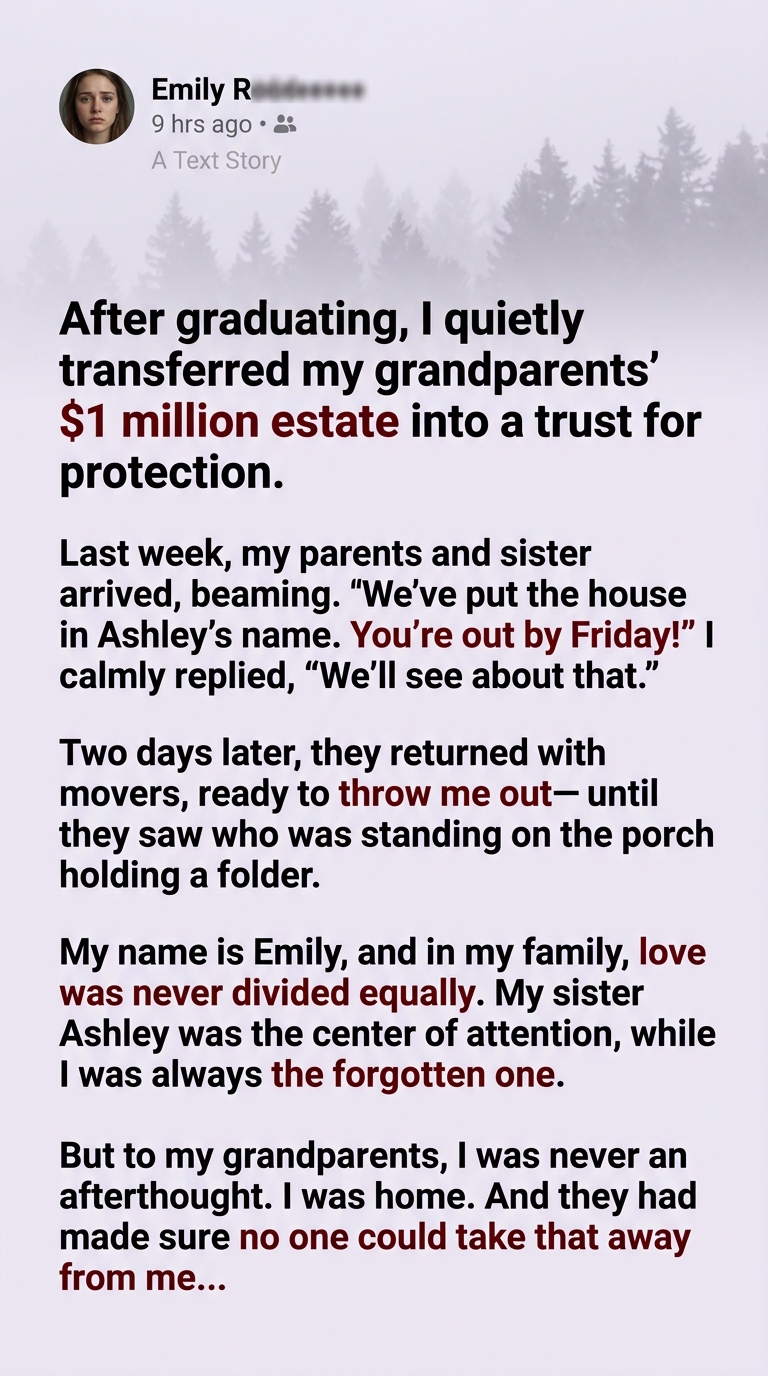
My Parents Put My Grandparents’ Million-Dollar House in My Sister’s Name and Ordered Me Out by Friday. Two Days Later, They Returned With Movers—Until They Saw Who Was Waiting on the Porch.
My name is Emily, and in my family, love was never divided equally.
My younger sister, Ashley, was the golden child. If she wanted something, my parents found a way to get it. If she made a mistake, they called it a learning experience. If I accomplished something, they found a reason to remind me that Ashley had her own special talents.
When Ashley got a new car, my parents threw her a party.
When I graduated with honors, my mother asked whether I could help Ashley prepare for her next semester.
When Ashley announced she was moving into a bigger apartment, my father paid her deposit.
When I needed help paying for textbooks, he told me that independence was an important life lesson.
I learned early not to expect much from them.
Fortunately, I had my grandparents.
Grandma Rose and Grandpa William lived in a beautiful old house with a wide front porch, a garden full of roses, and a kitchen that always smelled of cinnamon and freshly baked bread. Whenever my parents made me feel invisible, my grandparents made me feel like I mattered.
Grandma listened to every story I told. Grandpa taught me how to repair a broken fence, balance a checkbook, and stand up for myself without becoming cruel.
“You don’t have to compete with your sister, Emily,” Grandma once told me while we sat on the porch watching the sunset. “You just have to build a life you can be proud of.”
I never forgot those words.
As the years passed, I became the person they could depend on. I drove them to appointments, helped with groceries, organized their paperwork, and spent weekends maintaining their home.
Ashley visited when there was a birthday cake to cut or a photograph to post.
My parents never complained about the difference.
Then, during my final year of college, my grandparents passed away within eight months of each other.
Losing them was like losing the only place where I had ever felt completely safe.
At the reading of their estate documents, I learned that they had left me their house and the majority of their estate, valued at approximately one million dollars.
Ashley received a separate inheritance. My parents received specific personal belongings and smaller gifts.
My parents were furious.
“This can’t be right,” my mother said, staring at the documents.
My father leaned toward the attorney. “They must have misunderstood what they were signing.”
The attorney calmly explained that the documents had been prepared and executed properly, and that my grandparents had made their intentions clear.
My parents didn’t congratulate me.
They didn’t ask how I was coping with the loss.
Instead, my mother said, “Your grandparents always did spoil you.”
I wanted to remind her that they had loved me, not spoiled me. But I was too exhausted to argue.
After graduating, I moved into my grandparents’ house. I couldn’t bear the thought of strangers occupying the rooms where so many of my happiest memories lived.
I also sought professional legal and financial advice before making decisions about the inheritance.
The estate was substantial, and I knew better than to assume that simply receiving it meant I understood how to protect it.
With the help of an estate attorney and a qualified financial adviser, I established a trust arrangement intended to preserve the assets and manage them according to my grandparents’ wishes. The house was handled according to the estate documents and applicable legal requirements.
Every step was documented.
I didn’t do it to punish my family. I did it because my grandparents had worked their entire lives to build something meaningful, and I wanted to honor their intentions.
I kept the details private.
My parents knew I had inherited the property, but they didn’t know the specifics of the trust. I had learned long ago that sharing good news with them often turned it into a negotiation about what Ashley deserved.
For a while, life was peaceful.
I found a job, paid my bills, and slowly restored the garden. I planted new roses beside Grandma’s old bushes and repaired the porch swing Grandpa had built.
For the first time, I felt that I was building a life of my own.
Then, last Tuesday, my parents arrived with Ashley.
They were smiling.
Not the ordinary kind of smile, either. It was the triumphant smile people wear when they believe they’ve already won.
My mother stepped inside without waiting for an invitation.
“We have some wonderful news,” she announced.
Ashley held up her phone, showing me a photograph of a document.
“We’ve put the house in my name.”
I stared at her.
“What?”
My father folded his arms.
“Your sister needs a stable place to live. We’ve decided she’ll take over the property.”
I actually laughed because I thought they were joking.
“You can’t simply put a house in Ashley’s name.”
My mother’s smile vanished.
“Don’t be difficult, Emily. This is a family matter.”
“No,” I replied. “It’s a property matter. And the property belongs to the estate arrangement my grandparents established.”
Ashley rolled her eyes.
“Mom and Dad said you wouldn’t cooperate. They said you were keeping the house for yourself just to make me jealous.”
I looked at my sister.
“Have you seen the actual ownership documents?”
She hesitated.
My father answered for her.
“We’ve handled everything. The paperwork is done.”
I asked to see it.
My mother held up one hand.
“You don’t need to see anything. You have until Friday to move out. Ashley is taking possession, and we’re bringing movers to help her.”
For a moment, I couldn’t speak.
They had walked into my home, announced that they had given it to my sister, and ordered me to leave the place my grandparents had left me.
They were so confident that they had forgotten one important detail.
They didn’t own the house.
I looked at my mother, then my father, then Ashley.
“Is that what you’ve decided?”
“It’s already done,” my father snapped. “You can make this easy or difficult.”
I took a slow breath.
“Then we’ll see about that.”
My mother laughed.
“Don’t threaten us, Emily. You have until Friday.”
They left believing I was frightened.
I wasn’t.
I was heartbroken that they had gone this far, but I wasn’t confused about what needed to happen next.
That evening, I called my attorney.
I explained what my family had claimed and sent copies of every document I had received during the estate process. My attorney reviewed the situation and confirmed that my parents’ announcement did not, by itself, transfer ownership.
He also cautioned me not to assume that the documents Ashley had shown me were meaningless without examining them.
The following morning, we discovered what my parents had done.
They had submitted paperwork to begin a property transfer, relying on an authorization document my father claimed gave him the right to act on my behalf.
It didn’t.
The document appeared to be an old form connected to routine estate administration, not permission to transfer the property to Ashley. The signatures and legal authority needed for the proposed transfer had not been properly established.
My attorney immediately contacted the relevant parties, formally disputed the attempted transfer, and requested that the property records be reviewed. He also advised me not to sign anything or allow anyone to take possession while the matter was unresolved.
Because the precise legal effect of the submitted documents needed to be established, he arranged for the appropriate legal and property professionals to review the records.
I felt sick when I realized my parents hadn’t merely misunderstood the inheritance.
They had acted as though they could decide what happened to it without my consent.
My attorney asked whether I wanted to contact my parents directly.
I shook my head.
“Everything should go through you now.”
He agreed.
On Friday morning, I woke to the sound of a truck pulling into the driveway.
Then came the scrape of equipment and the slam of a vehicle door.
I looked through the window.
Two movers were unloading boxes.
My father stood near the porch, pointing toward the front entrance. My mother was holding a clipboard, and Ashley was standing beside a large rental truck with her arms folded.
They had come to remove me from my own home.
I called my attorney, who was already on his way.
Then I stepped onto the porch.
My father saw me and smiled.
“Good. You’re up. The movers will help you get your things out.”
I didn’t answer.
My mother climbed the steps.
“Emily, please don’t turn this into a scene. Ashley needs the house, and we need to get everything settled.”
“Have you received a response from my attorney?” I asked.
My father’s expression hardened.
“We don’t need lawyers involved in a family decision.”
“Then why did you submit property documents without confirming that you had the authority to do so?”
The smile disappeared from his face.
Ashley looked from him to me.
“What is she talking about?”
Before anyone could answer, a car pulled into the driveway.
My attorney stepped out carrying a thick folder.
Beside him was a property records professional who had been assisting with the review. He climbed the porch steps and introduced himself to the movers, explaining that there was a disputed ownership issue and that they should not remove any of my belongings until the situation had been properly resolved.
My father scoffed.
“This is ridiculous. The house is Ashley’s.”
My attorney opened the folder.
“Mr. Carter, the documents we reviewed do not establish that you had authority to transfer this property. The estate records and trust documentation identify the legal ownership arrangements, and the proposed transfer is formally disputed.”
He handed my father a copy of the relevant records and a written notice explaining the dispute.
My father’s face changed as he read.
My mother reached for the papers.
“What does this mean?”
“It means,” my attorney replied evenly, “that you cannot simply declare the house transferred and remove Emily. The proposed transfer has not been established as valid. The matter is being handled through the appropriate legal process.”
Ashley looked stunned.
“But Dad told me the house was mine.”
My father said nothing.
My attorney continued, “We have also requested a review of the authorization document submitted with the proposed transfer. Until that review is complete, no one should treat the property as having been transferred to Ashley.”
The movers exchanged glances.
One of them quietly asked whether they should unload the remaining equipment.
My attorney told them there was no reason to proceed with removing my belongings. They began putting the equipment away.
My mother turned toward me, her face flushed.
“You planned this.”
I shook my head.
“No. Grandma and Grandpa planned their estate. I simply respected their wishes.”
My father finally looked up from the documents.
“You had no right to hide all this from us.”
I felt something inside me settle.
“The trust was established with professional advice to protect the inheritance. You were not entitled to control it just because you were my parents.”
Ashley began to cry.
“You could have helped me.”
I looked at her.
“I would have listened if you’d come to me honestly. But you came here believing you could take my home because Mom and Dad told you it was yours.”
“I thought everything had been handled!”
“I understand that,” I said. “But you should have asked to see the actual records before arriving with movers.”
For once, Ashley had no answer.
My mother started to speak, but my attorney interrupted politely.
“Any further discussion about the property should go through my office. That will protect everyone’s interests while the records are reviewed.”
My parents left without another word.
Ashley followed them, still holding her phone.
The movers drove away.
And I stood on the porch, staring at the garden my grandparents had planted, trying to absorb what had just happened.
I had won nothing that morning.
There had been no dramatic courtroom verdict, no instant punishment, and no magical moment when my family suddenly understood everything they’d done wrong.
There was only a legal dispute that still needed to be resolved, a house that had not been validly transferred on the evidence reviewed so far, and the painful realization that my parents had been willing to push me out before checking whether their claims were true.
But I was still home.
Over the following weeks, my attorney continued working through the property records and the disputed authorization. The review confirmed that my father had no valid authority to transfer the house to Ashley, and the proposed transfer was not completed. The records were corrected through the appropriate process.
My parents were furious.
They accused me of humiliating them and dividing the family. My mother sent long messages about forgiveness, loyalty, and how children should support their parents.
I read them carefully.
Then I replied with one sentence:
I love you, but I will not give up my rights to keep the peace.
I didn’t block them. I didn’t publish their actions online or try to turn relatives against them. I simply made it clear that any future discussion about the estate would happen through my attorney and that nobody was permitted to enter the property or remove belongings without my consent.
Ashley eventually contacted me alone.
She apologized for arriving with the movers and admitted that she’d accepted our parents’ explanation without asking questions.
“I thought they had the right to do it,” she said. “I didn’t realize how much I was hurting you.”
I appreciated the apology, but I didn’t pretend that everything was suddenly fine.
“I need you to understand that this wasn’t just about a house,” I told her. “It’s about whether you believe I deserve the same respect you’d expect for yourself.”
She nodded.
We began speaking occasionally after that, cautiously and without pretending that our relationship had been repaired overnight.
As for my parents, I left the next step to them.
If they wanted a relationship with me, it would have to be built on honesty and respect—not on the assumption that my inheritance was a family resource they could redistribute whenever they wished.
One evening, several months later, I sat on the porch with Grandma’s old blanket across my knees.
The roses were blooming again.
I remembered the day she’d told me that I didn’t have to compete with Ashley. I only had to build a life I could be proud of.
For years, I had thought protecting my place in the family meant accepting less, staying quiet, and hoping that someday my parents would finally see me.
Now I understood that love and boundaries could exist together.
I could love my family without handing them control over my future. I could forgive someone without pretending their actions had been harmless. And I could honor my grandparents without apologizing for the choices they had made about their own estate.
They had left me more than a million-dollar inheritance.
They had left me a home, a future, and the freedom to decide what kind of life I wanted to build.
And no one—not even my parents—had the right to take that away simply because they believed Ashley deserved it more.
I looked at the front door, the garden, and the porch swing Grandpa had repaired so many times.
Then I smiled.
For the first time in my life, I wasn’t waiting for my family to decide that I mattered.
I already knew I did.