My phone was still in my hand when the man in the suit walked through the showroom doors.
Everyone went quiet.
The manager’s face turned pale.
Bill looked annoyed.
Then confused.
Then nervous.
The man walked directly toward me.
Extended his hand.
And said:
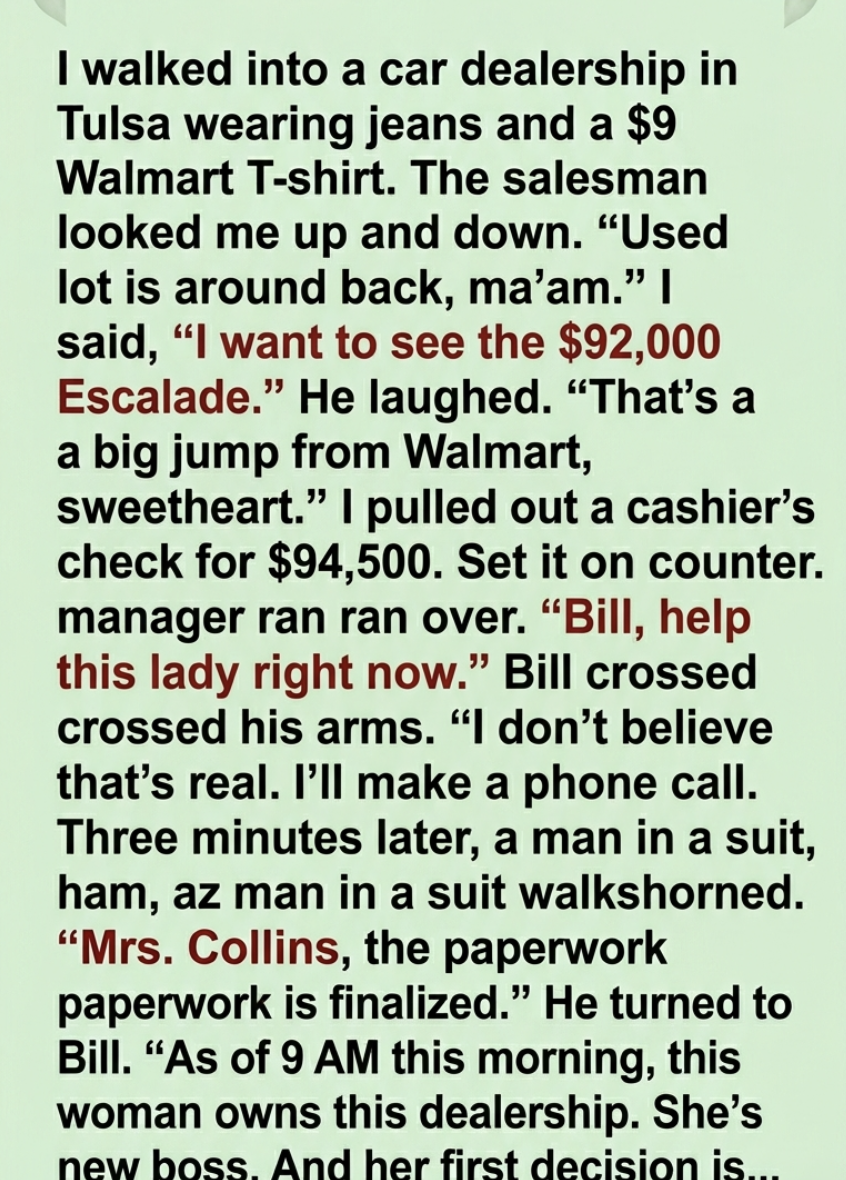
“Mrs. Collins, the acquisition paperwork is finalized.”
You could have heard a pin drop.
Bill blinked.
“What acquisition?”
The attorney turned toward him.
“As of 9:00 this morning, Mrs. Collins became the majority owner of this dealership.”
Bill laughed.
Actually laughed.
Until nobody else did.
Then he realized nobody was joking.
The manager looked like he wanted the floor to swallow him whole.
Bill’s eyes moved from me…
To the attorney…
To the cashier’s check…
Then back to me.
The woman he’d mistaken for a broke shopper.
The woman he’d sent to the used-car lot.
The woman wearing jeans and a Walmart T-shirt.
I smiled.
Not because I enjoyed humiliating him.
Because life has a strange sense of humor.
Then the attorney handed me a folder.
Ownership documents.
Transfer agreements.
Everything official.
Bill’s face lost all color.
Finally he managed:
“You’re serious?”
I nodded.
“Very.”
Then the manager started apologizing immediately.
Fast.
Too fast.
The kind of apology people make when they’re afraid.
But I wasn’t interested in apologies.
I was interested in culture.
Because Bill wasn’t the real problem.
The real problem was that nobody had stopped him.
Nobody corrected him.
Nobody intervened.
Nobody treated me like a customer.
They treated me like a stereotype.
Then the attorney asked:
“Would you like to address the staff?”
I looked around the showroom.
Salespeople had stopped working.
Customers were watching.
Even the receptionist was staring.
So I said yes.
I stepped onto the small platform where they normally displayed new vehicle launches.
Then I spoke.
“My husband and I built a trucking company from one truck.”
The room went silent.
“People laughed at us.”
“People underestimated us.”
“People judged us by our clothes.”
A few employees looked down.
Then I continued.
“The funny thing about success is that it doesn’t always wear a suit.”
Now nobody was looking at Bill.
Because everyone knew exactly who I was talking about.
Then I announced my first decision.
Bill visibly flinched.
He was sure he was about to be fired.
Everyone thought so.
Instead I surprised them.
I said:
“My first decision is mandatory customer-respect training for every employee, including management.”
Bill looked shocked.
The manager looked relieved.
Then I added:
“And Bill will be attending the first session.”
A few people smiled.
Then I continued.
“Because this isn’t about punishment.”
I looked directly at Bill.
“It’s about learning.”
For a moment, nobody spoke.
Then something unexpected happened.
Bill stepped forward.
His face was red.
Embarrassed.
Humbled.
And he quietly said:
“Ma’am… I was wrong.”
Not a perfect apology.
Not a dramatic one.
Just honest.
Then he added:
“I judged you before I knew you.”
I nodded.
“That’s exactly the problem.”
Six months later, dealership sales were up.
Customer complaints were down.
And the employee who received the highest customer-service rating?
Bill.
Apparently getting publicly humbled can be educational.
One afternoon he approached my office.
Holding a photograph.
A woman in jeans buying a truck.
Bill smiled.
“I sold her a vehicle today.”
“Good.”
“You know what I noticed?”
“What?”
He laughed.
“Nothing.”
I smiled.
Because that was the correct answer.
Not her clothes.
Not her job.
Not her age.
Not her appearance.
Just a customer.
Exactly as it should be.
The Escalade I originally came to buy still sits in my garage.
But it isn’t my favorite purchase that day.
That honor belongs to something else.
A reminder that respect costs nothing.
And the people who deserve it most are often the ones others underestimate. ❤️